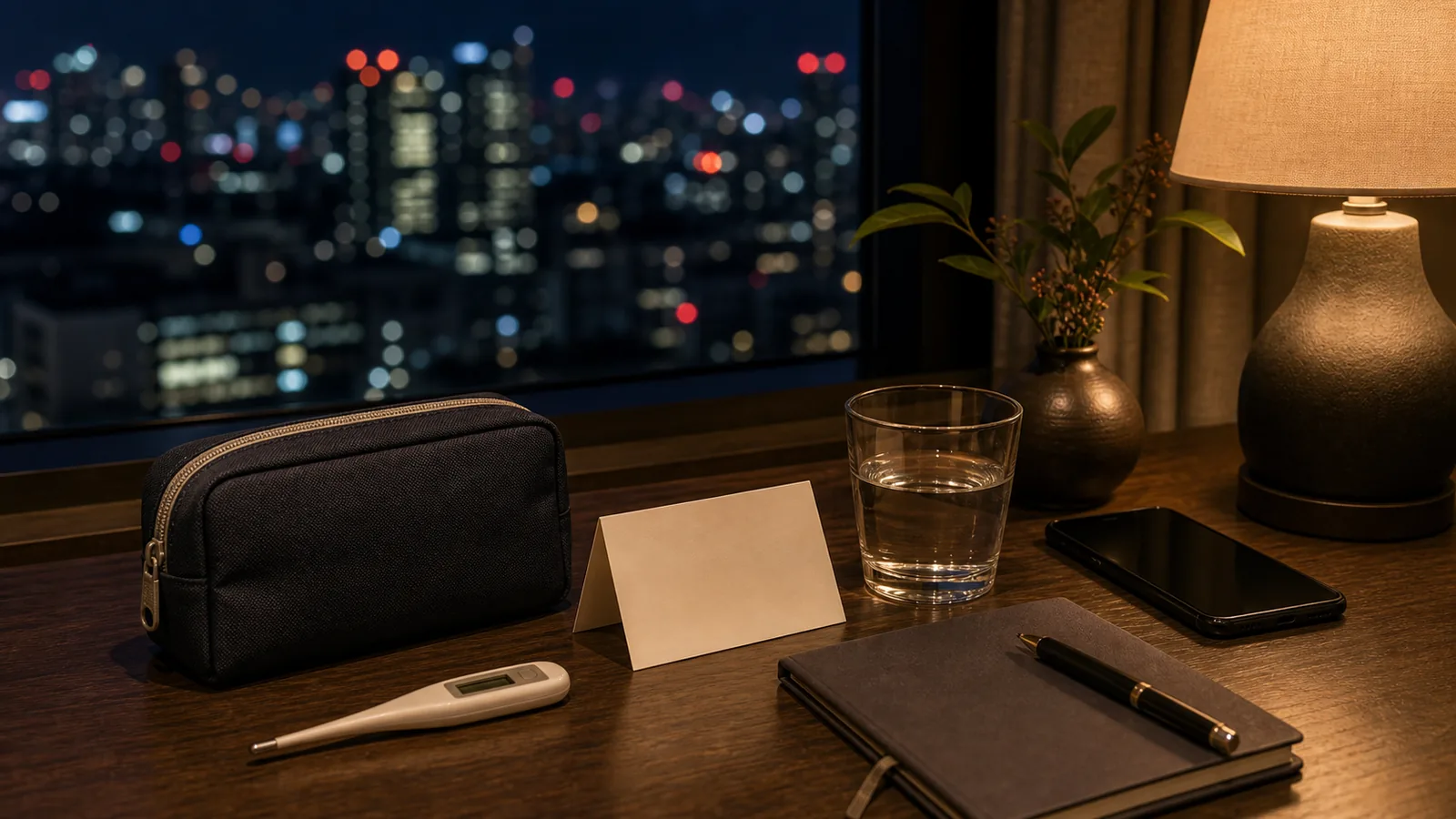
You wake up at 2 a.m. with a 38.5°C fever, tossing in your hotel bed. The pharmacy closed hours ago. Now what? Japan has more 24-hour drugstores than most travelers realize, but knowing where they are, what to buy, and when to skip the pharmacy and head straight to a hospital can save your trip. Here is the complete self-rescue guide.
The bottom line: Don Quijote (MEGA Donki) runs 24h with full drugstore plus everything else. Select Matsumoto Kiyoshi branches are 24h. Lawson and 7-Eleven stock basic OTC meds.
One, Don Quijote (ドン・キホーテ, the discount kingdom): roughly 600 stores nationwide, most open 24 hours. Carries cold medicine, painkillers, first-aid supplies, and pretty much everything else (electronics included). Shinjuku, Shibuya, Shinsaibashi, Kyoto Shijo-Kawaramachi, and Hakata all have 24h locations.
Two, Matsumoto Kiyoshi (マツモトキヨシ): 1,600 stores nationwide, most close between 22:00 and 24:00. Some downtown Tokyo, Osaka, and Kyoto branches run 24h — Google 「マツキヨ 24時間 [city]」 before you fly.
Three, Sundrug, Welcia, Cocokara Fine, Sugi Drug, OS Drug: most close between 22:00 and 23:00.
Four, konbini (7-Eleven, FamilyMart, Lawson): open 24h but only stock basic OTC — painkillers, cold remedies, pain-relief patches, band-aids. No prescription drugs or pharmacist-gated meds.
Common symptoms and what to grab (Japanese brand names)
One, headache or fever: 「バファリン (Bufferin)」 is the default. 「EVE」 or 「ロキソニン S」 hit harder.
Two, cold: 「パブロン (Pabron)」, 「ルル (Lulu)」, or 「コンタック (Contac)」. Three times daily, moderate strength.
Three, sore throat: 「ヴィックス ドロップ (Vicks)」 lozenges.
Four, stomach pain: 「新キャベジン (Cabbage)」 or 「太田胃散 (Ohta Isan)」. The latter is a traditional powder — bitter but potent.
Five, diarrhea: 「正露丸 (Seirogan)」 is the legend. Notorious smell, but it works.
Six, muscle soreness or bruises: 「サロンパス (Salonpas)」 patches.
Seven, eye fatigue or redness: 「ロート (Rohto)」 or 「サンテ (Sante)」 eye drops. Watch the cooling-strength rating — anything labeled 5+ is glacial and can shock first-timers.
Eight, allergy or congestion: 「アレジオン (Alegysal)」.
Nine, constipation: 「ビオフェルミン (Biofermin)」 — gentle lactic-acid bacteria.
How drugstores actually sell meds
Large drugstores classify medicines into two tiers:
One, 第2類医薬品 and 第3類医薬品 (green and yellow labels): self-service shelves, just take it to the register. Covers most of the common meds above.
Two, 第1類医薬品 (white or red label): requires a licensed 薬剤師 (pharmacist) consultation before purchase. Pharmacists go home at night, so this tier is unavailable after hours — including stronger painkillers and sleep aids that travelers might want.
Konbini OTC meds
Since 2009, convenience stores have been allowed to sell limited OTC drugs (class three only). Selection is thin. Lawson partnered with Welcia to run an in-store 「Welcia内薬区」 with broader stock — one of the few konbini that can actually rescue you at 3 a.m.
Severity ladder — what to do
One, mild (light cold, mild headache, mild diarrhea): hit a 24h drugstore, rest the night, observe.
Two, moderate (38.5+ fever, repeated vomiting, severe abdominal pain, intense dizziness): call #7119 in Tokyo, Osaka, and other major cities. Operators triage and direct you to night clinic or ambulance.
Three, emergency (chest pain, breathing difficulty, severe bleeding, fainting, altered consciousness): dial 119 for an ambulance immediately.
Night clinics
Big cities run 「夜間急患診療所」 (yakan kyukan shinryojo) — typically open 21:00 to 24:00 and 0:00 to 6:00.
Tokyo: 東京都夜間急患診療所 in Shinjuku, Ikebukuro, and Shinagawa. Osaka: 大阪急病診療所 in Umeda and Namba. Kyoto: 京都市夜間休日急患診療所 in front of Kyoto Station.
Heads up: most night clinics do not accept direct billing from foreign insurers. You pay out of pocket up front (7,000 to 15,000 yen initial consultation plus medication) and claim back home with receipts.
If you have Japan travel insurance
Most overseas travel policies bought in Taiwan, Hong Kong, or mainland China cover medical reimbursement. Critical: keep the hospital 「領収書 (りょうしゅうしょ, receipt)」 and 「診断書 (しんだんしょ, medical certificate)」 — you need both to file claims. Ping An, Fubon, Shin Kong, AIG, and Chubb all offer Japan travel insurance.
Some larger hospitals operate an 「国際クレジット」 desk that can direct-bill, but you must coordinate with your insurer in advance.
Drugstore tax-free: 5,000 yen single-store minimum
Medicine counts as 消耗品 (consumables), so 5,000 yen at one store per day qualifies for tax-free. Do not break the sealed bag before leaving Japan. See the tax-refund guide for details.
Pro tip one: stock a hotel kit on day one
First day in town, hit Don Quijote and grab a starter pack: painkillers (EVE, 200 yen), cold meds (Pabron, 1,000 yen), stomach powder (Ohta Isan, 500 yen), band-aids, and a digital thermometer (1,000 yen). Total 2,500 to 3,000 yen, done in three minutes. Then whenever something hits at 2 a.m., you just reach into your bag.
Pro tip two: bring your own meds for allergies or chronic conditions
Many imports are restricted in Japan, including Allegra (antihistamine) and various blood-pressure drugs common in Taiwan. If you have a chronic condition (hypertension, diabetes, asthma), pack 14 to 30 days of your usual meds, ideally with an English or Japanese prescription printout.
Pro tip three: hospital versus clinic
「病院 (びょういん)」 means hospital — large, 24h ER. 「クリニック / 診療所 (しんりょうじょ)」 means clinic — usually 9:00 to 18:00, for minor issues.
For late-night symptoms, head to 「夜間急患診療所」 (cheaper) or the ER at 「[city name] 総合病院」 (pricier but fully equipped). Before you fly, save the location of the night clinic nearest your hotel — that one prep step can save you 30 minutes of frantic Googling when it actually matters.
Frequently Asked Questions
Can every 24-hour drugstore in Japan sell medicine at night?
No. An open store does not always mean a pharmacist or registered seller is present, and some OTC medicines may not be sold late at night.
When should I go to emergency care at night?
Chest pain, breathing difficulty, confusion, severe abdominal pain, head injury, persistent high fever, dehydration, or serious allergic reaction should be handled through 119 or hotel assistance.
Can convenience stores sell cold medicine?
Some branches sell limited OTC medicine, but not all. Convenience stores more commonly offer masks, throat candies, electrolyte drinks, cooling sheets, and basic care goods.
Can I bring my own medicine to Japan?
Reasonable personal-use quantities are usually possible, but some ingredients, psychiatric medicines, injections, or large quantities may require checking rules or Import Confirmation.