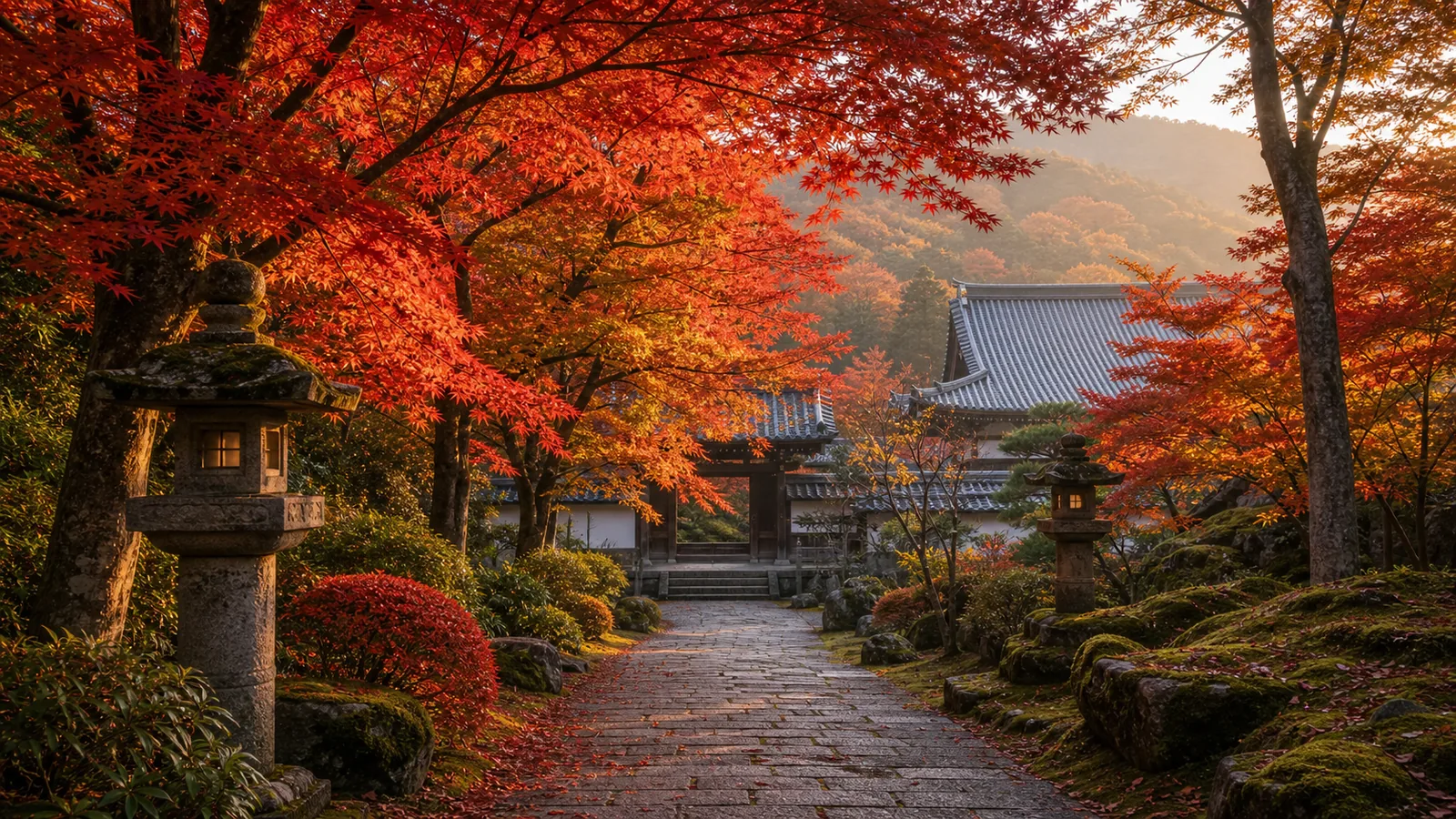
Think Japan in autumn means Kyoto? Wrong. Japan’s autumn leaves (「もみじ」) run from late September in Hokkaido to late December in Okinawa — three full months. Kyoto is just one stop, and it has the highest crowd density in the country. If you want stunning foliage without the human traffic jam, there are smarter moves than Kyoto.
The 「もみじ前線」 runs opposite to the 「桜前線」
Cherry blossoms march from south to north. The momiji front goes the other way — starting at Daisetsuzan in Hokkaido in late September, then heading south. Tokyo does not hit peak (「見頃」) until mid-to-late November.
Nationwide foliage schedule
One, Daisetsuzan, Hokkaido: September 15-25 (earliest in Japan, alpine zone at 2,000m).
Two, Sapporo, Hokkaido: mid-to-late October.
Three, Sendai, Tohoku: late October to early November.
Four, Nikko: mid-to-late October — top pick near Tokyo, especially around Kegon Falls.
Five, Karuizawa, Nagano: mid-to-late October.
Six, Hakone: early-to-mid November.
Seven, Shinjuku Gyoen and Meiji Jingu, Tokyo: late November to early December.
Eight, Arashiyama, Tofuku-ji, and Eikando, Kyoto: mid-to-late November.
Nine, Todai-ji area, Nara: late November.
Ten, Minoo Park, Osaka: late November to early December.
Eleven, Miyajima, Hiroshima: mid-to-late November.
Twelve, Fukuoka and Aso, Kyushu: late November to early December.
Thirteen, Okinawa: late December — different species, leaning yellow.
Kyoto: skip Eikando, try these instead
Kyoto’s five busiest foliage spots: Tofuku-ji, Eikando, Kiyomizu-dera, Arashiyama, and Kibune. On a November weekend, density hits one person per half square meter. You cannot even get a clean photo.
Alternatives:
One, Nanzen-ji: right next to Eikando, one-third the crowd.
Two, Ohara Sanzen-in: an hour by bus north of Kyoto, 70% fewer visitors, more rugged foliage.
Three, Kurama-dera: mountain-forest vibe, great for a hike.
Four, Sekisan Zen-in: hidden gem with limited late-November opening (「拝観」).
Hokkaido versus Kyoto
Kyoto’s palette is dominated by 「もみじ」 (maples) — red and orange tones.
Hokkaido mixes 「白樺」 (white birch), 「ナナカマド」 (rowan), and maples — gold, red, and green in contrast. More varied than Kyoto, with one-tenth the crowds. The catch: it peaks a month earlier (mid-to-late October), so many travelers miss it entirely.
Kyushu and Okinawa
Aso Highland in Kyushu peaks in late November, with foliage drifting through onsen steam — a unique atmosphere. Okinawa’s late-December 「リュウキュウマツ」 (Ryukyu pine) is an evergreen conifer, which means Okinawa has no real autumn-foliage destinations. Do not fly there hunting momiji.
Best times to view
One, 7-9 a.m.: Arashiyama at this hour has one-fifth the daytime crowd, with low-angle light shining through the leaves.
Two, clear day after rain: leaves washed clean, color saturation at its highest.
Three, 「ライトアップ」 (illuminated nights): Kiyomizu-dera, Eikando, and Tofuku-ji run special evening openings from mid-November to early December. Tickets cost an extra 500-1000 yen but the atmosphere is unmatched.
Rain contingency
Foliage hates 「木枯し」 (early-winter winds). One strong storm can strip 30% of leaves. A week before your trip, check 「紅葉ライブカメラ」 (live foliage cams at major spots) to confirm conditions before locking in plans.
Pro tip
The best anti-crowd combo for Kyoto: November 4-10 (before the weekend explosion) + 7 a.m. weekdays at Tenryu-ji in Arashiyama + an afternoon Shinkansen to Kanazawa’s Kenroku-en (equally famous foliage, one-tenth the crowd). Three days, three completely different autumn vibes — far more worthwhile than grinding through Kyoto for three straight days.
Frequently Asked Questions
Where does Japan autumn foliage usually start?
It usually starts in Hokkaido and higher elevations, then moves through Tohoku, Honshu lowlands, and Kyushu.
When is Kyoto autumn foliage best?
Most years, late November to early December. Go on weekday mornings or use less crowded areas such as Ohara or Yamashina.
How should I check autumn foliage conditions?
Search the spot name plus koyo migoro, then check recent photos, leaf fall, and weather during the final week.
How are Hokkaido and Kyoto foliage different?
Hokkaido is broader nature and mixed tree colors. Kyoto is temples, gardens, and walking routes. The travel rhythm is different.