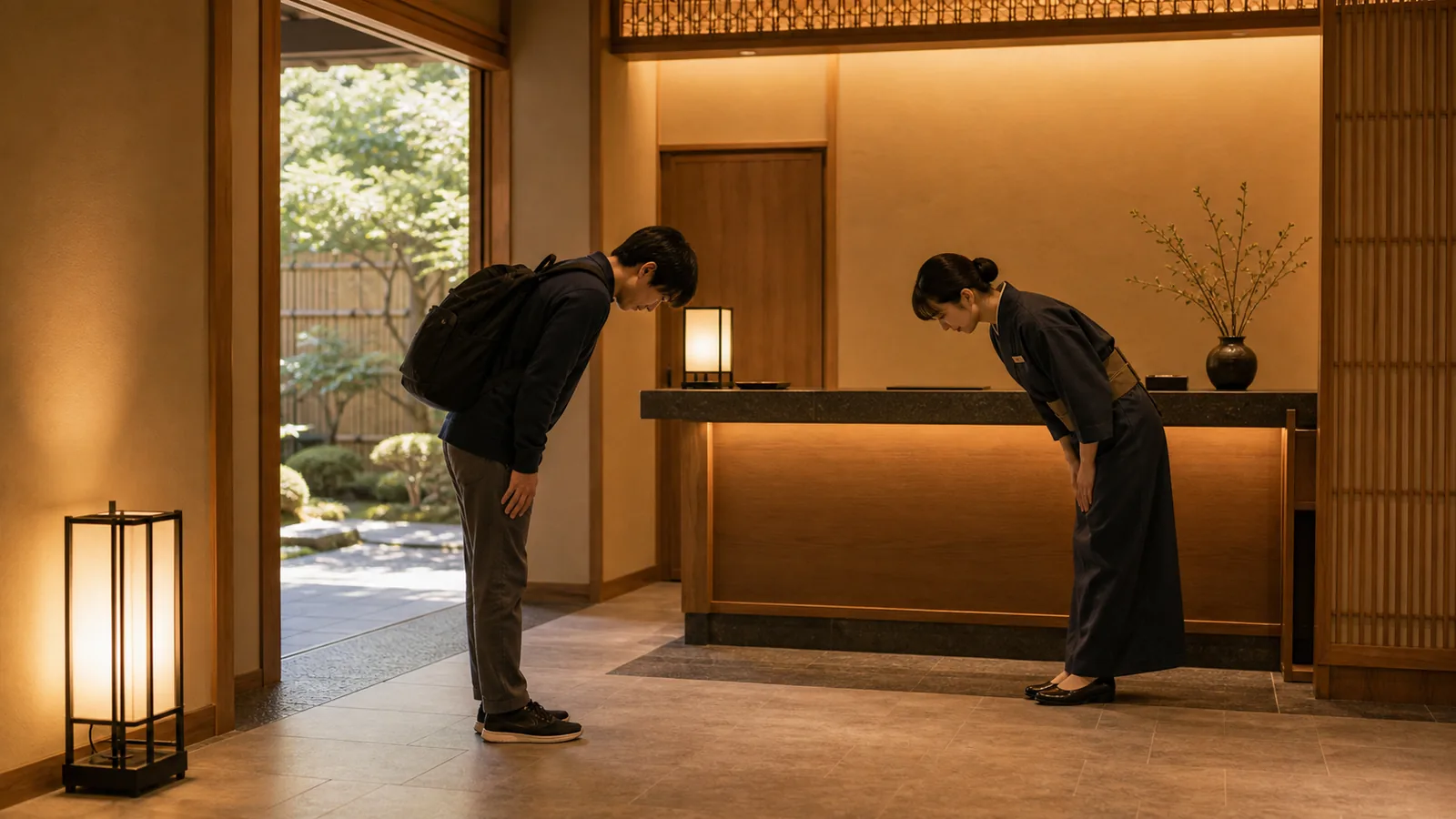
In Japan you will see every kind of bow — the quick nod from a konbini clerk, the deep waist-bend in a restaurant lobby, the long 90-degree hold from airport ground staff sending off a flight. Bowing is not just a greeting; it is a precise grammar of respect. The angle, the duration, the context — each combination carries a different meaning. Tourists rarely need the 45-degree deep bow, but understanding the system lets you read Japan’s social hierarchy and nail the moments that count.
The basic posture Stand straight. Hands at your sides for men, folded in front for women. Eyes lowered. Bend from the waist — not the neck, not the shoulders. Hold briefly (length depends on angle), then rise. Eyes: during the bow, look 1-2 meters in front of your feet; on the rise, lift your eyes to meet theirs.
15° 「会釈」 (eshaku) — the light bow The lightest angle, basically a nod with a slight forward lean. When to use it: — Passing coworkers in the company hallway. — Sharing an elevator with strangers. — Receiving an 「いらっしゃいませ」 at a konbini or supermarket. — Acknowledging a clerk’s greeting as a tourist. Hold for about one second. This is the bow tourists use most, and once it becomes natural you will use it everywhere — konbini, restaurants, counters.
30° 「敬礼」 (keirei) — the standard bow Medium angle, 30 degrees from the waist, held 2-3 seconds. When to use it: — First meetings (introductions). — Speaking with a superior or client at work. — Welcoming guests at upscale restaurants. — The two-bow, two-clap, one-bow shrine ritual (that bow is at this angle). — Weddings, funerals, and other formal occasions. This is the standard Japanese business bow. As a tourist, you will see okami at high-end ryotei or traditional ryokan greeting you at exactly this angle.
45° 「最敬礼」 (saikeirei) — the deepest bow 45 degrees from the waist, held 3-5 seconds, often with hands folded in front. When to use it: — For the most honored guests or VIPs. — Apologies for serious mistakes or customer complaints. — Wedding hosts greeting and sending off guests. — Airport and luxury-hotel staff sending off important visitors. — Shinto priests performing prayers to the kami. Tourists almost never use 45°, but you will see it. The send-off bow Japanese airport and Shinkansen staff perform — bowing deeply until the train disappears — is 45° held even longer, the ultimate expression of service.
Wrong depth = rude Match the depth to the context. A 45° bow to a konbini clerk is awkward (way too formal). A 15° nod to a major client is insufficient. The beginner rule: 30° for unfamiliar people, first meetings, and formal settings. 15° for everyday casual moments. When unsure, default to 15° — overdoing warmth rarely backfires, but coming across as cold does.
Do not talk while bowing Stay silent while you are bent over and speak only after rising. The most common tourist mistake: 「ありがとうございました!」 mumbled mid-bow, voice buried in your chest. Correct order: look at them, say 「ありがとうございました」, bow silently, rise.
Bowing while walking is a no Nodding while walking is fine, but a real bow on the move reads as half-hearted etiquette. If you are going to bow, stop, turn to face them, complete the bow, then continue. If you are in a rush, at least pause for a second.
Japanese people bow on the phone too You will see Japanese people bow into the receiver mid-call. But the other person cannot see them? True — but the bow is for the bower, an internal adjustment that makes the voice carry sincerity. Strange but real, and a window into Japanese workplace culture. Tourists do not need to do it, but understanding it gives you a different read on the country.
Special case: business card exchange For first business meetings, you hand the card with both hands while bowing lightly (about 30°). The recipient reads it, then places it on the table during the meeting — never into a pocket. Tourists rarely need this, but if you ever meet a Japanese business partner, drill the sequence.
Pro tip: Japanese executives dial bows down for Western clients Japanese business elites understand cultural adaptation — they know Western counterparts find 45° bows excessive, so they voluntarily downshift to 15-30° with foreign clients, sometimes layering in a handshake (hybrid greeting). As a tourist, you do not need to master deep bows. A light 15° plus a smile is already a 90 out of 100. The peak moment: watching an elderly Japanese man bow deeply at the Senso-ji altar, and you offering your own quiet 15° beside him — that is when you start to feel the layered aesthetics of Japanese etiquette.
Frequently Asked Questions
Do travelers need to learn exact bowing angles?
No. A light nod or small bow is enough in most travel situations. Bow a little deeper for formal thanks or hospitality.
Should I bow back to convenience store staff?
A small nod, smile, or thank you is enough. A deep bow can feel too heavy for a casual transaction.
Why do Japanese people bow on phone calls?
It is often workplace habit and body language that shapes polite speech. Travelers do not need to copy it.
What if one person bows and the other offers a handshake?
Follow the other person naturally. If they offer a hand, shake hands; if they bow, bow back lightly.