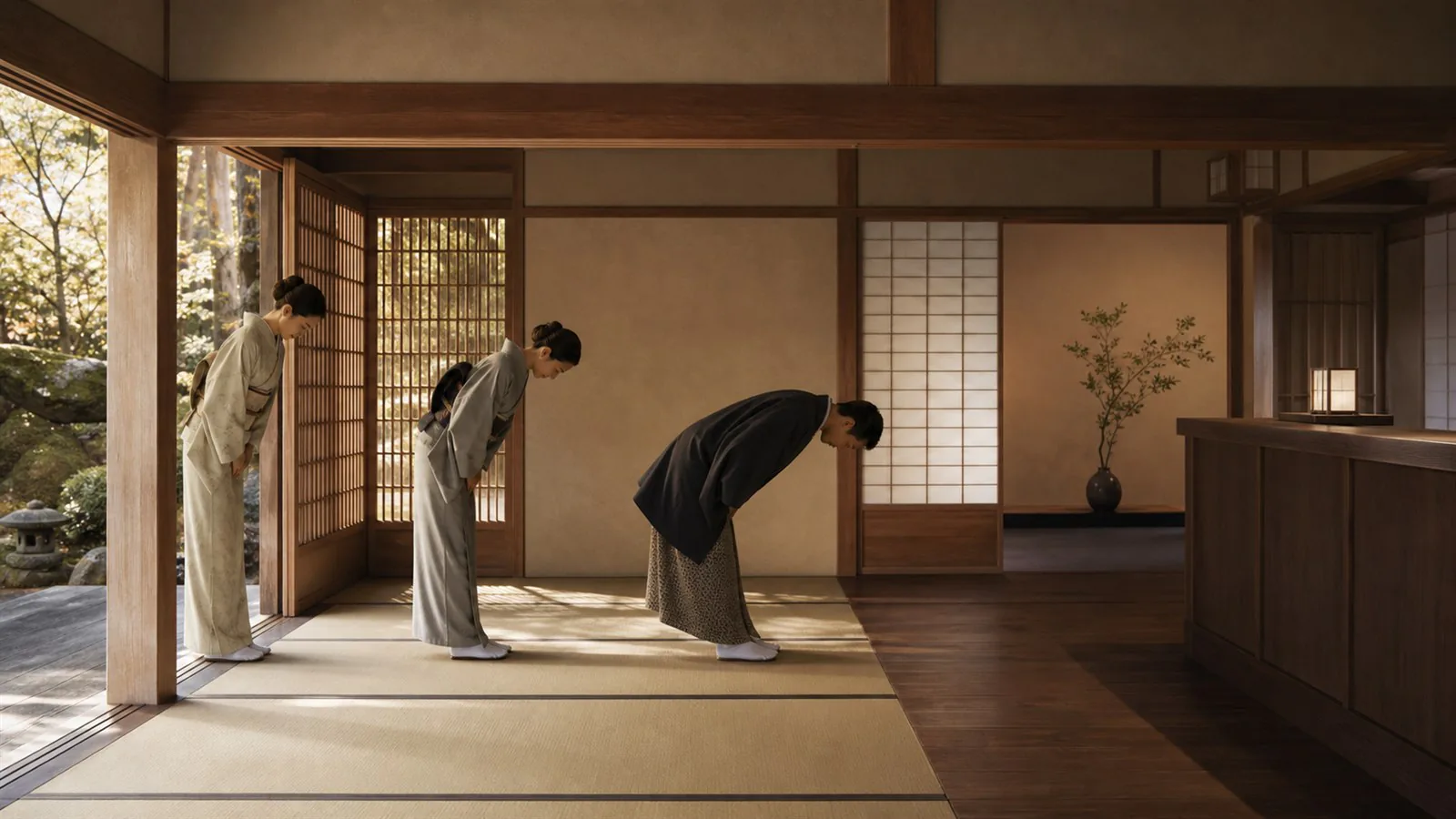
Think Japanese bowing is just bending over? In reality, the angle carries precise workplace meaning, and even where you put your hands has rules. Three angles map to three contexts. Get them wrong and you are being rude.
「会釈」 (eshaku): 15° — casual coworker greetings
The lightest bow, around 15°, just enough to tilt your back line while keeping your gaze forward. Use for: passing coworkers in hallways, stepping into elevators, quick hellos, bumping into an acquaintance on the street. Japanese office workers do this dozens of times a day, without actually stopping, blending it into their stride.
At a ryokan, staff will bow at this angle as you pass — a quick shallow nod in return is enough. Bowing too deeply back is awkward.
「敬礼」 (keirei): 30° — for elders and clients
The standard business bow. 30 degrees, held about two seconds before rising. Hand position: men’s hands at the outside of the thighs, women’s hands folded at the belly (right hand over left). Use for: first-time client meetings, greeting superiors, addressing teachers, business 「ありがとうございました」 moments.
It is also the default angle for Japanese service staff. Hotel check-in or check-out desks bow at 30°. Department store door greeters bow 30° to every entering customer.
「最敬礼」 (saikeirei): 45° — apologies and deep gratitude
The deepest bow. 45° (in some cases 60°), held three seconds or more. Use for: formal apologies, funerals, profound gratitude, paying respects to the Emperor. The press-conference bow where a corporate president apologizes for a product defect is this one — the 2024 Kobayashi Pharmaceutical red yeast incident, where the president bowed at 60° for seven seconds, was a national moment.
Tourists almost never need this bow, but understanding it helps you read Japanese news and corporate culture.
Hand-position details
Men: hands at the thighs, fingers naturally extended along the seam of the pants. Women: hands folded in front, right over left, since the left side is ceremonial and the right is martial — left underneath signals weapons stowed. The distinction matters in traditional kendo, tea ceremony, and kimono contexts.
Bowing taboos
First, do not bow while walking — that is eshaku, and using eshaku in a business setting reads as disrespectful. Second, do not let your hands flop around — keep them pinned or folded. Third, do not smile — smiling through a formal apology ruins it. Fourth, women with long hair should hold their hair in place — flying hair during a bow is rude. Fifth, do not repeat bows — one clean bow, not a rapid pecking motion.
Bowing scenarios for tourists
First, entering and leaving a shrine’s main hall: 30°. Second, the nakai bringing tea at a ryokan: return a 15° eshaku. Third, leaving a restaurant: 30° toward the owner or chef plus 「ごちそうさまでした」. Fourth, after asking for directions: 30° plus 「ありがとうございました」. Fifth, paying for purchases: no bow needed, a nod suffices.
Pro tip: the folded-hands stance
In formal spaces — before a shrine’s main hall, in a ryokan tatami room, in a tea ceremony — stand with your hands folded in front (men: right over left; women: left over right; the traditional rule is reversed but the modern version dominates). The posture itself signals respect for the space, and Japanese people pick up on it instinctively.
Why so complicated?
The bow’s gradations come from Edo-period samurai etiquette (the Ogasawara school). When society was rigidly divided into samurai, farmer, artisan, and merchant classes, the depth of a bow directly displayed the other party’s rank. Modern Japan has flatter hierarchies, but the ritual survives as today’s three-angle system.
Next time you visit Japan, do not over-bow — just hit the right angle for the situation. Japanese bows are brief (30° for two seconds, then up). Asian tourists tend to bow too many times for too long, which actually puts pressure on the other person. Precision beats frequency. That is the heart of Japanese bowing culture.
Frequently Asked Questions
What is the difference between 15, 30, and 45 degree bows?
A 15 degree bow is a light greeting, 30 degrees is common for polite thanks or welcome, and 45 degrees is deeper for apologies or formal gratitude.
Do tourists need to memorize bow angles?
No. A nod, a normal bow, and a deeper bow are enough for most travel situations.
Where should your hands go when bowing?
For ordinary travel, posture and calm movement matter more than exact hand placement. Service industries have more formal rules.
Can you shake hands and bow at the same time?
It can happen in business, but tourists do not need to mix them. Mirror the other person naturally.