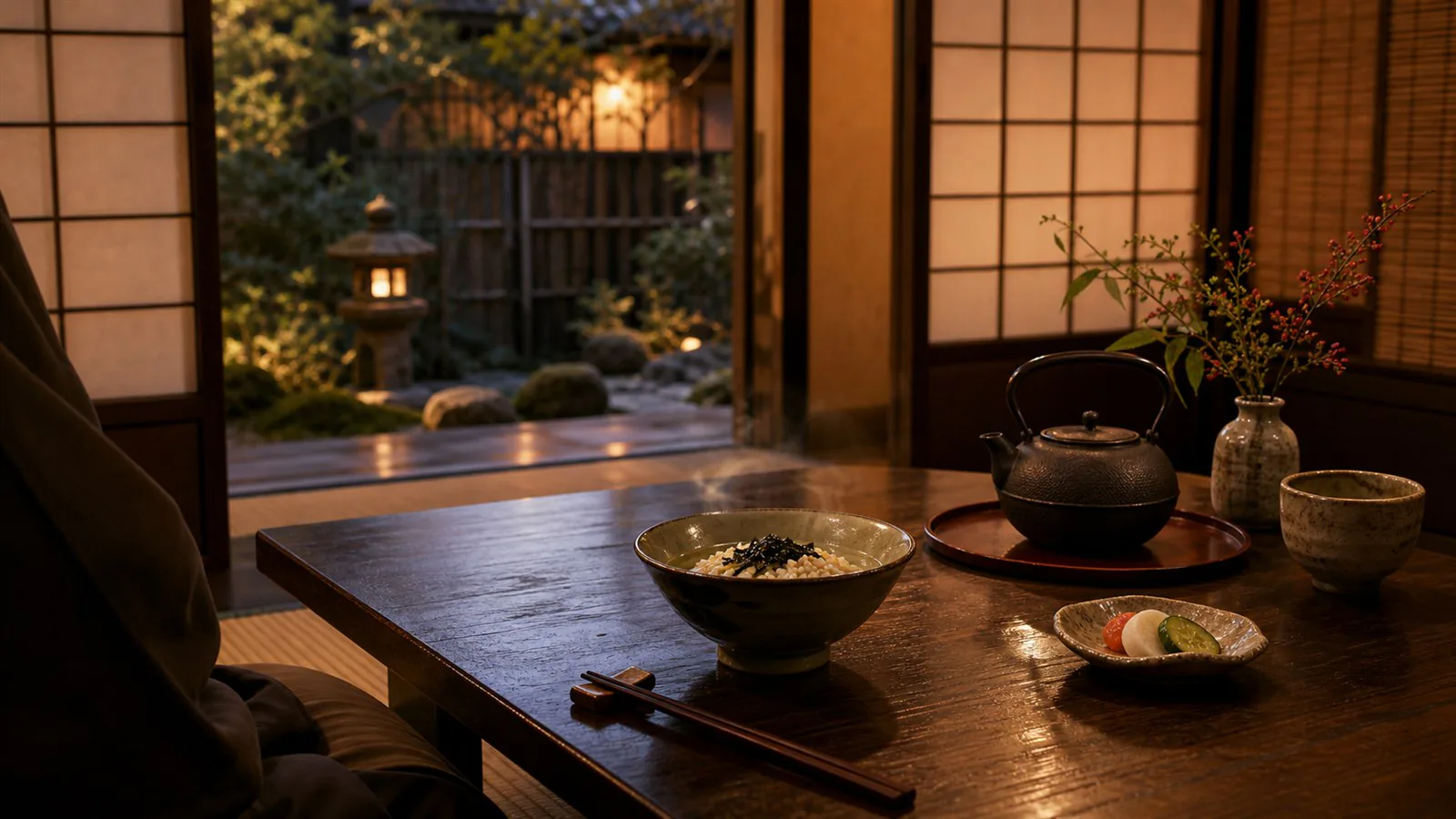
Think a Kyoto host offering you 「ぶぶ漬け」 (tea over rice) is being warmly hospitable? This is Japan’s most famous example of the indirect-refusal culture — when a Kyoto local says 「ぶぶ漬けでもどうどす?」, the real meaning might be time to go home. But the interpretation is also being pushed back on by Kyotoites themselves in recent years. The truth is more layered than the cliché.
The traditional reading of 「ぶぶ漬けでもどうどす?」
「ぶぶ漬け」 is Kyoto dialect for 「お茶漬け」 (rice with tea poured over it). The classic story goes like this: you are visiting a Kyoto household and the conversation runs long. When dinnertime rolls around, the host asks 「ぶぶ漬けでもどうどす?」 (Care for some bubuzuke?).
Literal meaning: want a bowl of tea-rice? (standard hospitality phrase) Real meaning: it is late — you should head home.
Why? Because Kyoto people will never directly tell a guest to leave. They wrap it in 「let me feed you」 politeness — a soft nudge that says 「dinner needs to start, and you are still here」. The correct response is 「ありがとうございます、もう失礼します」 (Thank you, I should be going).
Where this reading comes from
Kyoto was the capital for over a thousand years, and social density was extreme. Samurai, nobles, monks, and merchants navigated dense webs of obligation, and direct refusal was seen as crude. Indirectness was refined to its peak in Kyoto, where almost every sentence carries a surface meaning and a real meaning.
The bubuzuke story dates back at least to the Edo period and calcified into a 「Kyoto people speak in code」 trope during the Meiji era. Japanese variety shows began referencing it heavily in the 1980s, turning it into a nationally known joke.
Modern Kyotoites push back
But many Kyoto residents reject the story. A 2018 Kyoto Citizens Association survey found that 70% of respondents said 「I have never used this phrase that way, and I have never heard my family use it that way」. A folklorist at Kyoto University put it plainly: 「This is an Edo-period anecdote that modern audiences have romanticized into 『Kyoto people are like this』. In reality, it only ever applied to a tiny set of formal settings.」
So in practice, 90% of the time 「ぶぶ漬けでもどうどす?」 is a sincere offer of food. Only in a few formal contexts — old Kyoto families, traditional machiya, geisha houses — does the double meaning still live.
Other examples of Kyoto’s indirect culture
Even if 「ぶぶ漬け」 is debated, Kyoto’s indirectness is real. The following examples are common among older Kyoto residents:
One, 「お子さん、ピアノが上手やね」 (Your child plays piano so well) — possible meaning: your kid is making noise at night, please tone it down. Two, 「素敵な時計やね」 (What a beautiful watch) — possible meaning: have you noticed the time? You should leave. Three, 「ええお召し物どすね」 (Lovely outfit) — possible meaning: that outfit is not quite right for this occasion. Four, 「考えときますわ」 (I will think about it) — real meaning: a polite no. 99% of Kyoto people use it this way. Five, 「お元気そうで何より」 (So good to see you in such good health) — possible meaning: you look unwell, or you have put on weight.
Why do Kyoto people speak this way?
It is not fake — it is an extreme strategy for not harming the other person. The Kyoto logic: saying 「your kid is too loud」 damages face → wrapping a request inside a compliment lets the listener fix it if they catch on, and lose nothing if they do not. A win-win design.
But to outsiders — including other Japanese people — the system is hard to decode, hence the stereotype that Kyoto people are 「two-faced」. In reality, Kyoto people use the same patterns with each other, not just with outsiders.
How tourists should respond in Kyoto
First, when a Kyoto person compliments you, accept it gracefully without taking it literally. If they say 「あなたの日本語、上手やね」 (Your Japanese is great), reply 「いえいえ、まだまだです」 (No no, I have a long way to go). That is the expected response. Do not say 「そうですか?頑張ってます!」 (Yeah, I work hard at it!) — accepting compliments directly reads as un-humble to Kyoto ears.
Second, when visiting a Kyoto home, voluntarily take your leave after 1.5 to 2 hours. Do not wait for explicit cues — they may already have hinted three times that you missed.
Third, count how often 「もう」 (もう, 「already」) appears. When a Kyoto host says 「もう、お茶でも」 (Already, perhaps some tea?), that 「もう」 alone is a hint that the visit has run its course.
Kyoto people do not judge openly
Even if a Kyoto local thinks you have been rude, they will never tell you to your face. They will express it indirectly — you fix it if you catch on, and if you do not, they will gossip behind your back (Kyoto’s reputation for 「悪口」, sly criticism, is very real). But the surface always smiles.
So Kyoto’s elegance and Kyoto’s complexity are the same thing — the inheritance of a millennium-old capital, the sharpest expression of Japan’s 「察し文化」 (read-the-air culture).
Pro tip: not understanding is fine
Kyoto people do not expect foreigners to decode the whole system, but they appreciate visible effort to observe. When visiting a Kyoto household, watch the host’s expressions, mind the clock, and wrap things up early on your own. They will quietly file you under 「polite tourist」.
Final thought: do not mock, learn
Kyoto’s indirect-refusal culture often gets mocked as fake, but the core principle is 「never wound anyone」. Once you see that, Kyoto’s elegance stops being surface manners — it becomes 1,200 years of accumulated interpersonal wisdom.
Next time you are in Kyoto, sit in a machiya cafe sipping matcha and watch the rhythm of a conversation between the owner and a local regular — the pacing, the pauses, the precise placement of a smile. That is the culture in action.
Frequently Asked Questions
What does “bubuzuke demo doodusu?” mean?
Literally, it means “Would you like some tea over rice?” In Kyoto culture writing, it is famous as a polite phrase that can imply the guest should leave.
Do Kyoto people really use this phrase to ask guests to leave?
Do not treat it as a fixed code today. Many Kyoto residents deny using it that way, but the story still captures a style of indirect, face-saving communication.
How should travelers respond to indirect politeness in Kyoto?
Read the situation before overthinking the sentence. If it is late, the host is tidying up, or the conversation is clearly winding down, thank them and take your leave gracefully.
Is bubuzuke different from ochazuke?
Both refer to tea over rice. Bubuzuke has a Kyoto flavor, which is why it often appears in discussions of Kyoto-style indirect speech.