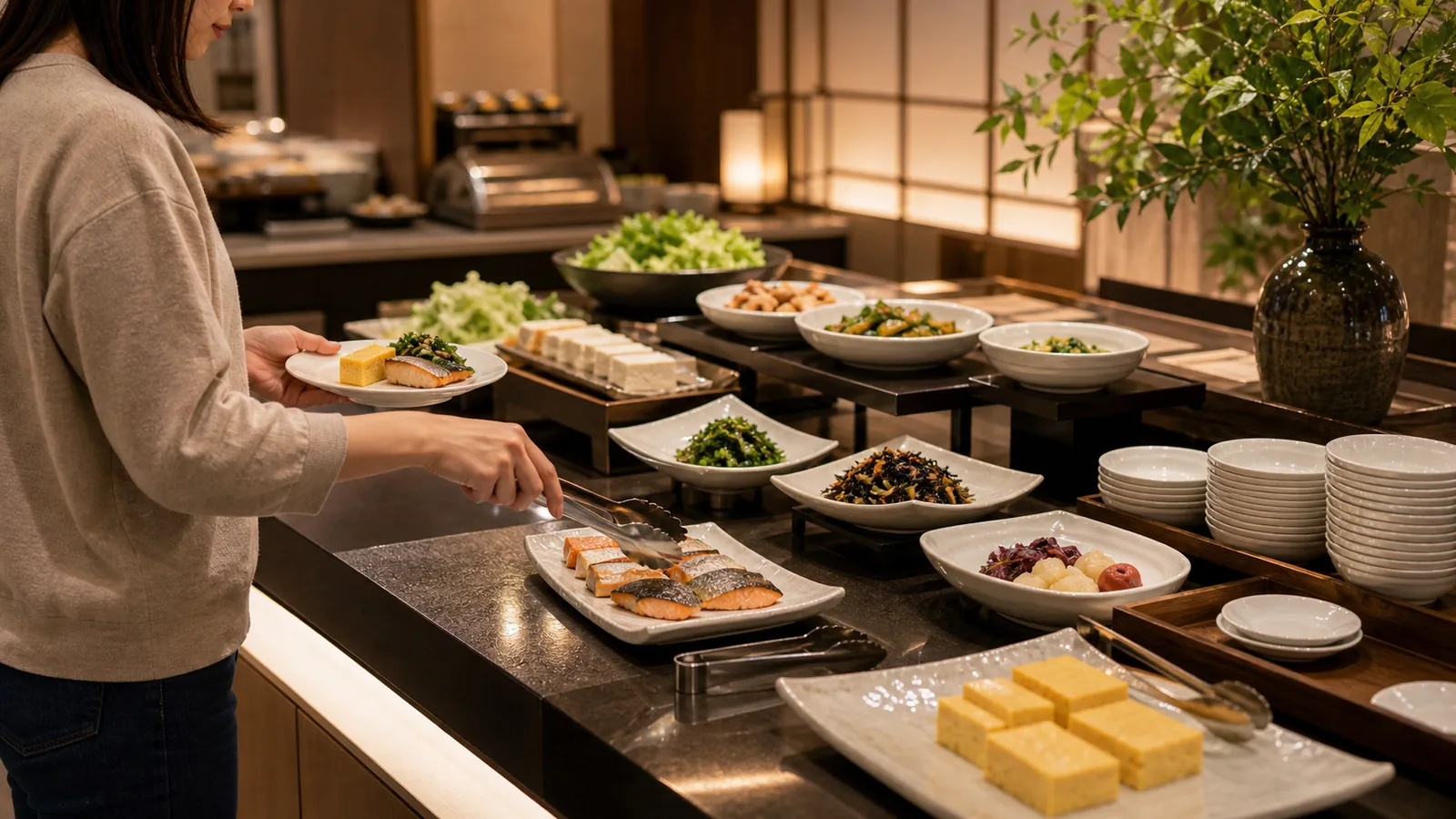
Japanese hotel buffets — whether at the Okura, New Otani, Royal Park, or even the Toyoko Inn near an airport — run the most orderly food lines on Earth. Plates do not stack into mountains. People do not grab each other’s tongs. Everyone drifts back to their seat without incident. This is not because Japanese people are uniquely refined; it is because the buffet has a full set of unwritten rules, and tourists default to their home-country habits. Here are seven hidden rules at hotel buffets.
Rule one: use a fresh plate every round Japanese buffets expect you to grab a new plate each trip — eat what is on the plate, leave it at the table (or staff will clear it), and take a clean plate for round two. — Wrong move: using the same plate for round after round — a plate that touched food now touching the serving area is cross-contamination. — Right move: leave used plates at the table, pick up a fresh plate from the clean stack. The massive stack of clean plates exists for exactly this reason — use it freely.
Rule two: do not stockpile The unspoken rule is 「take only what you can eat」. Wrong move: piling meat, seafood, dessert, and salad onto one plate and leaving half of it untouched. Why this is taboo: — One, food waste is the most sensitive cultural button in Japan (kids are raised on 「もったいない」, do not waste). — Two, the correct approach is many small trips — round one for salad, round two for mains, round three for dessert, 5 to 7 items per round. — Three, leftovers on the table get noticed, and regulars whisper to each other about the rude tourist at table 12.
Rule three: use the right tongs for each dish Every dish has its own dedicated tongs or spoon — soups get ladles, sashimi gets tongs, seaweed gets different tongs. Wrong move: using the shrimp tongs to grab ham, or the soup ladle for sauce. Why: — One, allergies: some guests have specific food allergies, and tong-swapping causes cross-contamination. — Two, hygiene: each dish has its matched utensil. — Three, etiquette: return tongs to their original spot (not casually dropped on adjacent food). Heads up: disposable gloves are there if you want them, but most people skip them (they look overly anxious) and just use the tongs.
Rule four: do not touch food with your hands Use tongs, spoons, or forks for everything. The tourist mistake: grabbing bread or fruit with bare hands. — Wrong move: fingers touching the surface of toast, bananas, or oranges. — Right move: use the adjacent serving tongs. Tongs or forks for fruit (especially cut fruit); bread tongs for bread (if missing, use a napkin to shield your hand). Exception: once food is on your own plate, you can eat it however you want — finger-grab fries, tear into bread, no problem. Only on your own plate.
Rule five: queue without crowding — One, move one-way along the buffet line (most hotels lay out a loop or a long bar); do not walk against the flow. — Two, leave space — about 50 cm behind the person ahead; do not rush them. — Three, decide and move, or step aside — pick the dish you want quickly; if you are still deciding, step out of the line to let others through. — Four, premium stations (sushi, sashimi, Kobe beef) are usually portion-limited — take your fair share, not five slices of beef and ten pieces of sushi in one go.
Rule six: keep your seat tidy — staff are watching On the table: — Used plates: stack them neatly (large on the bottom, small on top, utensils on top), placed at the edge or center of the table. — Napkins: place them on the plate when done — not strewn on the table or dropped on the floor. — Cups: leave empty cups on the table — staff will clear them. — Chairs: push them gently back under the table when leaving — no scraping noises. On the floor: do not drop food — if something falls, pick it up immediately or flag staff to handle it.
Rule seven: 「ご馳走さま」 on the way out Before leaving, say 「ご馳走様でした」 (gochiso-sama deshita, 「thank you for the meal」) to the staff or register. No bow needed — a nod and a smile is enough. Staff will reply 「ありがとうございました」. Even if you do not speak Japanese — a smile, a nod, an English 「thank you」 works. The point is to leave with grace — the worst tourist behavior is eating and walking out without acknowledgment.
Different buffet types: breakfast, lunch, dinner, premium hotels — 朝食バイキング (breakfast buffet): the most common, simple and cheap, standard at most big hotels. Japanese side (rice, natto, miso soup) plus Western (toast, bacon, eggs) plus salad and drinks. — ランチビュッフェ (lunch buffet): less common than breakfast, usually a step up — carved beef stations, sushi chefs working live. — ディナービュッフェ (dinner buffet): at higher-end hotels, broad variety, full bar, made-to-order dishes. — コース料理ビュッフェ (course-style buffet): at some luxury hotels, hybrid format — self-serve appetizers plus a plated main brought to your table.
Pro tip: scout the room first, do not dive in When you enter the buffet, your first move is not grabbing a plate — it is walking the entire loop empty-handed, scanning every station: what is there, what is popular, what is limited (sushi chef, live-grilled steaks, special desserts). Then eat strategically — limited items first, staples later, dessert last. 30 minutes is reasonable for breakfast, an hour for dinner buffets. Do not try to sweep everything in one round; pace yourself across 2 to 3 rounds. Next time you stay at a Japanese hotel, try this rhythm and you will move through the buffet exactly like the locals.
Frequently Asked Questions
Should I use a new plate for each buffet round?
Usually yes. It keeps used plates and utensils away from shared food. Follow local signs if different.
Can I take a lot at a buffet?
You can eat a lot, but take small portions over multiple rounds to avoid waste.
Can buffet tongs be shared between dishes?
No. Use the utensil assigned to each dish. This matters for hygiene, allergies, vegetarian food, and religious diets.
What should I say when leaving a buffet?
A nod and thank you are enough. After a meal, gochisousama deshita is natural if you know the phrase.