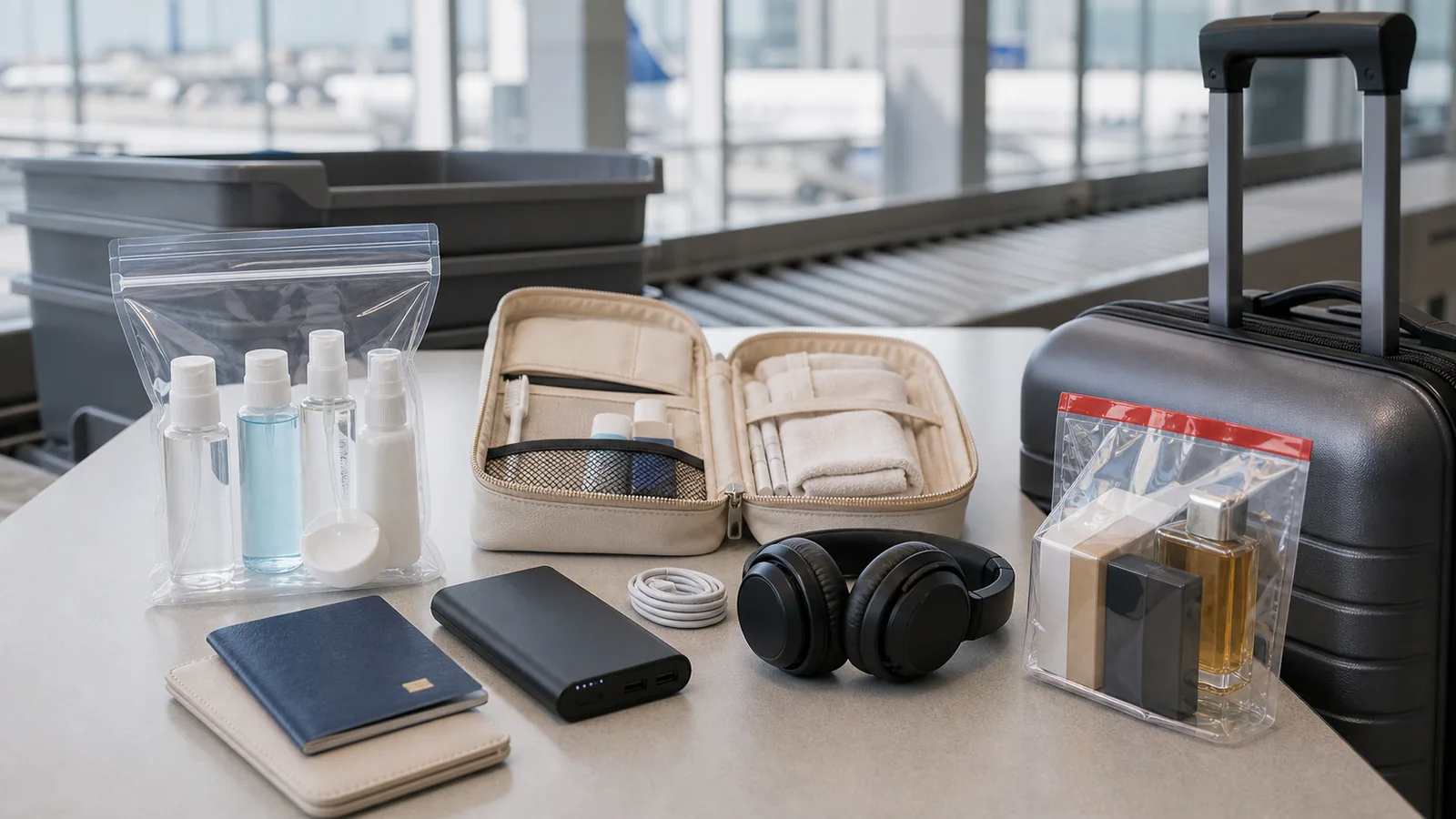
Airport security stops you. You misremembered the 100 ml rule, and your 200 ml toner gets confiscated. Worse — a customs officer takes your power bank, vaporizing 10,000 yen of gear in five seconds. This is the latest rundown of carry-on rules for flights to Japan, so you clear security in one pass.
Three core categories
One, the 100 ml liquid rule
The international standard: single containers no larger than 100 ml, total volume under 1 liter, all packed in a transparent zip bag (20 × 20 cm or smaller).
— Toner, perfume, alcohol, juice, yogurt = liquids. — Toothpaste, shampoo, face cream, hand cream = liquids. — Canned food = also counts (depending on liquid content).
Trap one: a 200 ml toner bottle will be confiscated even if it holds only 50 ml! Security checks the bottle size, not the contents. Only bottles 100 ml or under qualify.
Trap two: multiple 80 ml bottles totaling 800 ml are fine — as long as each bottle is 100 ml or less, the total is under 1L, and everything fits in a clear bag.
Trap three: a Taiwanese-brand toner is usually fine, but labels from certain Asian countries can trigger ingredient questions. Stick to international brands with English labels to play it safe.
Two, power banks and lithium batteries
ICAO regulations:
— Under 100Wh (roughly under 27,000 mAh): carry-on only, not allowed in checked luggage. — 100Wh to 160Wh (27,000 to 40,000 mAh): requires airline pre-approval, carry-on only. — Over 160Wh: banned from flights (rare consumer scenarios).
Most consumer power banks at 10,000 to 20,000 mAh sit well under 100Wh. But the unit must clearly display its Wh rating — anything without a label gets confiscated because security cannot verify.
Trap four: power banks cannot be checked! Plenty of travelers tuck them into checked luggage for neatness, only for customs to open the bag, discover them, and refuse the entire suitcase — switch to carry-on or discard.
Trap five: camera lithium batteries count as the same category — also no checked luggage.
Three, food and drink
Bringing food into Japan: Japan is generally lenient, but:
— Meat products (pork, beef, chicken, sausage, pork floss, jerky) = banned from entry! Foot-and-mouth disease risk. Taiwanese travelers trip on this constantly. — Animal products (honey, cheese, fresh milk) = heavily regulated, some banned. — Fruit and vegetables = require quarantine — average tourists should skip. — Cookies, snacks, chocolate, tea = fine.
Trap six: Taiwanese pork jerky, even vacuum-sealed, is banned from Japan. X-rays catch it, you get fined 50,000 yen, item confiscated. Trading 50,000 yen for jerky is not the bet you want.
Bringing food from Japan back to Taiwan:
— Japanese beef and pork products = banned in Taiwan (foot-and-mouth risk), including prep meals, instant gyudon, and wagyu bento. — Seafood (sashimi, sushi, live products) = generally allowed, but refrigeration matters — long transit times risk spoilage. — Cookies, chocolate, snacks = all fine. — Alcohol = duty-free up to 1 liter (carry-on still limited to 100 ml per container — buy larger bottles and check them).
Other prohibited items
One, scissors and blades: no carry-on, checked luggage only. Nail clippers and Swiss army knives are not exceptions.
Two, lighters and matches: carry-on only, never checked. One per person. Zippo-style wind lighters require pre-approval.
Three, cigarettes and cigars: duty-free up to 200 cigarettes, 50 cigars, or 250g of pipe tobacco. Above that, declare and pay tax.
Four, medications: up to 30 days of personal prescription are allowed; more requires a prescription and English documentation. Amphetamine-class prescriptions (ADHD meds) are strictly controlled in Japan and require pre-approval.
Five, sports gear: snowboards, bikes, golf clubs — most airlines accept checked, but require special packing. Check with your airline in advance.
Tax-free items bought in Japan
Purchases through 「免税手続き」 (tax-free procedures) are usually sealed in a transparent bag. Do not open the bag while still in Japan — it voids your tax-free status. Keep it sealed until you fly home — if security has to open it, you will be questioned.
Special cases: babies and medical needs
— Infant formula and breast milk: can exceed 100 ml, notify security. — Baby food jars: can exceed 100 ml. — Prescription liquids (insulin, special medications): can exceed 100 ml, present medical certificate and prescription.
Tactical airport-security tips
One, bring your own clear zip bag: Narita and Haneda sell them for 200 yen; bring one for free.
Two, decant toner and shampoo into sub-100 ml bottles: Daiso or Muji travel bottles are cheap.
Three, before security, re-check: place all liquids, power banks, and scissors where you can pull them out fast.
Four, declare food honestly on the 「申告書」: customs asks about meat products — saying 「no」 is fine if true. But failing to declare and getting caught is 300,000 yen plus a black mark on your entry record.
Pro tip
A week before you fly, run a luggage triage test: lay everything out and sort into three piles — checked (clothes, books, solids) / carry-on (laptop, meds, passport) / 100 ml clear bag (cosmetics, liquids). Weigh, verify liquid sizes, confirm power banks are in the carry-on pile. Skip this step and your odds of security stopping you and confiscating items spike. Next time you fly to Japan, remember: security does not accept 「I did not know」 as an excuse. The homework is on you.
Frequently Asked Questions
How much liquid can I carry on when leaving Japan?
For international flights, liquids usually need to be in containers of 100 ml or less inside a transparent resealable bag of 1 liter or less. The container size matters.
Can power banks go in checked baggage?
No. Japan requires power banks to be carried in the cabin, not checked. Power banks over 160Wh are prohibited, and each passenger may carry up to 2 power banks.
What about tax-free cosmetics over 100 ml?
Complete tax-free or customs confirmation first, then follow airport staff instructions about checking or carrying items. Do not check required inspection items too early.
Can small scissors or tools go in carry-on baggage?
Airport and airline interpretation can vary. If you do not want to lose the item, put scissors and tools in checked baggage.