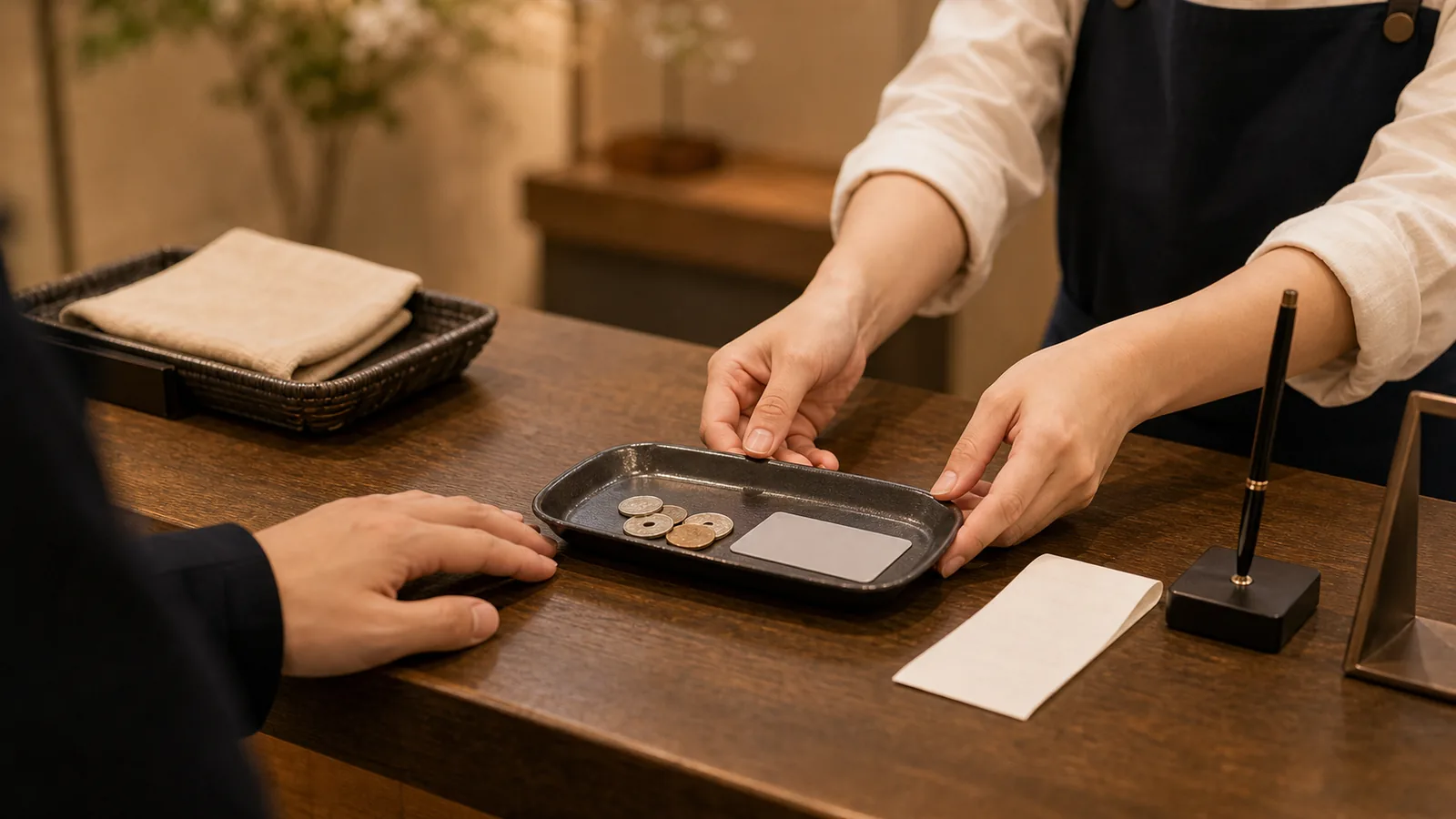
At the konbini, drugstore, or restaurant register in Japan, you will spot a small shallow tray on the counter — plastic, leather, or wood, usually black or dark brown. This is not decor; it is the central object of Japanese checkout etiquette. The classic tourist mistake: handing cash directly to the clerk. They smile for half a second and gesture at the 「カルトン」 — the little tray. Here is why Japanese clerks insist on the tray, plus six operational details.
What is this tray called? Officially 「カルトン」 (a Japanization of the French 「carton」, originally 「cardboard」), or 「キャッシュトレイ」, 「会計皿」, 「コイントレー」. It appears at every register — konbini, supermarkets, drugstores, restaurants, cafes, taxis, ticket windows.
Five reasons the tray is mandatory — One, hygiene: Japanese culture treats hand-to-hand money transfer as a hygiene issue — cash has passed through many hands and is bacteria-dense. The tray lets the clerk handle money without direct contact. — Two, clear accounting: the clerk lays the bills flat in the tray to verify the amount, avoiding miscounts. Tourists who hand cash directly cause small coins to drop, and the clerk has to count visibly, slowing everyone down. — Three, dispute prevention: 「I gave you 10,000 yen」 / 「No, only 5,000」 — the tray keeps the entire transaction visible, preventing arguments. Security cameras capture the cash on the tray, so disputes can be investigated. — Four, pacing buffer: the tray is a 「neutral zone」, letting the clerk finish a previous action while you place your money first. The rhythm flows smoother. — Five, tradition: in traditional Japanese commercial etiquette, hand-to-hand money exchange can read as overly intimate or rude. The tray provides polite distance.
Six operational details
Detail one: prep your cash while the clerk states the total The clerk says 「○○円になります」 (that comes to ○○ yen). Have your bills and coins ready at that moment — do not start rummaging through your wallet while the clerk waits. Japanese register rhythm is fast, and a tourist slowing the line gets noticed.
Detail two: place cash in the tray, push gently toward the clerk Lay bills flat, face-up (the side showing the Bank of Japan seal facing up); coins next to or on top of the bills. Push the tray gently toward the clerk (no need to actually slide it across — the intent is enough). Do not press cash into the clerk’s hand.
Detail three: change comes back on the same tray After ringing up, the clerk places your change on the same tray — bills on the bottom, coins on top. They will verbally confirm 「○○円のお返しです」 (here is your ○○ yen change).
Detail four: lift the tray and pour the money into your hand Do not reach into the tray to scoop the money. The right move: left hand tilts the tray toward your other hand → right hand catches the coins → lift the bills and tuck them into your wallet. The whole motion takes three seconds.
Detail five: the clerk bows and says 「ありがとうございました」 After handing over change, the clerk bows lightly and says 「ありがとうございました」. A small nod or a 「ありがとう」 in return is enough. No need to bow back — customers do not bow to clerks (a 15° nod is plenty).
Detail six: 10,000 yen bills get machine-verified When paying with a 10,000 yen note, the clerk inserts it into the register to verify authenticity (counterfeit check). The process takes 3 to 5 seconds. Do not rush off and do not hurry the clerk — wait for verification, then change on the tray, verbal confirmation, you collect the cash, and you go.
Special case: table-side payment at restaurants and cafes Some upscale restaurants and cafes use table-side checkout — staff bring a small leather or wood box (a 「Bill Holder」) with your bill inside. The flow: — One, open the box and check the bill. — Two, place the cash inside. — Three, close the box. — Four, staff take it away, ring it up, and bring back the change. No tipping in this context (Japan has no tipping culture); just tuck the change into your wallet.
What about credit cards and IC cards? When paying with credit cards or IC cards (Suica, Icoca), the tray is still used in most contexts. The clerk takes the card, swipes, and returns it on the tray. Modern setups will hand you the card reader so you tap it yourself — no tray needed there. Just observe and follow.
Pro tip: practice by buying water at a konbini If you want to drill this flow, walk into a 7-Eleven and buy a 130 yen bottle of water. You will experience: clerk asks 「お弁当温めますか?」 (heat up the bento? — skip for water) → total announced → you place cash on the tray → clerk processes → change on the tray → you scoop into your hand → bow on the way out. The whole thing is 30 seconds. Run it 5 or 6 times in a single day and you have it down. Next trip, your register rhythm will be indistinguishable from the locals’ — tourist-to-resident transformation complete.
Frequently Asked Questions
Do I have to put cash on the tray in Japan?
Use the tray when it is there. If not, follow the staff. It is a clarity tool, not a mysterious taboo.
How should I take change from the tray?
Wait until the staff finishes placing bills and coins, then pick them up calmly or tilt the tray slightly.
Do credit cards go on the tray too?
At traditional counters, often yes. At newer terminals, insert, tap, or enter your PIN yourself as instructed.
Should I leave a tip with table payment?
No. Japan does not have a tipping culture. Take your change and say thank you.