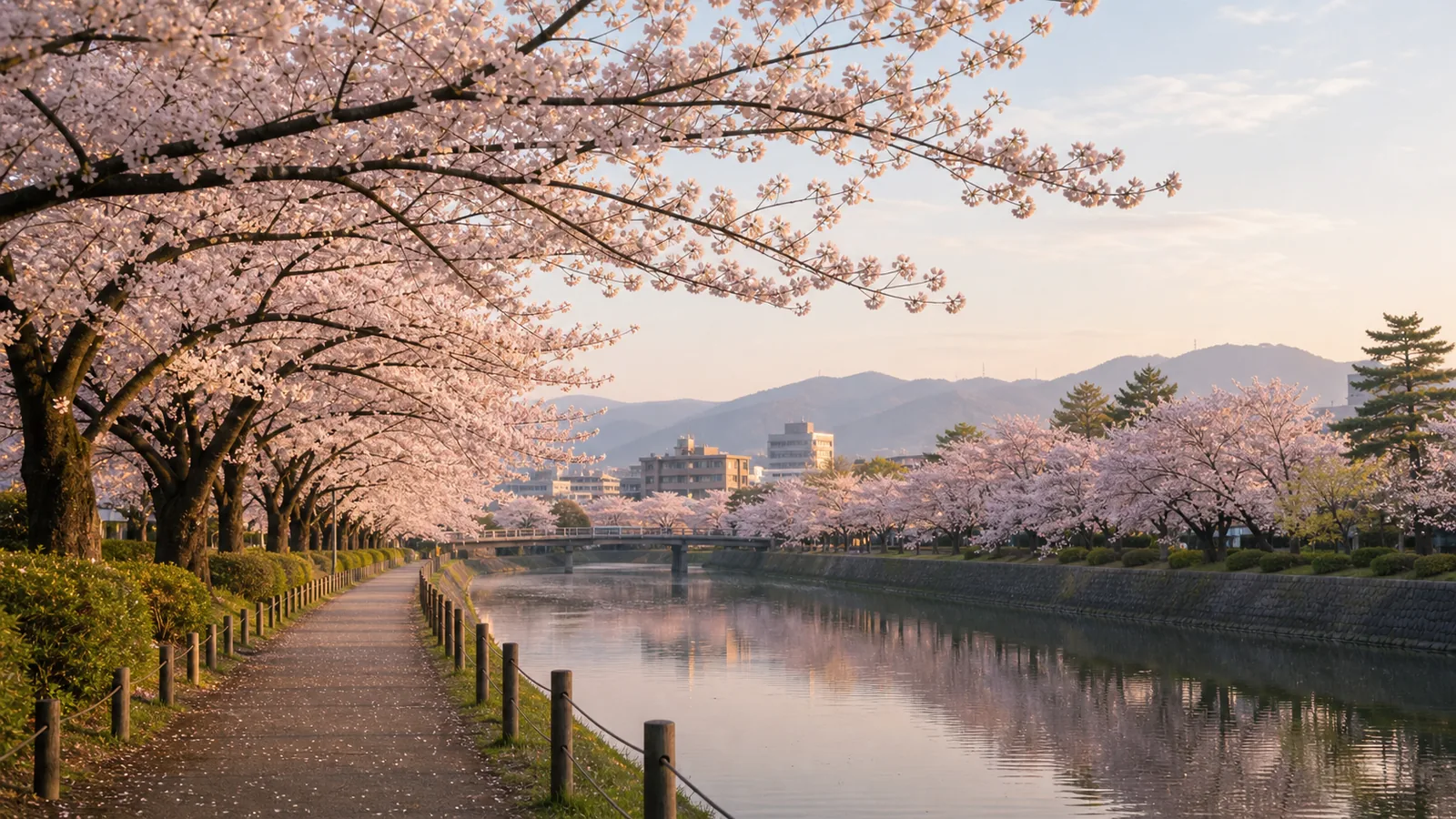
Think Japan’s cherry blossom season is just April? Not really. Sakura runs from late January in Okinawa to early May in Hokkaido — over 100 days end to end. If you fixate on 「early April in Tokyo」 and fly into Kyushu or Hokkaido, you may find bare trees, or petals already on the ground.
What is the 「桜前線」?
The 「桜前線」 (sakura zensen) is the official cherry-blossom advance line published annually by the Japan Meteorological Agency, tracking the dominant 「染井吉野桜」 (Somei Yoshino) variety as it blooms from south to north. Starting in Kyushu, it advances about 25 to 30 km per day. Each tree takes 5 to 7 days from 「開花」 (first 2-3 blossoms) to 「満開」 (80%+ open), then sheds within a week. The real viewing window is just 5 to 7 days.
National schedule (averages — actual dates shift 5 to 10 days year to year)
One, Naha, Okinawa: late January to early February (the 「寒緋桜」 variety, different from Somei Yoshino — deeper pink).
Two, Fukuoka, Kyushu: bloom March 22-25 → full bloom late March to early April.
Three, Hiroshima: bloom March 25-28 → full bloom April 4-7.
Four, Osaka and Kyoto: bloom March 27-30 → full bloom April 5-10.
Five, Tokyo: bloom March 22-25 (surprisingly early, thanks to the heat island effect) → full bloom late March to early April.
Six, Kanazawa and Niigata: bloom April 5-10 → full bloom April 12-18.
Seven, Sendai: bloom April 8-12 → full bloom April 15-20.
Eight, Hirosaki, Aomori: bloom April 20-25 → full bloom late April to early May (Japan’s most famous sakura destination).
Nine, Sapporo: bloom May 1-5 → full bloom May 5-10.
Ten, Nemuro (easternmost Hokkaido): mid-May, the country’s last wave.
Precision forecasting tools
A week before you fly, check two official sources: 「ウェザーニュース 桜開花予想」 (Weathernews bloom forecast) and 「日本気象協会 tenki.jp」. Both refresh weekly and pinpoint individual parks.
Anti-crowd strategy
One, early weekday mornings: Meguro River at 7 a.m. and 11 a.m. are completely different worlds.
Two, skip the famous spots: ditch Ueno Park and Chidorigafuchi. Try Showa Memorial Park in Tachikawa, Shinjuku Gyoen (paid entry keeps crowds down), or Sumida Park.
Three, pick second-tier regions: instead of Kyoto’s Philosopher’s Path, try Takato Castle Park in Nagano, Yoshino-yama in Nara, or Hirosaki Castle.
Rain contingency
The biggest sakura killer is 「花散らしの雨」 (the rain that scatters the blossoms). Two days of rain can strip 80% of petals. If the forecast at your destination shows back-to-back rain before you arrive, changing plans is smarter than waiting it out. Tokyo raining? Jump on a Shinkansen to Kanazawa or Sendai, where the bloom has not peaked yet.
Night sakura is a separate experience
「夜桜」 (yozakura, night cherry blossoms) is illuminated at Kyoto’s Maruyama Park, Tokyo’s Meguro River, and Osaka’s Mint Bureau. The mood is dreamlike compared to daytime — but the cold doubles. Early April nights in Kanto can drop to 7-10°C.
Pro tip:
If your trip misses sakura in Tokyo and Kansai, do not despair — book a Tohoku or Hokkaido flight right now. Late April in Hirosaki plus early May in Sapporo offers a more authentic sakura atmosphere than fighting crowds in Kansai in early April, and hotels are half the price of Kyoto. For your next trip, stop treating 「Japan’s cherry blossoms」 as a single date — treat it as a 100-day relay race and pick which leg you want to join.
Frequently Asked Questions
When is cherry blossom season in Japan?
Tokyo, Kyoto, and Osaka are usually late March to early April. Okinawa is earlier, while Tohoku and Hokkaido are later.
What is the difference between blooming and full bloom?
Blooming means flowers have started opening. Full bloom is the short peak window most travelers want to see.
Which cherry blossom forecasts should I check?
Use city forecasts from Weathernews, tenki.jp, or Japan Meteorological Corporation, then confirm local park conditions before travel.
What if I miss peak bloom in Tokyo or Kyoto?
Move north if your itinerary allows. Hokuriku, Tohoku, and Hokkaido often peak after Tokyo and Kyoto.