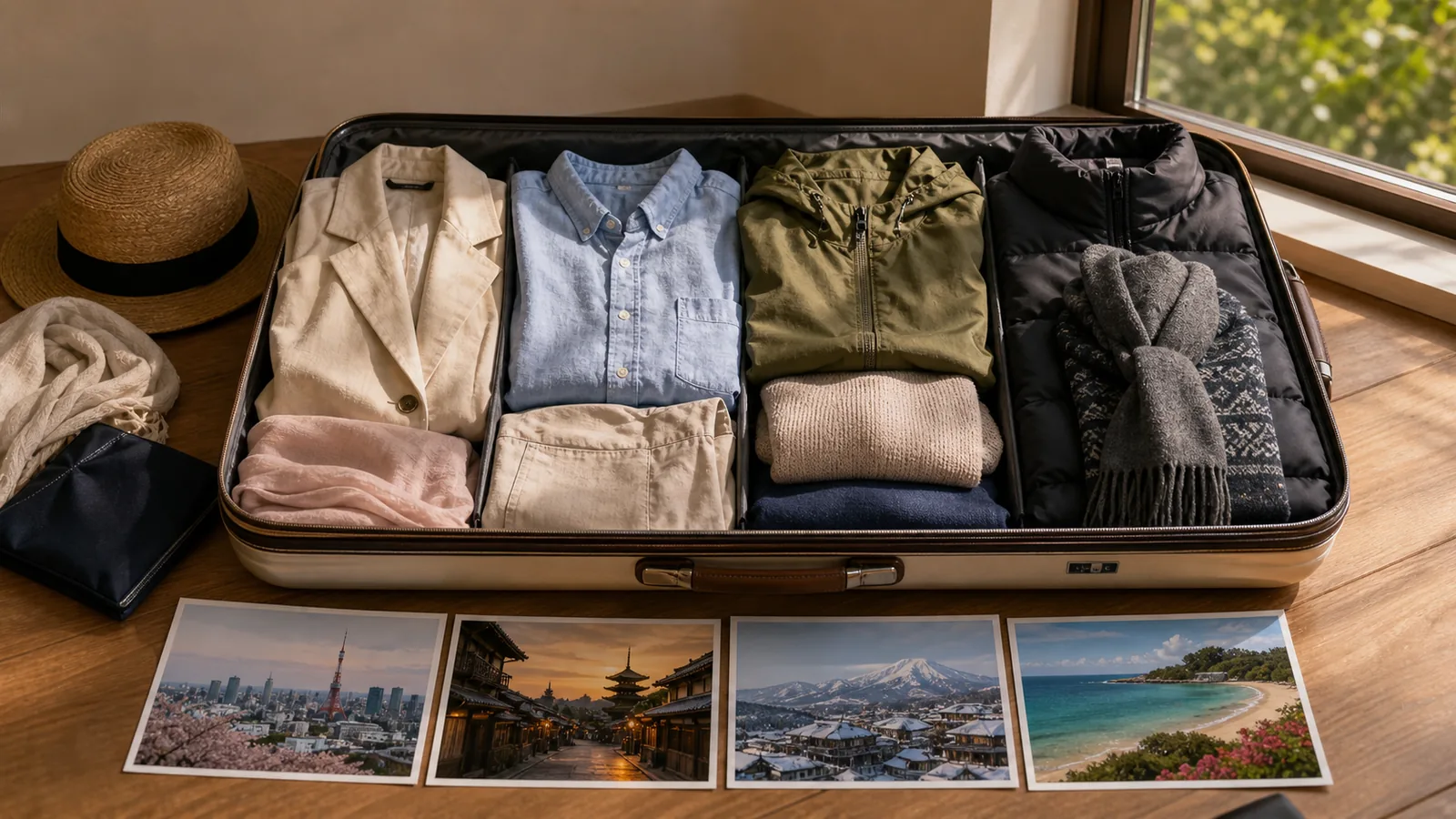
Think Japan is 「basically like Taiwan」? Only in summer. Japanese winters drop to -5°C and summers spike to 38°C — far wider swings than Taiwan. Wear the wrong layers and you face heatstroke, a cold, or a 10,000-yen overweight-baggage fee. Here is the month-by-month, region-by-region dress guide.
The big difference: Japan is dry cold and dry hot
Taiwan sits at 70%+ humidity. Honshu winter can drop to 30%. At the same 5°C, Japan feels warmer than Taiwan thanks to the dryness — but cuts colder when the wind kicks up. Summer 「dry heat」 changes things even more — Tokyo at 35°C dry beats Taipei at 32°C humid for comfort, but the sun is fiercer.
Month by month
January (deep winter)
— Tokyo and Kansai average 5-10°C, nights 0-3°C. — Hokkaido -5 to -15°C, snow. — Kit: down jacket (800 fill power or better) plus heavy sweater plus thermal base layer plus thick socks plus scarf plus gloves. — Hokkaido add-ons: non-slip snow boots plus hand warmers plus ski gloves.
February
— Same as January, slightly warmer in the day. — Sapporo Snow Festival is brutally cold — bring polar-grade gear.
March (early spring)
— Tokyo and Kansai average 10-15°C, mornings and evenings still cold. — Hokkaido still in winter gear. — Kit: light down or heavier jacket plus long sleeves plus jeans, onion-layer style (peel down to a T-shirt at 20°C indoor). — Pack a folding umbrella (spring rain is frequent).
April (hanami season)
— Tokyo and Kansai average 13-18°C, morning-evening swings of 8-12°C. — Kit: spring jacket (trench or light down) plus long sleeves plus jeans. — Night sakura demands warm layers — late April evenings still dip to 5-8°C.
May (early summer)
— Tokyo and Kansai average 18-23°C — daytime feels like Taiwanese autumn. — Kit: light long sleeves or thin jacket, ready to strip to a T-shirt when indoor AC is aggressive. — Hokkaido still cool, jacket required.
June (rainy season)
— Tokyo and Kansai average 22-27°C, humidity spikes to 80%. — Kit: short sleeves plus rain shell (not umbrella alone — bring a folding umbrella anyway). — Choose waterproof, non-slip shoes — in heavy rain, sneakers stay soaked all day.
July-August (peak summer)
— Tokyo and Kansai average 28-35°C, feels like Taipei but the sun bites harder. — Kit: short sleeves, shorts, light dresses plus hat plus sunglasses plus sunscreen. — Indoor AC runs aggressive — bring a thin jacket to department stores and restaurants to avoid catching a cold. — Hokkaido 21-26°C, mild, still want a thin long-sleeve. — Okinawa is similar to Tokyo but with strong sea breeze — perfect for T-shirts and shorts.
September (early autumn)
— Tokyo and Kansai average 23-28°C, similar to May. — Typhoon season — 2 to 3 typhoons typically approach Japan; pack a rain shell.
October (mid autumn)
— Tokyo and Kansai average 17-22°C — Japan’s most comfortable month. — Kit: long sleeves plus light jacket plus jeans. — Hokkaido foliage period — medium jacket needed.
November (peak foliage)
— Tokyo and Kansai average 11-17°C, 5-8°C swing between morning and night. — Kit: wool coat or heavy jacket plus sweater plus scarf. — Early-morning Kyoto foliage viewing (7 a.m.) requires thermal base layers.
December (early winter)
— Tokyo and Kansai average 7-12°C, nights 3-6°C. — Kit: down jacket plus sweater plus thermals. — Hokkaido is full winter — bring January-grade gear.
Two principles that matter most
One, the onion layer: Japanese indoor heating and cooling run hot (22°C in winter, 22°C in summer), so the temperature gap between outside and inside is 15-20°C. Your outer layer needs to come off easily.
Two, feet are everything: 10,000+ steps a day is normal on a Japan trip (a Tokyo walk hits 15,000). Old shoes or wrong fit equals trip hell. Two weeks before departure, break in new shoes on long walks.
Shoe choices
— Winter: insulated non-slip snow boots (essential in Hokkaido), waterproof boots (Honshu winter). — Spring and autumn: waterproof sneakers. — Summer: breathable sneakers or sandals plus foot sunscreen. — Rainy season and typhoon months: waterproof sneakers or rain boots.
Luggage-weight hacks
One, thermal base layer (heat-tech): under 200g, warms like a heavy sweater.
Two, down jacket: a good 800-fill-power down weighs 500-800g and compresses to nothing.
Three, rewear strategy: three short-sleeve shirts cover a 7-day summer trip (wash once at the hotel).
Four, laundry: hotel self-service washers run 100 yen per cycle — far lighter than packing seven outfits.
Pro tip
Three days before you fly, check the 7-day forecast at your destination (use 「ウェザーニュース」 weathernews.jp or Yahoo! 天気). Freezing for a day in Kyoto because you packed wrong can derail an entire trip. On your next trip, weight clothing planning the same as hotel booking — you would not wear shorts to Shirakawa-go, and you should not pack a down jacket to Okinawa.
Frequently Asked Questions
What matters most when dressing for Japan travel?
Shoes and outer layers. You may walk a lot, so shoes must be comfortable. Indoor-outdoor temperature gaps make removable layers useful.
Should I bring a light jacket in Japan summer?
If you get cold easily, yes. Outdoors are hot, but department stores, restaurants, and trains can have strong air-conditioning.
Do I need snow boots for Tokyo winter?
Usually not for central Tokyo, but waterproof shoes with traction are important for Hokkaido, Tohoku, Nagano, Niigata, and Shirakawa-go snow trips.
What shoes work for Japan rainy season?
Choose water-resistant, grippy shoes that stay comfortable for long walks. Wet pavement makes delicate new shoes a bad idea.