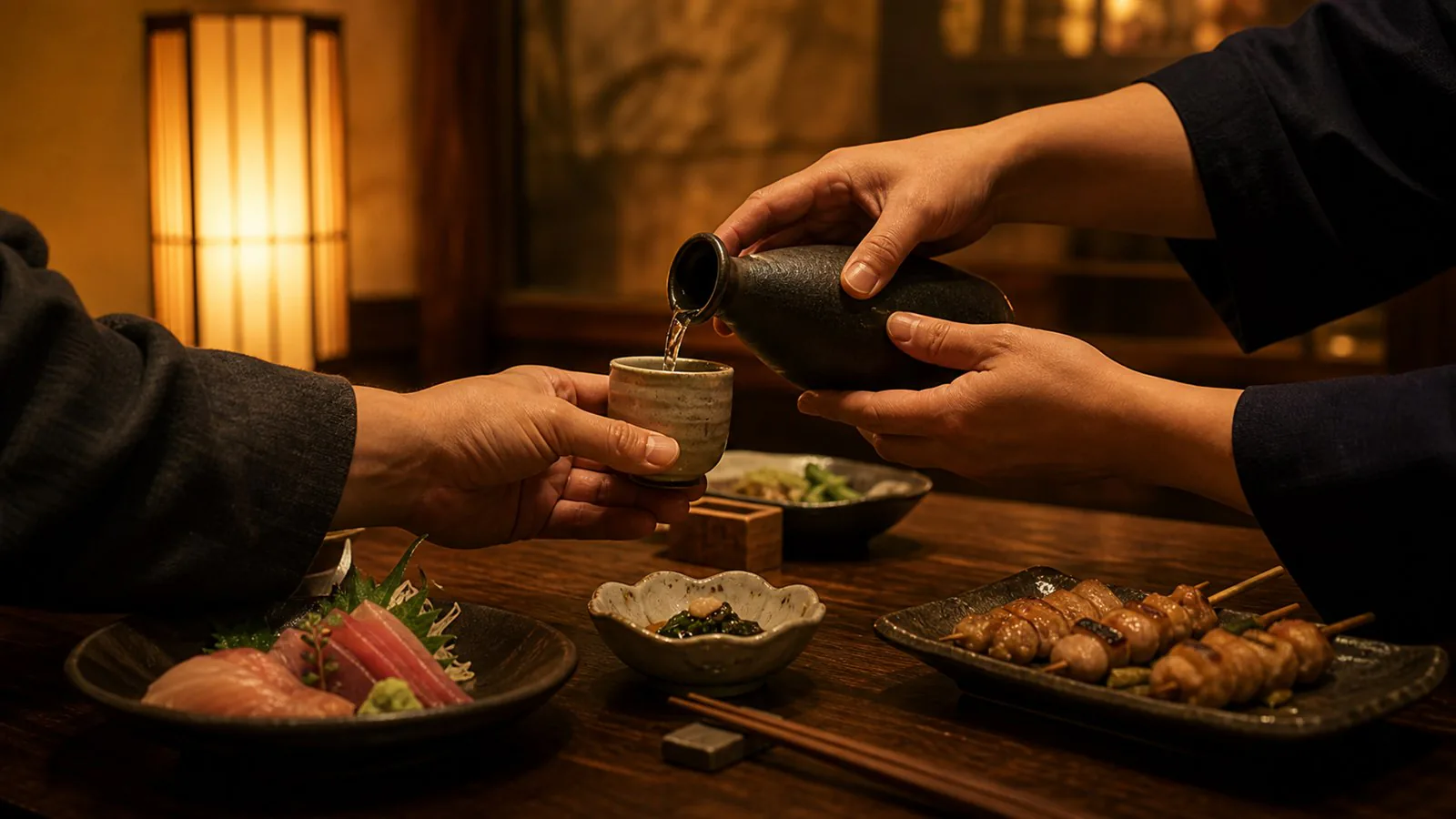
Think a Japanese izakaya is just a place to drink and relax? In reality, 「飲み会」 (nomikai, drinking parties) are an extension of Japanese workplace culture, and even who pours for whom follows a precise unwritten code. Get it wrong and you get quietly labeled 「the foreigner who does not get it」 — and no one will tell you.
The social weight of a nomikai
Japanese offices have a concept called 「飲みニケーション」 (nominication = drinking + communication), meaning the things you cannot say at the office, the questions you cannot ask, and the relationships you cannot build during work hours all happen at the izakaya. New-hire welcomes, seasonal department parties, client entertainment, family gatherings — all run through nomikai. Skipping nomikai means opting out of office politics.
Younger generations have begun pushing back since 2020 (「飲みニケーション拒否」, rejecting drinking socials), but the ritual remains core to Japanese work life. If a Japanese friend invites you to a nomikai, it is an important opening into the inner circle.
Unwritten rule one: the order of pouring 「お酌」
Once seated, the first round is for 「乾杯」 (kanpai). Juniors and lower-ranked people pour for seniors — the act is called 「お酌」 (oshaku). When pouring:
One, hold the bottle with both hands (right hand on the body, left hand bracing the bottom). Two, let the other person hold the cup; pour to about eight-tenths full. Three, you do not pour your own drink — wait for someone else. After a senior pours for you, you reciprocate by filling their cup. Reciprocal pouring is the heart of the ritual.
Unwritten rule two: how to 「kanpai」
Japanese 「乾杯」 is not 「down it all」 — it is raise the glass, light clink, single sip. Chugging is called 「一気飲み」 (ikkinomi), and since the 2000s many companies have explicitly banned it after new hires died from forced binge drinking. Anyone pressuring you to ikkinomi is out of line — refuse politely.
During the kanpai itself, lower-ranked people clink lower. Peers clink equally. With a boss, touch the rim of your glass to the body of theirs to signal subordinate position.
Unwritten rule three: 「お任せ」 for ordering
At an izakaya, the lowest-ranked person (usually the newcomer) handles ordering. But Japanese izakaya have the concept of 「お任せ」 (omakase), literally 「left to you」. A senior may say 「お任せで」 (you decide), meaning you need to order dishes everyone at the table can enjoy.
Safe defaults: yakitori (chicken skewers), sashimi platter, edamame, tamagoyaki (rolled omelet), natto rolls. Avoid: anything too spicy, anything too funky (natto for first-timers is a trap), weird seafood parts.
Unwritten rule four: what is 「お通し」?
When you sit down at an izakaya, staff bring out a small dish called 「お通し」 (otoshi). It looks like a free appetizer but is actually billed, usually 300 to 500 yen per person, and doubles as a seat charge. The classic tourist outrage: 「I did not order this!」 It is industry standard — you cannot refuse it.
If there is something you cannot eat (allergy, religious reasons), mention it upfront — 「アレルギーがあります」 (I have an allergy) — and they will swap it.
Unwritten rule five: how much to pour
Pouring more is not better. Sake: about 80% full. Beer: 80% beer plus 10% foam (2 parts foam, 8 parts beer). Oolong tea or soft drinks for non-drinkers: about 70%.
Most common tourist mistakes
First, pouring for yourself — no one saw it, you thought you were being self-sufficient, but it signals to the table that 「you are not taking care of me」, costing the host face. Second, pouring yourself a second glass the moment your first is empty — wait for someone else. Third, kanpai-ing with your glass above the boss’s — rude. Fourth, pressuring someone to ikkinomi — legally classified as 「アルハラ」 (alcohol harassment), workplace bullying. Fifth, claiming the last piece on a shared plate — the final piece is called 「遠慮の塊」 (the polite leftover), and no one dares touch it. Correct move: ask the table 「これ、どなたか召し上がりますか?」 (anyone want this?) and only take it if no one claims it.
Drunken taboos
Japan is relatively tolerant of public drunkenness (Friday-night trains are full of comatose salarymen), but some behaviors are non-negotiable: first, yelling at staff — you will be ejected. Second, sexually harassing female servers — 「セクハラ」 is illegal. Third, breaking property — pay damages plus police report. Fourth, picking fights with other customers — even when drunk, Japanese people stay restrained, and you will be the obvious 「outsider」 making trouble.
Pro tip: 「お先に失礼します」 is the magic exit phrase
When leaving a nomikai before it ends, stand up and bow: 「お先に失礼します、ご馳走様でした」 (I will excuse myself, thank you for the meal). The key word is 「ご馳走様」 — even though you split the bill, your host will be quietly moved by that phrase. This is the pivot point where Japanese surface politeness turns into genuine good impression.
Next time a Japanese friend invites you to a nomikai, learn to pour for the other person first. That single gesture promotes you from 「ordinary tourist」 to 「foreign friend who gets it」.
Frequently Asked Questions
What is basic izakaya drinking etiquette?
Wait for the group toast before drinking. Pouring, ordering, and leaving early depend on the relationship and setting.
Must your glass be lower than your boss at kanpai?
This matters in some workplace settings, but travelers and friends do not need to overthink it. Be respectful and relaxed.
Can you refuse alcohol in Japan?
Yes. Say “osake wa nomemasen” or order a non-alcoholic drink. Pressure to drink is increasingly seen as inappropriate.
What is otoshi at an izakaya?
Otoshi is a small starter served after seating and often functions like a cover charge. Treat it as normal unless the shop says otherwise.