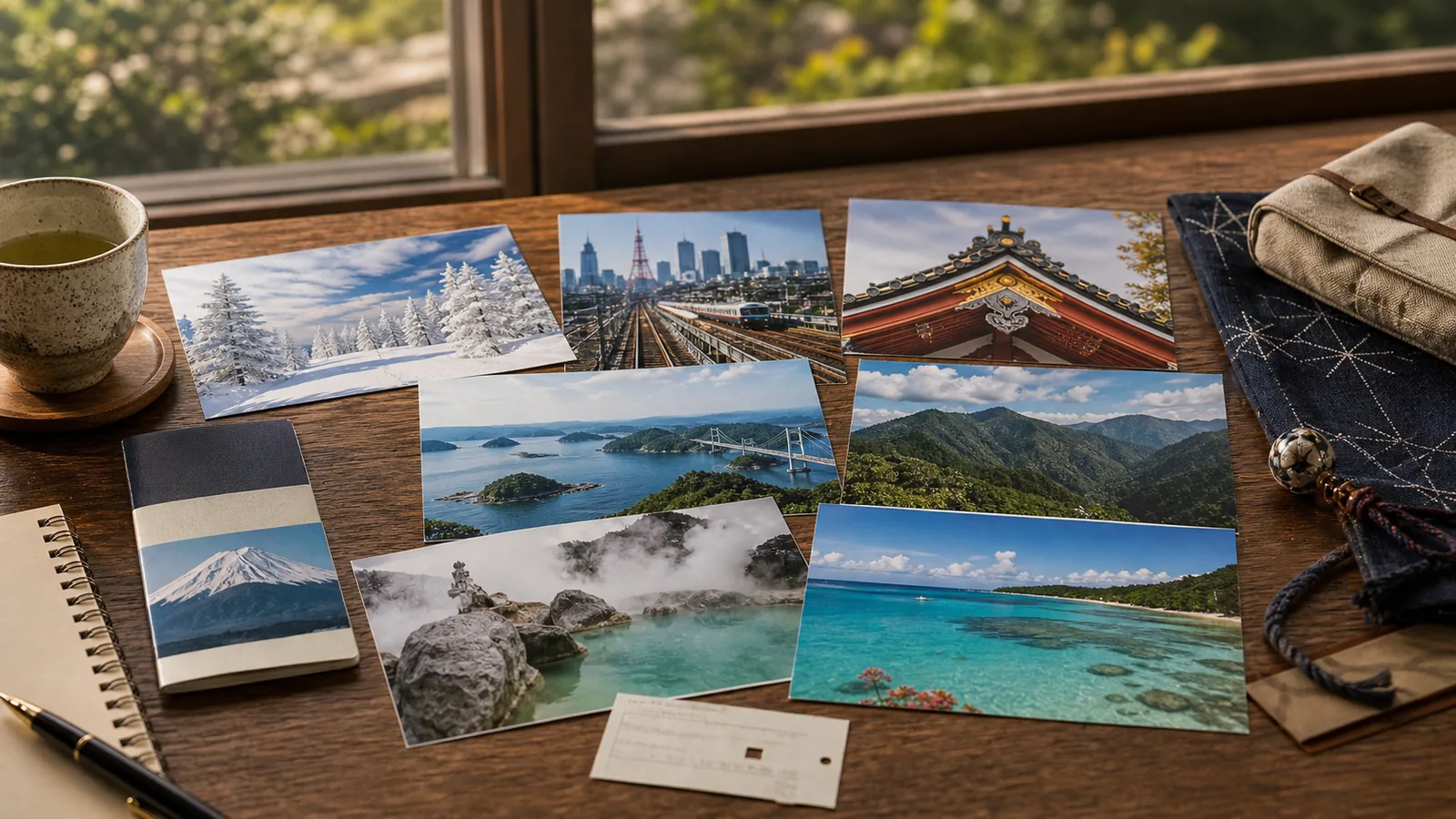
Japan’s 47 prefectures group into eight regions — the standard divisions Japanese people themselves use. Understanding the eight is 100x more useful than memorizing 47, because each region has its own climate, dialect, food, and history — essentially eight mini-countries.
Taiwan stretches 394 km north to south. The Japanese archipelago runs 2,845 km from Cape Soya in Hokkaido to Yonaguni in Okinawa, spanning 25 degrees of latitude. You may think it is 「all Japan」, but Hokkaido in winter at -30°C and Okinawa at the same moment at 25°C is a difference comparable to Beijing versus Bangkok.
Region one: Hokkaido (1 do, 5.41 million people) Japan’s northernmost and largest island, 83,424 sq km (bigger than Taiwan plus Korea combined). Winter snow piles 1-2 meters, summer stays cool at 25°C, no rainy season — climate-wise it feels Western. The indigenous people are the 「アイヌ」 (Ainu), and Hokkaido was only annexed in 1869. Sapporo, Hakodate, and Otaru are must-visits. Highlights: seafood (salmon, uni, crab), Hokkaido dairy, world-class skiing (Niseko), lavender fields. Go in winter for snow, in summer to escape the heat.
Region two: Tohoku (6 prefectures, 8.4 million people) Aomori, Iwate, Miyagi, Akita, Yamagata, Fukushima. The most underrated region in Japan because tourist traffic is thin. Snowfall is the heaviest in the country (Aomori can hit 4 meters in winter), summers are cool, and onsen quality is top tier (Nyuto Onsen, Ginzan Onsen).
The 2011 Tohoku earthquake hit here (off the Miyagi coast). Sendai is the largest city. Highlights: Aomori apples, Akita rice, Sendai beef tongue, Iwate wanko soba (the endless-buckwheat-noodles experience), Oirase Gorge, Ginzan Onsen (said to have inspired Spirited Away’s setting). The dialect is heavy — even Tokyo Japanese cannot fully follow.
Region three: Kanto (7 prefectures, 44 million people) Tokyo, Kanagawa, Chiba, Saitama, Ibaraki, Tochigi, Gunma. One-third of Japan’s population lives here. The Kanto Plain is the largest plain in Japan, which is why the population and industry pile up. Tokyo, Yokohama, and Kawasaki form a super-metropolitan belt.
Four clear seasons — winters dry and cold but rarely snowy, summers humid and hot. Must-visit: Tokyo’s 23 wards, Yokohama Chinatown, Kamakura (ancient capital), Nikko (World Heritage), Hakone (onsen plus Fuji views), Kawagoe (「Little Edo」).
Region four: Chubu (9 prefectures, 21 million people) Aichi, Shizuoka, Gifu, Nagano, Niigata, Toyama, Ishikawa, Fukui, Yamanashi. Spanning the middle of the main island, geographically the most varied — the Japanese Alps, snow country on the Japan Sea side (Niigata gets buried), and the warmer Pacific side.
Nagoya is the largest city. Nagano has skiing, Gifu has the Shirakawa-go gassho-zukuri village, Kanazawa has Kenrokuen (one of the three great gardens), and Mount Fuji straddles Yamanashi and Shizuoka. Highlights: Nagoya miso cuisine, Shinshu soba, Toyama shrimp, Ishikawa gold leaf craft.
Region five: Kansai (2 fu + 4 prefectures, 22 million people) Osaka, Kyoto, Hyogo, Nara, Wakayama, Shiga. Japan’s cultural heart — Kyoto was the capital for 1,074 years, Nara for 74 years, Osaka was the empire’s kitchen. Kobe’s port, Himeji Castle, Wakayama’s Kumano Kodo trails, and Shiga’s Lake Biwa.
The Kansai dialect (関西弁) differs from Tokyo speech the way Taiwanese differs from Mandarin. Kansai people are direct, love witty banter, and feel warmer. Highlights: Kyoto kaiseki, Osaka 「konamono」 (takoyaki, okonomiyaki), Kobe beef, Nara deer.
Region six: Chugoku (5 prefectures, 7.2 million people) Okayama, Hiroshima, Yamaguchi, Tottori, Shimane. Note: the Japanese word 「中国」 here means 「the Chugoku region」, no relation to China. Located on the westernmost stretch of the main island. Includes the Hiroshima Atomic Bomb memorial (Peace Memorial Park), Miyajima’s Itsukushima Shrine, Okayama’s Korakuen, Izumo Taisha, and the Tottori sand dunes.
Climate is mild — snowy on the Japan Sea side, Mediterranean-like on the Seto Inland Sea side (Hiroshima, Okayama). Highlights: Hiroshima okonomiyaki, Okayama white peaches, Izumo soba, Miyajima oysters.
Region seven: Shikoku (4 prefectures, 3.7 million people) Kagawa, Ehime, Tokushima, Kochi. The smallest of the main islands, and even Japanese people do not visit much. But enthusiasts love it — the Shikoku pilgrimage (88 temples, 1,200 km), udon (Kagawa’s Sanuki udon is world-class), and Dogo Onsen (the bathhouse said to have inspired Yubaba’s in Spirited Away).
Warm climate. Tokushima’s Awa Odori festival is one of Japan’s three great bon odori. Highlights: Kagawa Sanuki udon, Ehime mikan, Kochi katsuo tataki, Tokushima Awa Odori.
Region eight: Kyushu and Okinawa (7 prefectures plus 1, 14.4 million people) Fukuoka, Saga, Nagasaki, Kumamoto, Oita, Miyazaki, Kagoshima, plus Okinawa. A paradise of volcanoes and onsen — Mount Aso, Sakurajima, Unzen, Beppu, Yufuin, Kurokawa Onsen — the highest hot-spring density in Japan.
Subtropical climate. Kagoshima and Okinawa hit 15°C even in winter. Kyushu people are boisterous with heavy dialects (Hakata-ben, Satsuma-ben). Fukuoka is the largest city. Okinawa was originally the 「Ryukyu Kingdom」 and was only annexed in 1879, so its culture, language, and food feel different — closer to Taiwan plus Southeast Asia.
Highlights: Hakata ramen, Nagasaki champon, Kumamoto basashi (horse meat), Miyazaki mango, Kagoshima black pork, Okinawa sea grapes, bitter melon, and awamori liquor.
Which to pick? First trip to Japan: Kanto plus Kansai (Tokyo, Kyoto, Osaka). Second trip: Hokkaido (summer) or Kyushu (onsen). Third trip: Tohoku (snow and foliage) or Okinawa (islands). Bigger budget: Chubu (Shirakawa-go, Tateyama-Kurobe, Kanazawa). Niche but enthusiast favorite: Shikoku plus Chugoku (Hiroshima, Naoshima, Dogo).
Next time you plan, look past Tokyo. Each of Japan’s eight regions has its own personality — pick right and you will see a different Japan.