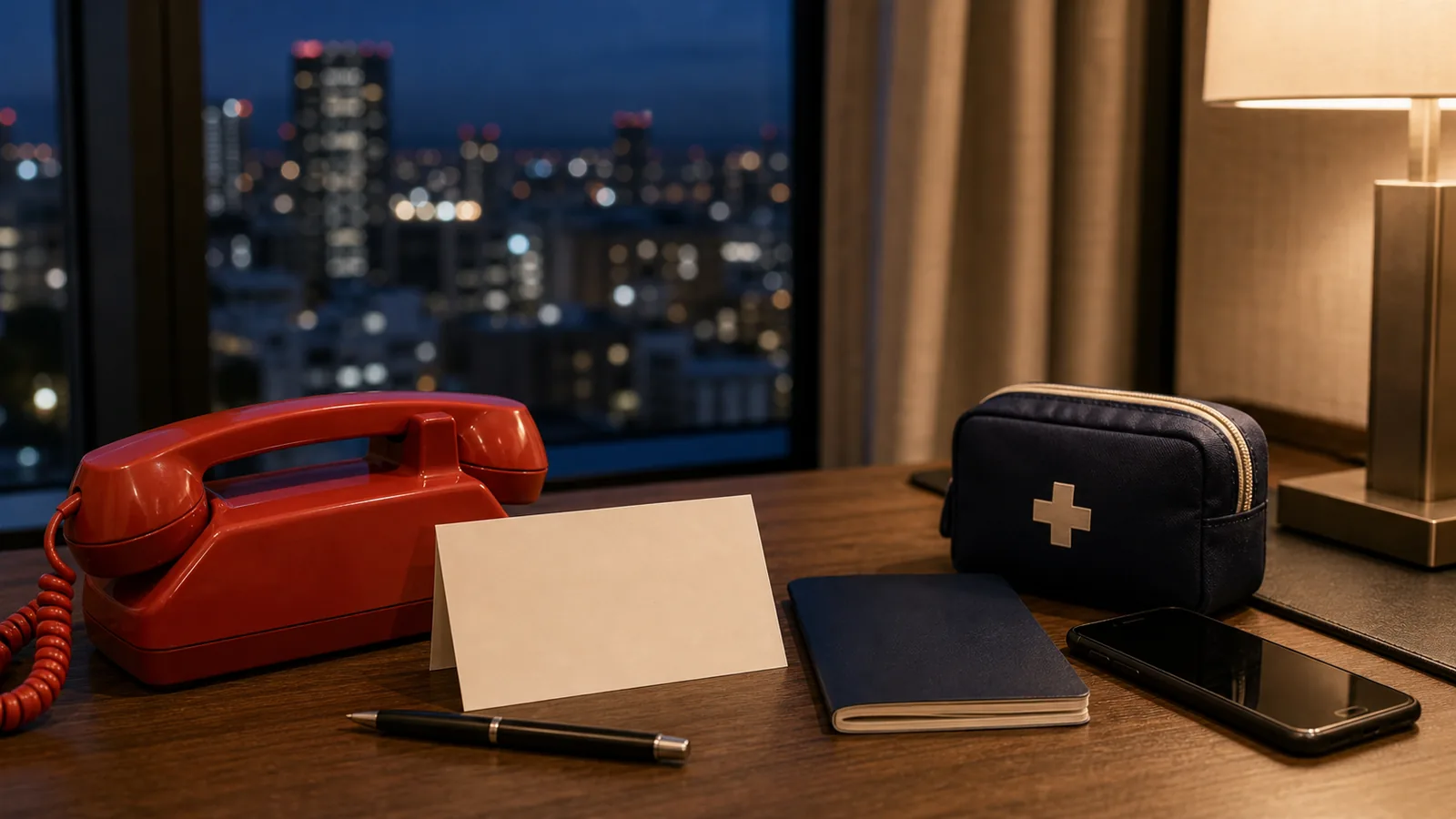
You are walking down a Japanese street and your chest tightens, cold sweat pours, no Japanese speaker around — which number do you call? 119 or 110? This guide walks through five real scenarios to explain how Japan’s emergency line works, plus a list of 24-hour multilingual (English, Chinese, Vietnamese, Korean, Thai) free hotlines to save in your phone before you fly.
The bottom line: 110 for police, 119 for ambulance and fire. Both are free, and public phones connect directly with no coins.
Japan’s emergency system splits differently from Taiwan or China — police and fire are two separate numbers. Do not mix them up.
One, 110: police. Crimes, traffic accidents, lost children, violence, suspicious persons.
Two, 119: fire plus ambulance. Fires, someone collapsing, severe bleeding, heart attacks, infant high fever, accidental injuries. 119 dispatches both ambulances and fire trucks — once connected, say 「救急車 (きゅうきゅうしゃ)」 for ambulance or 「消防車 (しょうぼうしゃ)」 for fire engine.
Three, 118: maritime accidents and coast guard (rarely used by tourists).
How to dial: from public phones, mobile, or hotel
Public phones: emergency calls work via the red emergency button (緊急ボタン) — dial 110 or 119 with no coins needed.
Mobile: dial 110 or 119 directly, free. Even with no data, no roaming, or no SIM, the Japanese local network will route emergency calls.
Hotel: dial 0 for the front desk, or reach an outside line directly (some hotels require 0 before 110).
Once connected, what do you say? Operators speak basic English, slowly
The first thing you hear on 119 is usually 「119、火事ですか、救急ですか?」 = 「This is 119 — fire or ambulance?」
Simple English works, but you may be routed to a multilingual operator (usually 30 to 60 extra seconds).
Suggested phrases (English is fine):
One, 「Help, I need ambulance」 / 「I need police」. Two, 「My location is [hotel name / station name / address]」. Three, 「Person is unconscious / bleeding / having chest pain」.
Your phone’s GPS helps responders find you — unlocking your phone to show them Google Maps is much faster than reciting an address.
Multilingual hotlines: 24/7, free, Mandarin and Cantonese available
If the situation is not 「life or death in 60 seconds」, calling a multilingual hotline first can save stress.
One, JNTO Japan Visitor Hotline: +81-50-3816-2787. 24 hours, English, Chinese, Korean, free. Beyond emergencies, you can also ask about transit and lodging.
Two, Police Agency multilingual hotline (alternative to 110 in non-critical situations): Chinese, English, Portuguese, Spanish, Korean, Thai, Filipino, Vietnamese (check the latest before you fly).
Three, Tokyo Fire Department emergency line: in Tokyo, after dialing 119 you can request three-way multilingual translation (English, Chinese, Korean 24/7; other languages have limited hours).
Specialized medical lines
One, Tokyo emergency advice line #7119: when symptoms feel borderline and you are unsure about calling an ambulance, medical staff help you triage. #7119 is available in Tokyo, Osaka, Kanagawa, Chiba, Gifu, Nara, and Fukuoka.
Two, #8000 pediatric emergency advice: nationwide, free overnight consultation for child emergencies (weekday evenings and holidays).
Scenario one: traveling companion has sudden chest pain and cold sweats
Dial 119 immediately → 「救急車、お願いします」 (ambulance please) → give location → wait. Do not call Uber or a taxi here — Japanese ambulances are free, and Uber has no medical equipment.
Scenario two: lost wallet or passport
Do not call 110. Go to the nearest 「交番 (koban)」 (street-corner police box). Officers help you file a lost-item report and issue an 「遺失届 (ishitsu-todoke)」. For lost passports, take this slip to your country’s embassy or office in Japan (Taiwan → Taipei Representative Office, China → Chinese Embassy, Hong Kong → Hong Kong Trade Office in Tokyo) to apply for a replacement.
Scenario three: traffic accident (minor injuries)
Dial 119 (ambulance) and 110 (police report). All traffic accidents in Japan require police involvement — even if the other party offers to settle privately, insurance will not pay without an official record. Police will help translate the paperwork.
Scenario four: restaurant food poisoning
Mild symptoms (diarrhea, nausea) → call #7119. Severe symptoms (dehydration, high fever) → 119 ambulance to the hospital → after treatment, take receipts to the public health bureau (保健所) to file a report. Restaurants can lose their business license.
Scenario five: earthquake (mild shaking)
Do not call anyone. Take cover under a desk or beside a pillar, wait for shaking to stop. If a building collapses and someone is trapped, call 119. Open NHK World or Yahoo! 防災 on your phone for live earthquake info.
Pro tip: save these numbers before you fly
Recommended contacts list:
One, 110 (police). Two, 119 (fire and ambulance). Three, +81-50-3816-2787 (JNTO 24h tourist hotline). Four, #7119 (Tokyo emergency advice) — use in eligible regions. Five, your country’s office in Japan (Taiwan +81-3-3280-7811, Chinese Embassy +81-3-3403-3380, Hong Kong Trade Office +81-3-3556-8990).
Pro tip two: backup phone or dual SIM
Dead battery or roaming failure is the most common failure mode. Carry a backup phone (an old handset plus a prepaid SIM) and an emergency card with hotel phone, your name, and any drug allergies — both are 「just in case」 insurance.
Before you fly, download the standard kit: Yahoo! 防災速報, NHK World, and Japan Travel by NAVITIME.
Frequently Asked Questions
What are Japan emergency numbers?
Call 110 for police, 119 for fire or ambulance, and 118 for maritime emergencies. If life or safety is at risk, call emergency services first.
Can pocket Wi-Fi call emergency numbers in Japan?
No. Pocket Wi-Fi provides data only. Use a voice-capable phone, public phone, hotel front desk, station staff, or nearby people for 110 or 119.
What is Japan Visitor Hotline?
JNTO Japan Visitor Hotline is a 24-hour traveler support line at +81-50-3816-2787 for accidents, illness, disasters, and multilingual travel assistance.
Should I call 110 for a lost passport?
If there is no danger, report the loss at a nearby koban, then contact your embassy or representative office. Call 110 if theft or personal safety is involved.