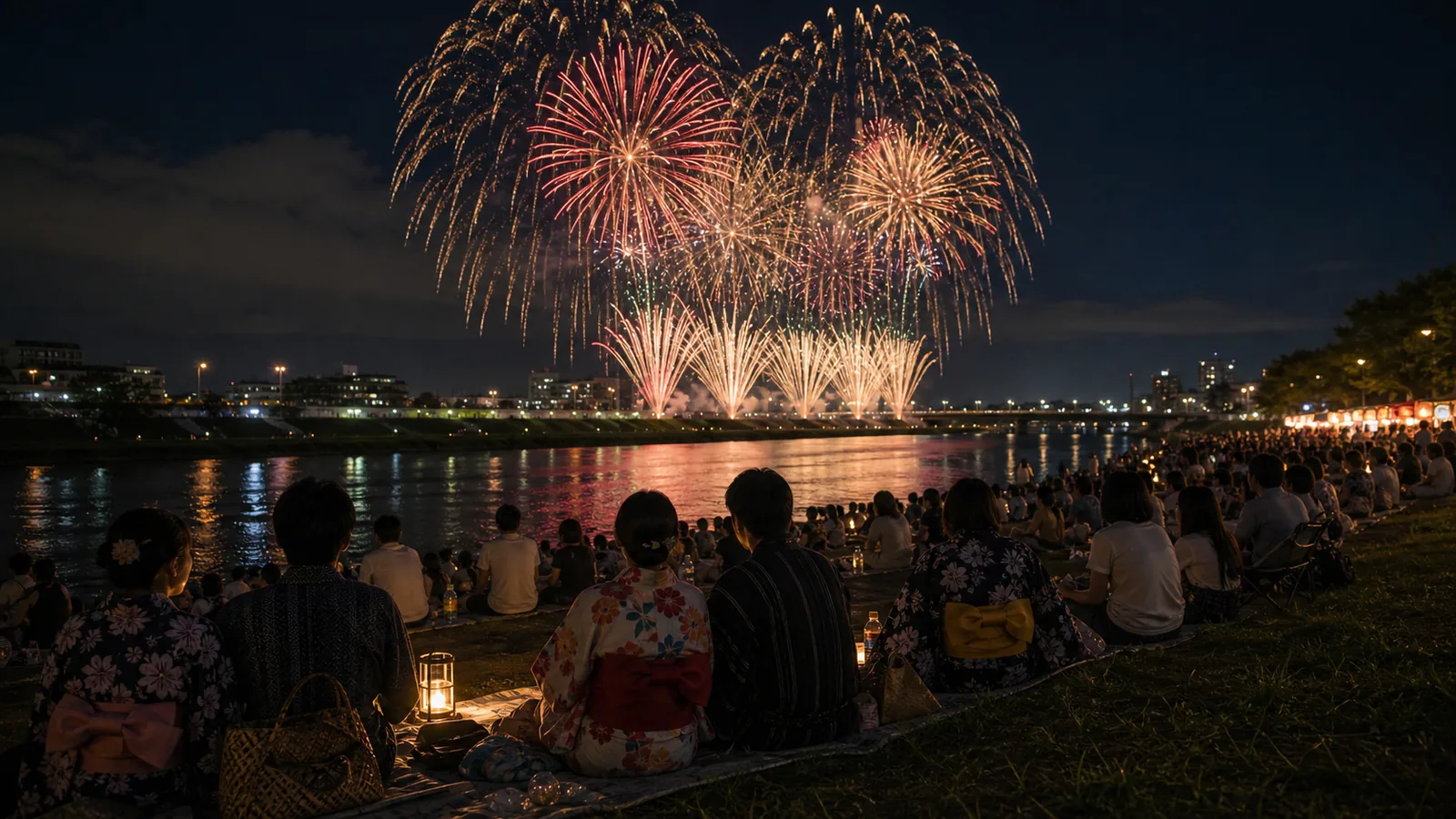
Seen Taiwan’s National Day fireworks? Japan’s "hanabi taikai" (花火大会) operates on an entirely different scale — 20,000 to 40,000 shells per show, choreographed to music as a kind of "fireworks art," with hundreds of thousands of spectators seated along the riverbanks. This guide covers Japan’s seven classic national-level firework festivals, turning your July or August trip into a "most beautiful night view in Japan" highlight.
Why are Japanese fireworks different?
Japanese fireworks carry a 400-year tradition, dating back to the Edo-era "Ryōgoku hanabi." Modern fireworks are essentially handcrafted art objects — perfectly symmetrical bursts, special shapes (hearts, stars, smiley faces), and synchronized musical choreography. Taiwan’s National Day show launches around 15,000 shells; a typical Japanese show fires 20,000 to 40,000, paired with live symphonic accompaniment.
The seven major national festivals
1. Tokyo Sumida River Fireworks — last Saturday of July
— 2026 date: Saturday, July 25 — Scale: 20,000 shells — Location: along the Sumida River (near Asakusa and Tokyo Skytree) — Best viewing: near Asakusa Sensoji, along the Sumida embankment, or from the Tokyo Skytree observation deck — Highlight: Tokyo’s oldest fireworks festival, dating back to 1733. Combined with the Skytree skyline, it is the most iconic Tokyo summer-night image. — Crowds: around 1 million people on site; you need to claim a spot by 1pm — Lodging: hotels in Asakusa and Oshiage triple in price; book 3 to 6 months ahead
2. Osaka PL Fireworks — August 1
— 2026 date: Sunday, August 1 — Scale: 12,000 shells, billed as the "best in the Orient" — Location: PL Kyodan headquarters, Tondabayashi, Osaka Prefecture — Highlight: smaller in volume but exquisite in execution, featuring the unique "PL fireworks ball" that emits seven distinct colors. Tondabayashi is suburban, offering wide hillside views. — Crowds: roughly 250,000 — Access: Kintetsu Minami-Osaka line from central Osaka (about 40 minutes) plus a walk to the viewing area
3. Niigata Nagaoka Matsuri Grand Fireworks — August 2-3
— 2026 date: Sunday and Monday, August 2-3 — Scale: 20,000 shells per night × 2 nights = 40,000 total, one of Japan’s three great fireworks festivals — Location: Shinano River banks, Nagaoka, Niigata Prefecture — Highlight: the "Shōsan-shakudama" (a 90 cm diameter mega-shell) bursts to 600 m across, nicknamed "the great flower of the sky." Nagaoka commemorates the Nagaoka air raid of August 1, 1945, giving the August 2 show a memorial tone. — Crowds: around 1 million — Viewing: large ticketed grandstands on both banks of the Shinano River (5,000-15,000 yen) — Access: about 2 hours by shinkansen from Tokyo; a day trip is impractical, so plan one night in Nagaoka
4. Akita Omagari National Fireworks Competition — last Saturday of August
— 2026 date: Saturday, August 29 — Scale: 17,000 shells — Location: Omono River banks, Daisen, Akita Prefecture — Highlight: Japan’s premier fireworks craftsmanship contest, with 27 top pyrotechnicians from across the country competing, every entry a showcase piece, all set to Japanese music. — Crowds: 750,000 — Lodging: Akita hotels book out 6 to 8 months in advance; local capacity is extremely limited — Access: 4 hours from Tokyo on the Akita Shinkansen "Komachi"
5. Ibaraki Tsuchiura National Fireworks Competition — early November
— 2026 date: Saturday, November 1 — Scale: 20,000 shells — Location: Tsuchiura, Ibaraki Prefecture — Highlight: the only national fireworks contest held in autumn. November nights are cold with thin cloud cover, and lower humidity makes the bursts visually sharper than in summer. — Crowds: 800,000 — Access: about 1.5 hours from Tokyo on the JR Joban line
6. Kyoto Uji River Fireworks — first Sunday of August
— 2026 date: Sunday, August 9 — Scale: 8,000 shells (smaller in volume but unbeatable in atmosphere) — Location: Uji River, Uji, Kyoto Prefecture — Highlight: silhouetted hills along the Uji River with the Byodoin Phoenix Hall in the background — Kyoto’s only large-scale fireworks event — Crowds: 250,000
7. Fukuoka Nishinihon Ohori Fireworks — early August
— 2026 date: Saturday, August 1 — Scale: 6,000 shells — Location: Ohori Park lake, Fukuoka City — Highlight: launched from the lake itself, doubling the spectacle with water reflections set against the city skyline. The most accessible fireworks festival inside central Fukuoka. — Crowds: 500,000
Practical tips for attending in yukata
1. Arrive by 10am. Viewing areas are cleared at the start of the day, and official spots open at 1pm. But to claim front-row positions, lay down a tarp (blue plastic mat or picnic blanket) between 8 and 10am.
2. Bring your own food and water. The "yatai" food stalls have endless lines on event day. Pack your own onigiri (rice balls), karaage (fried chicken), and water bottles (pet bottles).
3. Restroom strategy: scout nearby convenience stores or public restrooms in advance, then queue 20 minutes before the show. After the finale, the crowd surge makes restrooms impossible.
4. Returning home: shows finish between 19:30 and 21:00, and stations become packed beyond capacity, trains run full. Do not rush the station after the show — wait 30 minutes for the crowd to disperse.
5. Rain contingency: most festivals continue in light rain but reschedule for heavy rain. Check the official site and Twitter before leaving.
The harsh reality of bookings
— Asakusa hotels for the Sumida event: fill up 3 to 6 months ahead — Nagaoka hotels on Nagaoka fireworks days: fully booked 6 to 12 months ahead; consider central Niigata hotels with a 30-minute JR commute — Akita hotels on Omagari days: booked out 6 to 8 months ahead, with no easy long-distance commute option
Pro tip
If you are traveling in July or August, build at least one fireworks festival into your itinerary. The easiest combination is Tokyo Sumida (high tourist density but well-organized logistics) plus Kyoto Uji River (smaller scale, exceptional atmosphere). Worth a dedicated trip: Niigata Nagaoka and Akita Omagari, two of Japan’s three great fireworks shows. On your next summer visit, treat a hanabi night not as an add-on but as the centerpiece of the trip — once you see a Japanese fireworks show, Taiwan’s National Day display will feel like a small-scale event by comparison.
Frequently Asked Questions
When are fireworks festivals in Japan?
Most large festivals are in July and August, but dates can change and weather can postpone or cancel events. Check official listings before going.
Do I need paid seats for a hanabi festival?
Not always. Many events have free areas, but paid seats can reduce waiting time and make entrances, exits, and restrooms easier.
How early should I arrive?
For major events, avoid arriving at the last minute. Spend the afternoon nearby, then move slowly toward the viewing area.
How should I leave after the fireworks?
Check last trains and crowd controls first. Waiting, walking to another station, or staying near the venue can be much more comfortable.