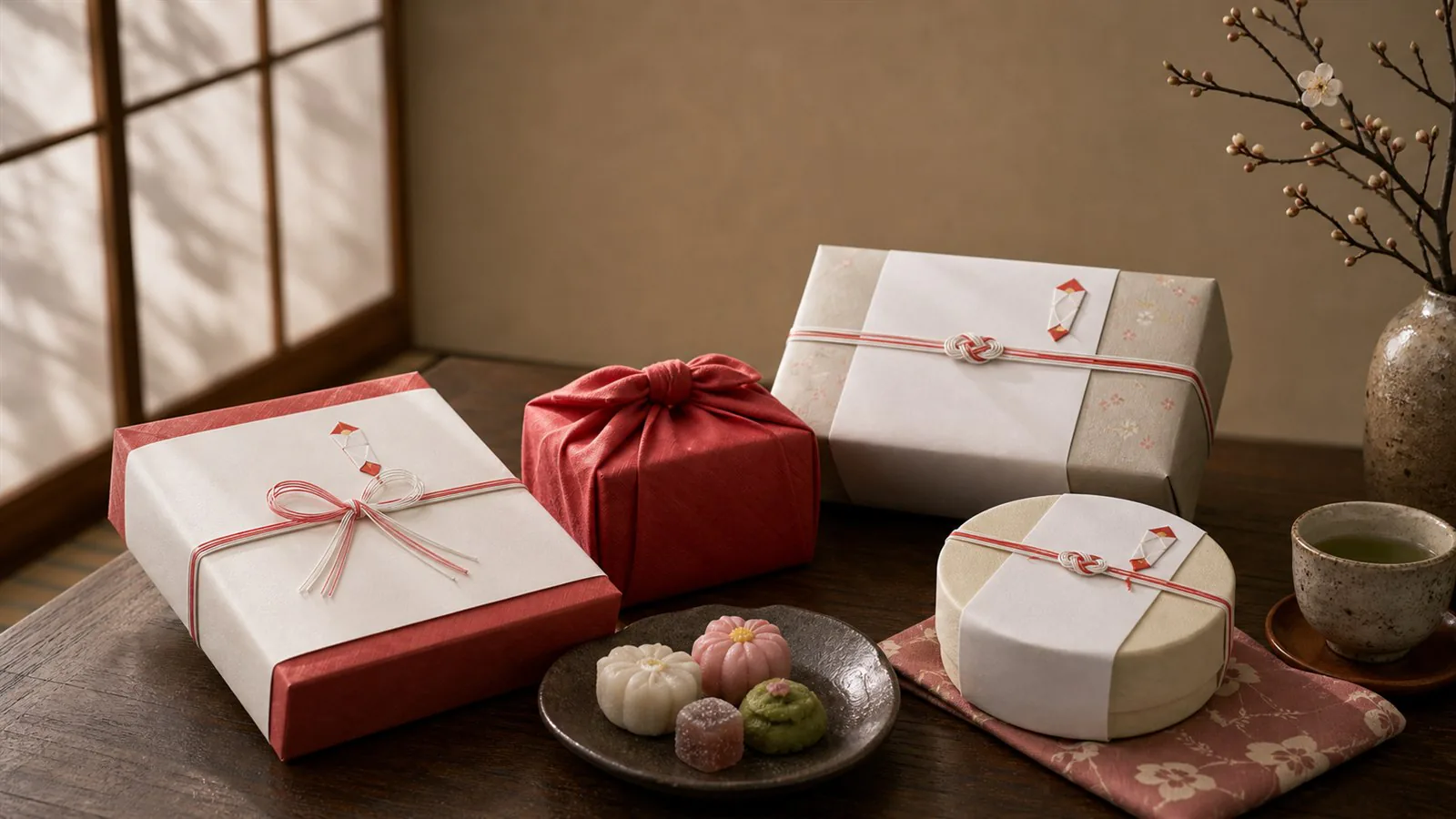
Many people assume Japanese gift-giving is just "buy something, wrap it, hand it over." In reality, gift-giving in Japan is a precise social ritual — what you give, when you give it, how it is wrapped, and how much you spend all follow specific rules. Get it wrong, and the recipient will notice.
The three main gift categories
1. "Omiyage" (お土産) — souvenirs brought back from travel. When Japanese employees take a business trip or vacation, they bring back a small gift for every coworker in the office, typically a local specialty (Kyoto yatsuhashi, Hokkaido shiroi koibito, Tokyo banana). A typical budget is 500-2,000 yen for a box of individually wrapped sweets. This is the social adhesive of office life — coworkers covered for you while you were away, so the snack box is a thank-you.
2. "Ochuugen" (お中元) and "oseibo" (お歳暮) — seasonal gifts. Ochuugen runs roughly July 1-15, oseibo December 1-25. Sent to people who have looked after you long-term — managers, clients, teachers, in-laws. Budget runs 3,000-10,000 yen. Common items: beer gift sets, canned ham assortments, cooking oil sets, wagashi boxes.
3. "Uchiiwai" (内祝い) — return gifts. After receiving congratulatory gifts for marriage, childbirth, or moving, you owe a return gift to express thanks. The budget is roughly one-third to one-half of the original gift, and it must be returned within three months. The packaging carries a red and white "noshi" label inscribed with "内祝."
Office rules for omiyage
You buy a box of 12 individually wrapped sweets — but the office has 15 people, now what? The rule is "one per person, including coworkers from other departments you barely know." Japanese travelers therefore choose boxes of 20 or 30 individual pieces. Do not buy a whole cake that needs cutting — nobody wants to be the cake-slicing person. Do not buy anything that needs refrigeration — office fridges fill up fast. The ideal omiyage is room-temperature, individually wrapped, and compact.
Why do Kyoto’s yatsuhashi, Tokyo banana, Hokkaido’s "shiroi koibito," and Fukuoka’s budget mentaiko remain bestsellers? Because they satisfy all three conditions: individually wrapped, shelf-stable, single-serving.
The hierarchy of wrapping
Japanese gift wrapping reaches world-class complexity. Paper bag tiers ascend from convenience store bag to department store bag to specialty boutique bag. Wrapping paper plus ribbon: when paying at a department store, the cashier asks "gozotouyou desu ka?" ("Is this a gift?"). Answering "hai" yields free professional wrapping. The "noshi" label: required only for formal gifts; it carries the giver’s name.
Forbidden items
- Sharp objects (scissors, knives) — they imply "cutting a relationship" and are forbidden for weddings and housewarmings.
- Combs ("kushi") — homophonous with "ku-shi" (suffering and death), inauspicious.
- White handkerchiefs — reserved for funerals.
- Bouquets of 4 or 9 flowers — those numbers sound like "death" and "suffering" in Japanese.
- Green tea — used as funeral return gifts only, never for living friends.
Safe choices
When visiting a Japanese home for the first time or meeting a partner’s family, prepare a "temiyage" (手土産, visitation gift) in the 1,500-3,000 yen range. Safe picks: local wagashi, an imported cookie set, Taiwanese pineapple cakes (recipients enjoy the "exotic" touch). On arrival, present the gift with both hands, bow slightly, and say "tsumaranai mono desu ga" ("This is just a small thing"). Literally meaning "boring," the phrase is a politeness formula that conveys "compared with your hospitality, this is trivial."
How to react when receiving a gift
First, accept with both hands and a bow. Second, do not open it on the spot (a Western habit) — Japanese hosts wait until the guest has left, or ask politely "akete mo ii desu ka?" ("May I open it?"). Third, return the favor with an uchiiwai within three months, otherwise the giver will read it as "you did not value the gift."
Practical use for travelers
When returning home, what do you give to Japanese friends? Pineapple cakes, sun cakes, individually wrapped candies, Taiwanese tea (oolong is the favorite; green tea is a no), Taiwan 7-Eleven limited snacks. Avoid large bottles of alcohol (hard to carry), avoid large craft pieces (small Japanese homes have no space), avoid a single high-value item (the recipient will agonize over how to return the favor proportionally).
Pro tip: omiyage culture is a traveler’s secret weapon
If a Japanese family hosted you, a ryokan went out of its way for you, or a stranger helped you in a major way, mail a regional specialty back to them after returning home, with a short thank-you note. They will remember you for life. This is far more effective than adding them on social media or promising to meet again — Japanese culture places enormous weight on reciprocal obligation ("giri").
On your next visit, look closely at how convenience stores and department store boutiques arrange their souvenir displays — the meticulous, military-precise rows are the visible expression of this entire culture.
Frequently Asked Questions
Why is gift giving in Japan so detailed?
Gifts manage relationships, seasonal greetings, and obligations. Occasion, wrapping, and balance often matter more than price.
What is omiyage?
Omiyage is a small gift brought back from a trip, often individually wrapped and easy to share at work or with friends.
What are ochuugen and uchiiwai?
Ochuugen is a summer greeting gift. Uchiiwai began as sharing family good news and is now often a return gift for congratulations.
What should travelers avoid when giving gifts in Japan?
Avoid gifts that are too expensive, too personal, or hard to reciprocate. Ceremonial occasions have extra rules.