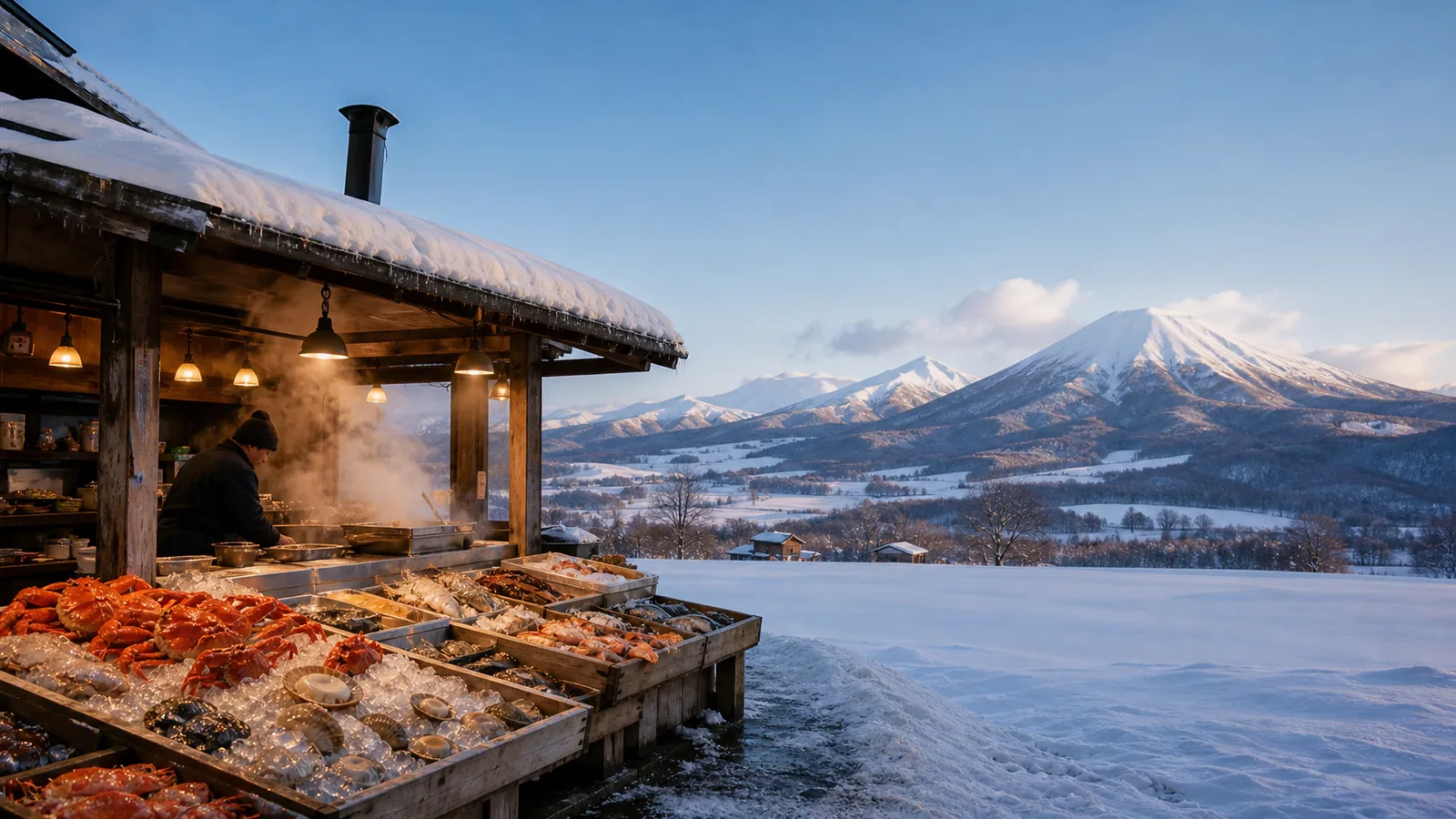
Hokkaido does not feel like the rest of Japan. Even Japanese travelers visiting Hokkaido feel as if they have left the country — the climate, food, streetscapes, and population density are nothing like Honshu. If you have already visited Tokyo and Kyoto and concluded "this is what Japan is," Hokkaido will redefine the country for you.
Start with geography — why Hokkaido stands apart The island spans 83,424 square kilometers, larger than Taiwan and South Korea combined, with a population of only 5.41 million (a quarter of Taiwan’s), making it the least densely populated region in Japan. At 41-45 degrees north, it sits on the same latitude as Heilongjiang and Vladivostok.
The climate is subarctic — cool summers (averaging 22°C in July and August, refreshingly mild while Honshu swelters), no rainy season (June pours on Honshu but barely touches Hokkaido), and brutal winters (averaging -5°C in January, with inland regions down to -20°C). Snowfall is staggering — Sapporo accumulates 5-6 meters over a single winter.
Why did Hokkaido join Japan so late? Because Hokkaido was not originally Japan — it was the homeland of the Ainu people. In 1869 the new Meiji government renamed "Ezo-chi" to "Hokkaido" and formally annexed it, just 156 years ago. That is why the buildings, streets, and farms here carry a Western flavor: the government adopted American frontier development models at the time. Sapporo’s grid streets, the Tokachi farms, and dairy culture were all established in this period.
Winter itineraries December through March is snow season.
Sapporo: the Snow Festival (early February, ice sculptures in Odori Park), the Shiroi Koibito Park, the Otaru Canal (intensely romantic at night), the city night views. From New Chitose Airport, the JR Rapid reaches Sapporo in 36 minutes.
Niseko: Asia’s top ski resort. Its powder snow ("powder snow," パウダースノー) is treated as sacred by serious skiers. Australians decamp here for two or three months every winter, often outnumbering Japanese on the main streets. About 3 hours by bus from New Chitose Airport.
Furano / Biei: snow scenery from the train. Summer is the main season — the lavender fields bloom in July.
Hakodate: Hakodate-yama at night (one of the world’s three great night views), and snow-covered red-brick warehouses in winter. About 3 hours 40 minutes by shinkansen from Sapporo.
Summer itineraries June through August is the golden season. While Honshu suffers through 35°C heatwaves, Hokkaido cruises at 25°C, and Japanese travelers flood north to escape the heat.
Furano: mid- to late-July sees lavender at full bloom. Farm Tomita and Shikisai-no-Oka turn the hills purple, the classic Japan postcard image.
Biei: the Blue Pond ("Aoi Ike"), Shirahige Falls, and rolling hills that feel European.
Shiretoko: a UNESCO World Heritage site with wild bears, deer, and seals. Boat tours along Cape Shiretoko reveal cliff coastlines and Japan’s most untouched wilderness.
Lake Mashu / Lake Kussharo / Lake Akan: caldera lakes ranked in the top three nationwide for water clarity.
Why Hokkaido food is extraordinary Seafood: surrounded by ocean and cold currents, the quality is exceptional. Sapporo’s Nijo Market and Hakodate Morning Market are essential. Salmon and ikura bowls, sea urchin (uni), hairy crab (kegani), king crab (tarabagani), scallops (hotate).
Dairy: Hokkaido milk leads Japan (over 4.0% milk fat). Ice cream, cheese, butter, Shiroi Koibito biscuits, Royce chocolate — all Hokkaido signatures.
Ramen: Sapporo miso ramen, Asahikawa shoyu ramen, Hakodate shio ramen — three distinct schools. Eating hot ramen in winter is unmatched.
Jingisukan (Genghis Khan barbecue): a Hokkaido specialty grilling lamb and vegetables on a domed cast-iron plate.
Soup curry ("scoop curry"): originating in Sapporo. The curry becomes a soup served with large vegetables and a chicken leg — completely different from Indian curry.
What to buy as omiyage Shiroi Koibito (Ishiya Confectionery), Royce nama-chocolate, Rokkatei hanazumi, Hokkaido milk, lavender oil, dried seafood. New Chitose Airport hosts a complete souvenir hall, so there is no need to shop in the city.
Transportation tips Hokkaido is vast, so renting a car is the most practical option. Sapporo to Furano is 2.5 hours; Sapporo to Hakodate is 4.5 hours. If you are not confident driving in snow, strongly consider trains — the JR Hokkaido Pass costs 25,000 yen for 7 days. Fly into New Chitose, out of Hakodate or Sapporo.
How many days is enough Winter: 5-7 days (Sapporo, Niseko, Otaru). Summer: 7-10 days (Sapporo, Furano, Biei, Shiretoko). Anything under 5 days is not recommended — transportation alone eats too much of the schedule.
On your next Japan trip, if you have already done Tokyo and Kyoto, Hokkaido should be the natural second round. Summer and winter are radically different Japans, both worth a separate visit.