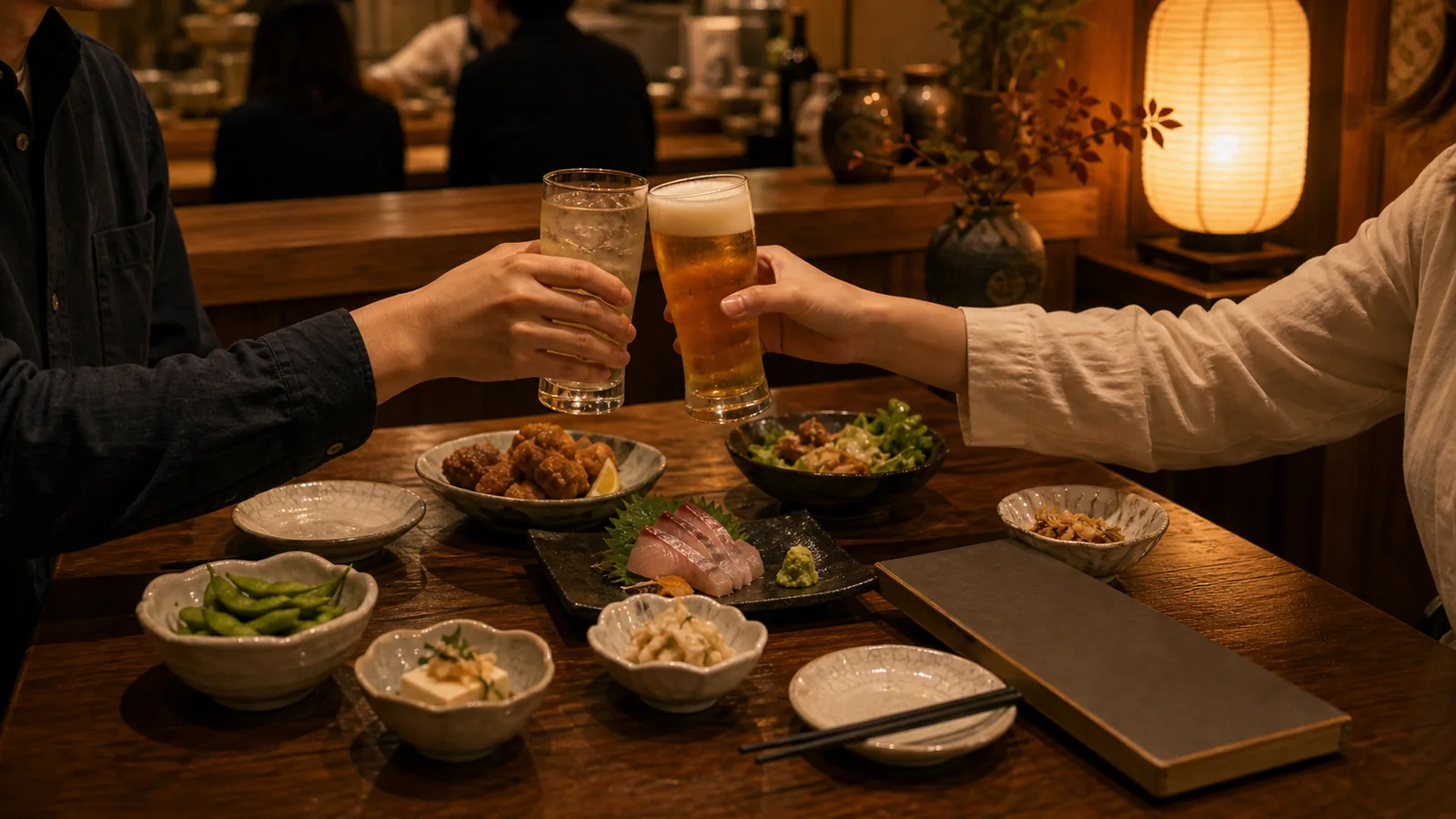
Your first time in a Japanese izakaya: you sit down, and a server places a small dish in front of you — chilled tofu, edamame, or a small plate of pickles. You did not order it. When the bill arrives, a 300-500 yen "otoshi" charge appears. The shop is not scamming you. This is one of the core hidden rules of Japanese izakaya, and like "nomihoudai" (all-you-can-drink) and the checkout process, it is one of the most common trip-ups for foreign visitors.
What is "otoshi"? Do you have to pay? "Otoshi" (お通し) is the small dish automatically served when you sit down — effectively a cover charge plus appetizer — costing 300-700 yen per person, or 800-1,500 yen at upscale Tokyo establishments. You cannot refuse it or say "I do not want it"; sitting down means you are charged. Most izakaya operate on a "low entry, high drink margin" model, so the otoshi subsidizes overhead. If you plan to drink two or three rounds, it effectively comes free; if you only want one drink and leave, it genuinely is poor value.
The "nomihoudai" trap: read the time and category fine print "Nomihoudai" (のみほうだい) means "unlimited drinks," typically 1,500-3,000 yen flat for 90-120 minutes. Three traps: First, there is a time limit (last order is usually 30 minutes before the end). Second, drink categories vary in tier — cheap versions may include only beer, shochu, and cocktails, with no sake or whisky. Third, minimum participation rules — most places require "everyone at the table joins nomihoudai," so a table of four cannot have only two opting in. Confirm before booking.
Ordering: wave hand or press the table button? Traditional izakaya require you to call out "sumimasen!" ("Excuse me!") to summon staff. Do not be shy — failing to get the server’s attention is the advanced traveler’s pain point. Modern izakaya feature a "yobidashi button" (呼び出しボタン, call button) or a tablet ordering system. Chains like Torikizoku and Watami have largely gone tablet-based.
Toasting: hold your glass lower than the senior person’s When drinking with Japanese people, watch the toast: the junior person’s glass rim should sit slightly lower than the senior person’s. This is a small but precise sign of respect — with a boss or elder, your glass goes visibly lower; with friends and peers, glasses level. The Japanese word "kanpai!" (乾杯) does not mean "bottoms up" as the Chinese homograph does — it simply means "clink and celebrate," with no obligation to finish the drink.
Pouring for others: support the bottom with your left hand If the table has a large bottle of beer or sake, pouring for others is basic etiquette (and they will pour for you). Pour by holding the bottle with your right hand and lightly supporting the base with your left, watching the other person’s glass as you fill it. Do not pour your own drink — wait and observe; when someone notices your empty glass, they will refill it. When someone pours for you, lift your glass slightly to receive it (do not leave it sitting on the table).
Asking for a refill — "okawari" Finished your beer and want another? Simply call out "sumimasen, nama wo mou hitotsu" ("another draft beer please"). Or even simpler: "okawari" (お代わり, refill). The same applies to sake and shochu.
Checkout: leave your seat and walk to the cashier Most izakaya do not bill at the table. When you finish, say "okaikei onegaishimasu" ("please bring the bill"). The server hands you a slip or directs you to bring your table number to the cashier at the entrance. Many places do not accept cash or credit cards at the table — have cash or an IC card (SUICA, ICOCA, etc.) ready when you reach the front. Tipping: Japan has no tipping culture — leaving money behind will confuse the staff, who may chase after you to return it.
The "ochazuke" wrap-up tradition Before the gathering ends, some diners order "ochazuke" (tea-rice) or "ramen" as the "shime" ("closer"). This is a cultural habit aimed at settling the stomach. Note: many Japanese people will say "sake no ato wa tansuikabutsu" ("carbs after alcohol") — not necessarily healthy, but a classic ritual.
Pro tip: Torikizoku and Kushikatsu Tanaka are beginner-friendly chains If you are new to izakaya, two chain recommendations: Torikizoku (uniform pricing across the menu, currently 360 yen per item, tablet ordering, simple menu) and Kushikatsu Tanaka (deep-fried skewers focus, tablet ordering, lively atmosphere). Transparent pricing, tablet ordering, cheap or free otoshi, and low pressure overall. Get comfortable with the workflow at one of these, and you will have the confidence to try a small backstreet izakaya next time.
Frequently Asked Questions
What is otoshi at an izakaya?
Otoshi is a small dish served after seating, often treated as a cover charge or appetizer. Whether it can be refused depends on the shop, so ask before sitting if budget matters.
Is nomihodai worth it for tourists?
It works if everyone drinks enough. If you only want a few drinks, ordering individually may be better. Check time, last order, and included drinks first.
How do I call staff at an izakaya?
Use the tablet or QR code if provided. Press the call button if there is one. In smaller shops, say “sumimasen” to call staff.
Should I tip at Japanese izakaya?
No. Tips are not expected. Cover charges, service charges, or otoshi are included on the bill when they apply.