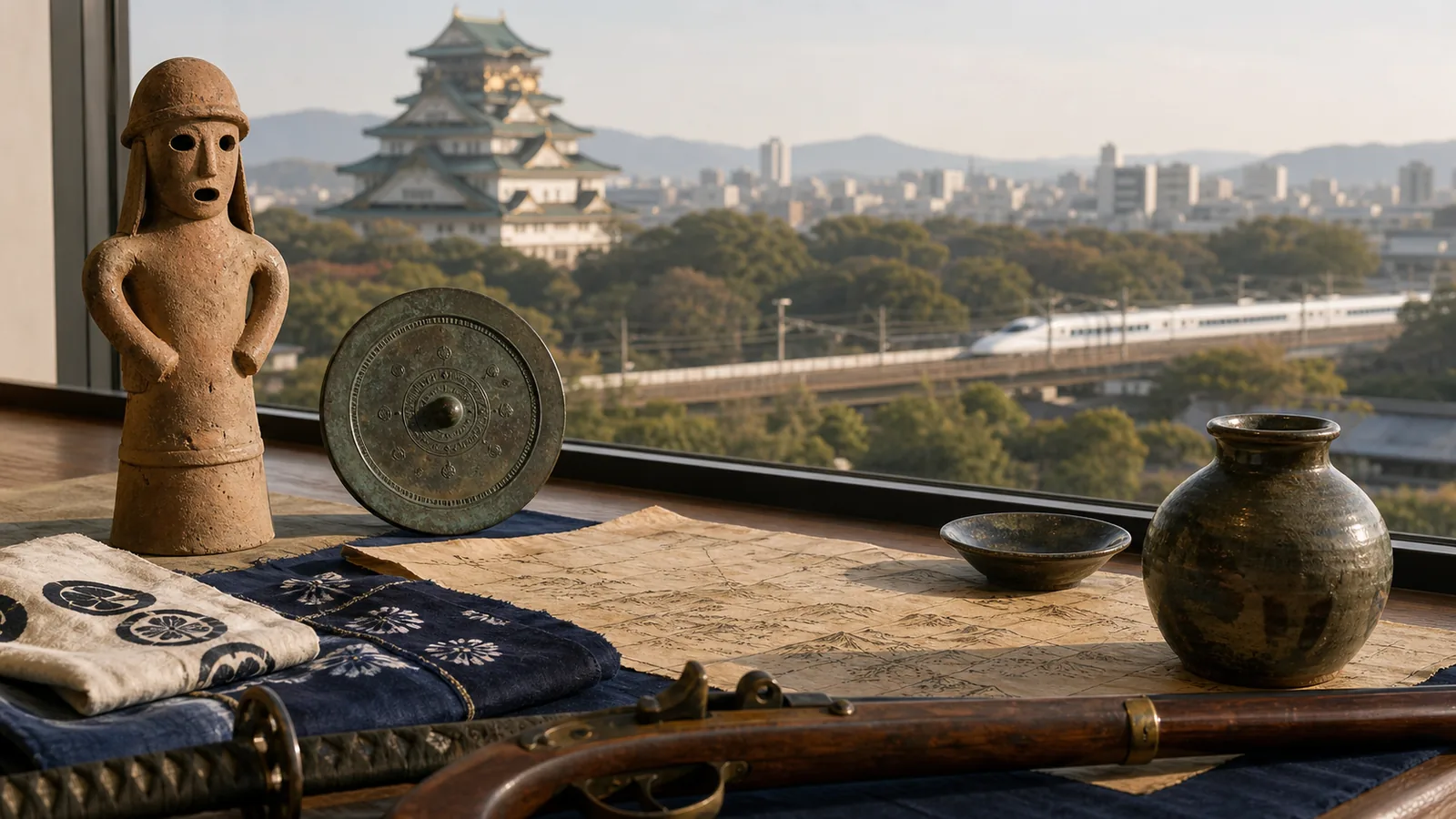
Japanese history sounds long, but you only need to remember 8 eras to understand every taiga drama, the background of every tourist site, and what Japanese people mean when they reference "the Edo period" or "the Sengoku period."
This is a minimalist cheat sheet of Japanese history for travelers. Forget memorizing dates — just remember each era’s keywords and where you can still see them today.
Stage 1: Kofun and Asuka (3rd-7th century) Keywords: arrival of Buddhism, the Yamato court, Nara starts looking like a state.
In the 3rd century, Yamatai’s Queen Himiko ruled (every modern Japanese person knows the name, though archaeologists still argue over the actual location). Buddhism arrived from Baekje in 538 (memorized by every student). In 604, Prince Shotoku issued the Seventeen-Article Constitution, laying the prototype for Japanese state governance. Horyuji (the world’s oldest wooden temple complex, a World Heritage Site) survives from Prince Shotoku’s era.
Where to see it today: Horyuji in Nara (built 607), the Nintoku Imperial Tomb in Sakai, Osaka (5th century, the world’s largest mausoleum at 486 meters long, a World Heritage Site).
Stage 2: Nara (710-794) Keywords: Ritsuryo system, envoys to Tang China, the Great Buddha of Todaiji.
In 710, the capital moved to Heijokyo (modern Nara), modeled on Tang dynasty Chang’an with a grid layout, lasting 74 years as the capital. The Kentoshi missions (630-894) sent 18 delegations to China to study, importing Buddhism, kanji, bureaucracy, and urban planning. The Todaiji Great Buddha (completed 752, a 15-meter bronze) was the Nara period’s largest project, consuming roughly half the wealth of Japan at the time.
Where to see it today: Todaiji, Kasuga Taisha, and the Heijo Palace site in Nara (all World Heritage Sites).
Stage 3: Heian (794-1185) Keywords: Kyoto as capital, aristocratic culture, Tale of Genji, birth of kana script.
In 794, the capital moved to Heian-kyo (modern Kyoto), modeled on Tang Luoyang and Chang’an. 400 years as the capital, with culture blossoming.
Aristocrats (led by the Fujiwara) dominated politics while emperors held only nominal power. Murasaki Shikibu wrote The Tale of Genji in 1008 (the world’s earliest long-form novel), and Sei Shonagon wrote The Pillow Book. Kana script (hiragana and katakana) evolved out of Chinese characters, giving Japanese its own writing system for the first time.
Where to see it today: the Phoenix Hall of Byodoin in Kyoto (the building printed on the 10-yen coin), Byodoin in Uji, the Kyoto Imperial Palace.
Stage 4: Kamakura (1185-1333) Keywords: rise of the samurai, Minamoto no Yoritomo’s shogunate, the Great Buddha of Kamakura.
After the Genpei War (1180-1185), Minamoto no Yoritomo prevailed and in 1192 established the Kamakura shogunate at Kamakura (modern Kanagawa Prefecture), Japan’s first samurai government. From here on, the "shogun" held actual power, with the emperor reduced to ceremonial status. The samurai spirit and Zen Buddhism (imported from Song China) took root in this era.
The Mongol invasions (1274 and 1281, the "Genko"): Kublai Khan twice sent armies of 100,000-150,000 to attack Kyushu, and twice typhoons annihilated the fleets. From then on, "kamikaze" (the divine wind) became a sacred concept in the Japanese psyche (later twisted into the kamikaze pilots of World War II).
Where to see it today: the Kamakura Great Buddha (1252), Tsurugaoka Hachimangu, Kenchoji (Japan’s oldest Zen training temple).
Stage 5: Muromachi (1336-1573) Keywords: Kyoto’s Golden Pavilion and Silver Pavilion, birth of tea ceremony, Sengoku period.
The Ashikaga family established the Muromachi shogunate in Kyoto, moving the samurai government back to the capital (next to the emperor). Kinkakuji (1397, built by Ashikaga Yoshimitsu), Ginkakuji (1482, built by Ashikaga Yoshimasa), the tea ceremony (foundations laid by Sen no Rikyu in this era), Noh theatre (founded by Zeami), and ink painting (Sesshu introducing Chinese styles) all emerged here.
The second half collapsed into chaos: the Onin War (1467-1477) wrecked Kyoto for 11 years, ushering in the Sengoku period — 100 years of warlords across the country fighting each other.
Where to see it today: Kinkakuji and Ginkakuji in Kyoto, the cradle of the tea ceremony (various Kyoto tea rooms).
Stage 6: Azuchi-Momoyama (1573-1603) Keywords: Oda Nobunaga, Toyotomi Hideyoshi, and Tokugawa Ieyasu — the three unifiers of the Sengoku.
In just 30 years, the three unifiers brought Japan together:
- Oda Nobunaga (1534-1582): militarily powerful, destroyed Mt. Hiei, suppressed the Ikko-ikki, crushed religious resistance. Killed by his retainer Akechi Mitsuhide in the Honnoji Incident of 1582.
- Toyotomi Hideyoshi (1537-1598): inherited Nobunaga’s campaign and completed national unification. Launched failed Korean invasions (1592 and 1597, the Bunroku-Keicho War). Built Osaka Castle.
- Tokugawa Ieyasu (1543-1616): won the Battle of Sekigahara (1600) and opened the Edo shogunate in 1603.
Where to see it today: Osaka Castle (built by Hideyoshi, rebuilt by the Tokugawa), the ruins of Azuchi Castle (Nobunaga’s seat), the site of Jurakudai in Kyoto.
Stage 7: Edo (1603-1868) Keywords: Tokugawa Ieyasu, 265 years of peace, sakoku isolation, Edo = modern Tokyo.
Tokugawa Ieyasu opened the Edo shogunate in 1603, with 15 successive shoguns spanning 265 years. No major wars (except at the very end), earning it the title of Japan’s "longest peace."
Sakoku isolation (1641-1853): trade restricted to China, Korea, and the Dutch (via Dejima); all other European nations banned. The samurai class became rigid, while chonin culture (merchants and townspeople) flourished — ukiyo-e (Hokusai, Hiroshige), kabuki, haiku (Matsuo Basho).
The Black Ships arrived in 1853 (Commodore Perry’s American fleet), forcing Japan to open, and the shogunate lost legitimacy.
Where to see it today: the Edo-Tokyo Museum, the area around Asakusa Sensoji, Kawagoe (Little Edo), Nijo Castle in Kyoto (the Tokugawa Kyoto stronghold).
Stage 8: Meiji to modern (1868-present) Keywords: Meiji Restoration, modernization, World War II, postwar revival, Reiwa.
The Meiji Restoration of 1868: overthrew the shogunate, restored imperial rule, moved the capital from Kyoto to Tokyo. Within 30 years, Japan transformed from a feudal state to an industrial power, winning the First Sino-Japanese War (1894-1895) and the Russo-Japanese War (1904-1905), joining the ranks of the great powers.
1937-1945: invasion of China and the Pacific War. August 6, 1945 Hiroshima atomic bomb, August 9 Nagasaki atomic bomb, August 15 the Gyokuon-hoso (Emperor Showa’s broadcast announcing surrender). The postwar GHQ occupation lasted 7 years (1945-1952), bringing the pacifist constitution and the economic miracle.
1964 Tokyo Olympics and 1970 Osaka Expo: Japan returned to the international stage. The Heisei era began in 1989 (31 years, the bubble economy and the lost decades). 2019 marked the start of the Reiwa era (the current era name, drawn from the Manyoshu).
Where to see it today: the Edo-Tokyo Museum, Hiroshima Peace Memorial Park, Nagasaki Peace Park, Yasukuni Shrine at Kudanzaka (a politically sensitive site).
The 8-era cheat sheet Kofun and Asuka (3rd-7th c.) → Nara (710-794) → Heian (794-1185) → Kamakura (1185-1333) → Muromachi (1336-1573) → Azuchi-Momoyama (1573-1603) → Edo (1603-1868) → Meiji to now (1868- ).
The next time you watch a taiga drama, read a shrine information board, or walk through Arashiyama in Kyoto, map the scene onto one of these 8 eras and you will instantly know where you stand in history. Japanese history is not intimidating. Eight keywords are enough for a lifetime.