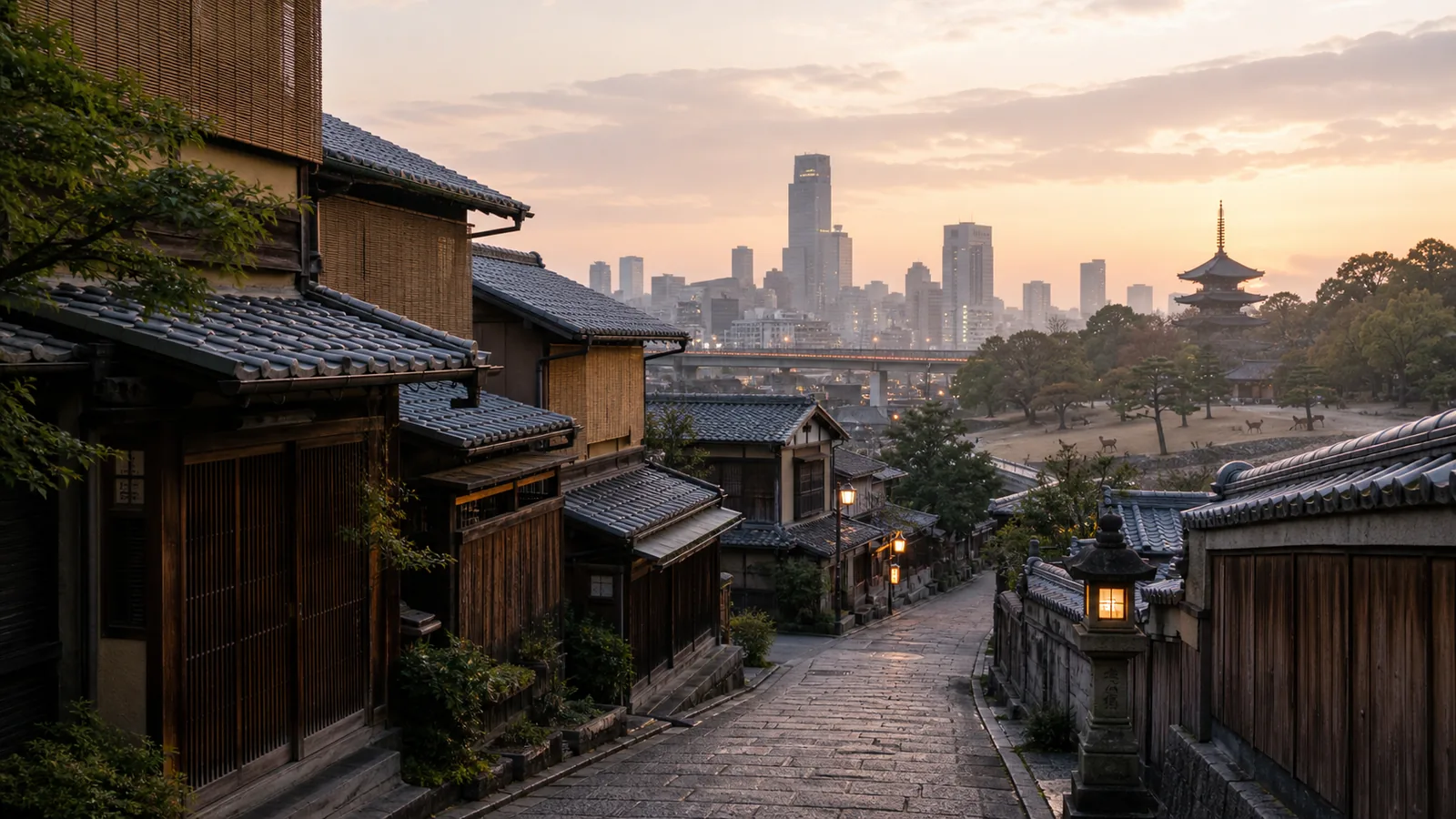
Many first-time Japan visitors pick the standard "Tokyo + Kyoto + Osaka" combo, but any real Kansai fan will tell you 7 days dedicated entirely to Kansai is still not enough. Kyoto, Osaka, Nara, Kobe, Himeji, Wakayama, and Shiga each deserve 2-3 days of deep exploration. This guide shows you how to cover Kansai’s essentials in 7 days with maximum efficiency.
Start with Kansai’s geography Kansai consists of 6 prefectures: Osaka, Kyoto, Hyogo, Nara, Wakayama, and Shiga, plus Mie (sometimes counted as Kansai, sometimes as Chubu).
Geographic character: Osaka Bay extends inland, with Kyoto ringed by mountains (a basin), Nara even deeper inland (another mountain basin), Kobe facing the Seto Inland Sea, Wakayama at the southern coast, and Shiga home to Lake Biwa (Japan’s largest lake).
Travel times: Kyoto to Osaka 28 minutes on the JR Special Rapid for 410 yen, Osaka to Nara 40 minutes on Kintetsu, Osaka to Kobe 25 minutes, Osaka to Himeji 60 minutes. Everything is within an hour, effectively making all of Kansai one large metropolitan area.
Day 1: Arrive in Osaka, explore Namba and Dotonbori Land at Kansai Airport, catch the Nankai Rapi:t for 40 minutes to Namba. Spend the afternoon walking Shinsaibashi and Dotonbori, and in the evening eat takoyaki (Tsukiji Gindako or local shops like Takoya Dotonbori Kukuru), okonomiyaki (Fugetsu, Chibo), and kushikatsu (Daruma, Shinsekai).
Evening highlight: take a photo in front of the Glico Sign in Dotonbori — the running man has stood there since 1935, 90 years and counting.
Day 2: Osaka Castle or USJ, pick one Option A: Osaka Castle + Kuromon Market + Tsutenkaku. Toyotomi Hideyoshi built Osaka Castle in 1583, the Tokugawa rebuilt it in 1620, and the current keep is a 1931 concrete reconstruction with a rich museum inside. Kuromon Market is "Osaka’s kitchen," where you eat fresh seafood on the spot. Tsutenkaku is Osaka’s Eiffel Tower, dripping with Showa-era nostalgia.
Option B: a full day at Universal Studios Japan. The Super Nintendo World area opened in 2021, and Minions, Harry Potter, and Jurassic Park zones are all on-site. Arrive at opening; popular rides routinely have 90-180 minute waits.
Day 3: Nara day trip Take the Kintetsu Nara line from Osaka Kintetsu Namba for 40 minutes to Kintetsu Nara.
Morning: Nara Park + Kasuga Taisha + the deer herd (around 1,200 wild deer coexist with people across the city, but deer charge the moment you pull out shika senbei — keep kids alert).
Midday: Todaiji (World Heritage Site). The Great Buddha Hall is one of the world’s largest wooden buildings, housing a 15-meter bronze Great Buddha (completed 752, the current statue recast in 1185).
Afternoon: Kofukuji + the five-story pagoda (built when the capital moved to Nara in 710; the pagoda is the second tallest in Japan).
Evening: return to Osaka.
Day 4: Kyoto — Arashiyama, Kinkakuji, Nijo Castle Catch the JR Special Rapid early from Osaka to Kyoto Station in 28 minutes. Start early to avoid the crowds.
Morning: Arashiyama (Togetsukyo Bridge, bamboo grove path, Tenryuji). Arrive before 8am to dodge the masses. The bamboo grove is a single path, and morning light is the most beautiful.
Midday: a casual burger or teishoku in central Kyoto, or yudofu (Arashiyama obanzai) in the Arashiyama area.
Afternoon: Kinkakuji (the Muromachi-era retreat of Shogun Ashikaga Yoshimitsu, built 1397, rebuilt in 1955 after a 1950 arson) and Nijo Castle (built by Tokugawa Ieyasu in 1603, where the restoration of imperial rule was announced when the Meiji government took over in 1868).
Evening: return to Osaka, or stay overnight in Kyoto to save travel time.
Day 5: Kyoto — Fushimi Inari, Kiyomizu-dera, Gion We recommend staying in Kyoto (around Kyoto Station or Shijo Kawaramachi).
Early morning: Fushimi Inari Taisha (you must arrive by 6-7am). The Senbon Torii accumulates more than 10,000 vermillion gates collected over centuries. Inari worship arrived in Japan in the 7th century. The full loop up the mountain takes 2 hours.
Midday: Ramen Koji next to Kyoto Station.
Afternoon: Kiyomizu-dera + Ninenzaka + Sannenzaka (Kyoto’s oldest stone-paved streets, Tokugawa-era merchant lanes now lined with 200+ craft shops, wagashi stores, and matcha ice shops). Kiyomizu-dera (founded 778; the existing main hall was rebuilt in 1633). The Japanese proverb "to jump off the Kiyomizu stage" comes from its 13-meter drop.
Evening: Gion and Hanami-koji. You may see geisha walking at dusk, but photographing without permission is forbidden (Gion legislated against geisha photography in 2020).
Day 6: Kobe or Himeji, pick one Option A: Himeji Castle. 50 minutes by shinkansen from Kyoto. A World Heritage Site, preserving its original form for 400 years. Japan’s largest surviving castle keep (7 stories, 92 meters tall), nicknamed "the White Heron Castle" for its pure white walls. Return to Osaka in the afternoon.
Option B: Kobe. 25 minutes from Osaka. Chinatown + Kitano Ijinkan + Kobe Port night view + Kobe beef. Kobe became a treaty port with the Meiji opening in 1868, leaving a wealth of Western architecture, comparable to Yokohama.
Day 7: choose your own adventure Option A: Lake Biwa and Shiga — Otsu and Mt. Hiei Enryakuji (a World Heritage Site, founded by Saicho in the 9th century, a Japanese Buddhist heartland; Oda Nobunaga’s 1571 burning of the mountain reshaped Japanese history).
Option B: Wakayama Kumano — the Kumano Kodo (a World Heritage Site, a thousand-year pilgrimage trail).
Option C: Uji — a small town south of Kyoto with the Byodoin Phoenix Hall (the building on the 10-yen coin) and the origin of Uji matcha.
Option D: return to Osaka for shopping and Kansai Airport duty-free — Shinsaibashi Daimaru, Hankyu, Abeno Harukas (Japan’s tallest building at 300 meters).
Transport recommendations For 7 days in Kansai, buy an ICOCA plus a JR Kansai Wide Area Pass (12,000 yen for 5 days, including the shinkansen to Himeji).
Lodging recommendations 3 nights in Osaka (Namba or Umeda) plus 3 nights in Kyoto (Kyoto Station or Shijo). Switching cities saves transit time — do not commute daily from Osaka to Kyoto; the 1.5-hour round trip eats an entire day.
When planning your next Kansai trip, do not split time evenly. Kyoto needs at least 3 days (too many temples to see), Osaka 2 days (food, shopping, USJ), Nara half a day (morning to evening back to Osaka), and Kobe or Himeji 1 day (whichever you choose). Leave the last day as flexible buffer — this minimizes waste.