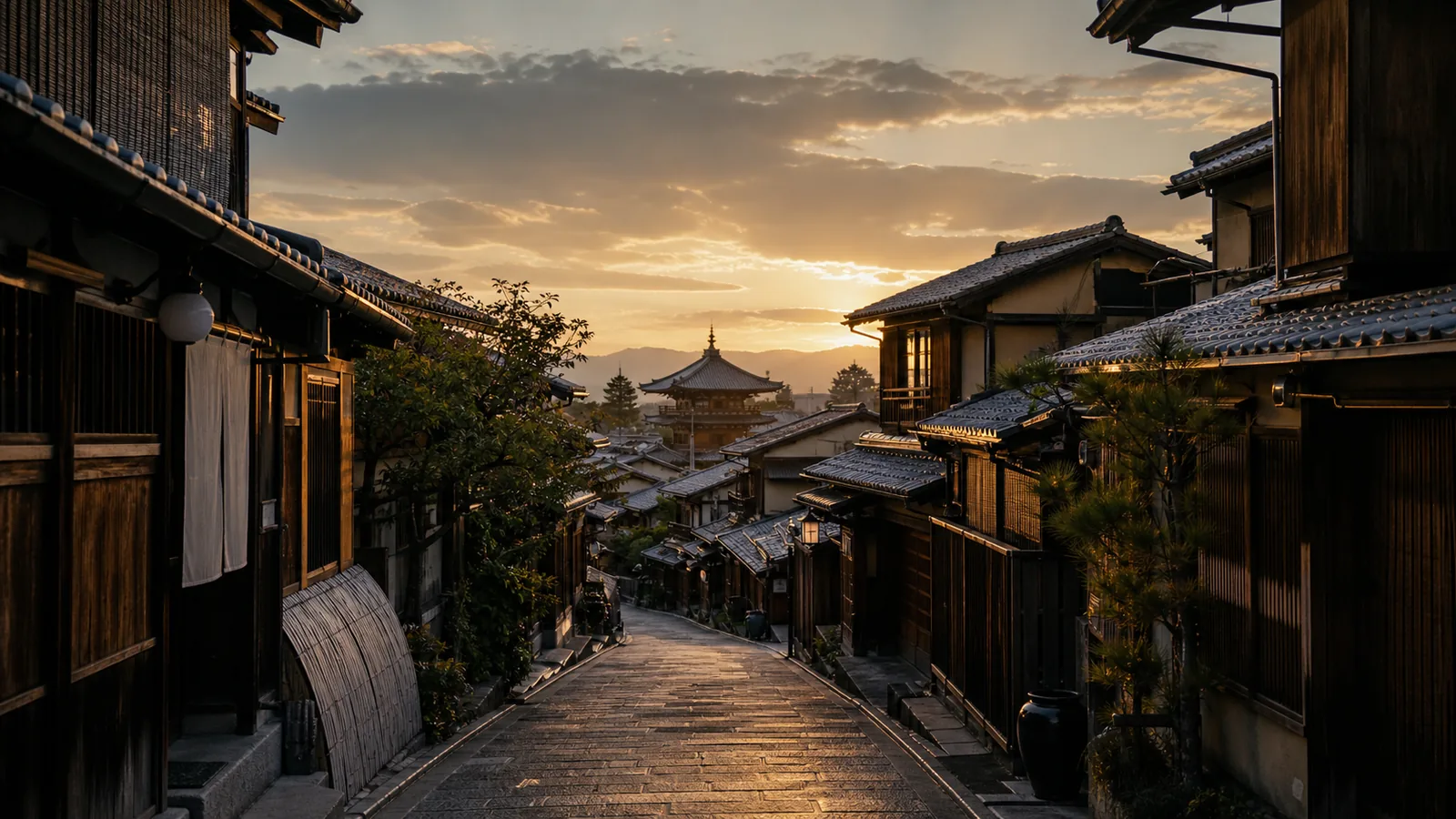
Walking through Arashiyama’s bamboo grove, watching the gold leaf reflect off Kinkakuji, encountering a geisha in Gion — these are Japan’s most precious historical landscapes. But here is a fact you may have never considered: Kyoto served as the capital for 1,074 years (794-1868), and miraculously preserved an enormous quantity of ancient architecture.
In world urban history, this is extraordinarily rare. Beijing was remade (the Forbidden City survived by luck), Chang’an became Xi’an (only ruins remain), Paris was modernized (medieval buildings survive only sparsely), and most of Rome’s ancient monuments are reconstructions. Kyoto is the only world-class city that has been a capital for 1,000 years and still retains its original character.
Why? This article unpacks 4 critical moments — the times Kyoto came close to destruction 4 times and miraculously survived each one.
Where does Kyoto come from? In 794 Emperor Kanmu moved the capital to "Heian-kyo" (modern Kyoto), built on the Tang dynasty Luoyang and Chang’an grid model. 4.5 km east-west by 5.2 km north-south, with the imperial palace (Daidairi) in the north and Suzaku Avenue running south (where Senbon-dori now lies), forming a neat grid of streets.
1,074 years as the capital, from 794 to 1868. During that entire span the Japanese capital never moved — Kyoto was Japan’s heart.
Crisis 1: the Onin War of 1467-1477 This is when Kyoto suffered its largest-scale destruction.
The eighth shogun Ashikaga Yoshimasa faced an internal succession dispute that ignited a citywide war. The Eastern Army (under Hosokawa Katsumoto) and the Western Army (under Yamana Sozen) fought a civil war of 300,000 troops inside Kyoto for 11 years.
Results:
- 70% of central Kyoto burned
- Shokokuji, next to Kinkakuji, was destroyed (later rebuilt)
- The old Heian-kyo imperial palace was reduced to ruins
- 300,000 residents died or fled
- Kyoto’s population plunged from over 1 million to 300,000
Buildings that miraculously survived:
- Kinkakuji (in western suburbs, far from the battlefield) — survived
- Ginkakuji (Yoshimasa’s villa, built 1482 after the war)
- Kiyomizu-dera (in eastern Higashiyama, far from the battlefield) — survived
- Toji’s five-story pagoda (southern Kyoto) — survived, the tallest wooden pagoda in Kyoto
But central Kyoto (within the Heian-kyo footprint) was essentially flattened, with slow reconstruction over the following century.
Crisis 2: 1582 Honnoji Incident and Nobunaga’s death Oda Nobunaga carried out many extreme acts — destroying Mt. Hiei Enryakuji, crushing the Ikko-ikki. Had he continued ruling, Kyoto would likely have become a casualty of his reshaping (he planned to move the capital to Azuchi).
But in 1582 Akechi Mitsuhide assassinated Nobunaga at Honnoji in Kyoto, abruptly halting Nobunaga’s plans.
His successor Toyotomi Hideyoshi, despite building Osaka Castle and Fushimi Castle in commanding fashion, adopted a protective stance toward Kyoto:
- Rebuilt the Imperial Palace and multiple temples
- Constructed the Odoi (a 25 km earthen rampart around Kyoto for flood control and defense, parts of which still survive)
- Built the Hokoji Great Buddha (later torn down on a pretext by Tokugawa Ieyasu)
After Tokugawa Ieyasu founded the Edo shogunate in 1603, Edo became the political center while Kyoto, though demoted, was preserved — because the emperor remained in Kyoto, the Tokugawa shogunate could not casually rearrange the city. This "political center versus cultural center" dual-city structure unintentionally protected Kyoto for 265 years.
Crisis 3: the Kinmon Incident of 1864 During the chaotic Bakumatsu, Kyoto became a gathering place for "loyalist warriors" (kinno shishi) supporting the emperor against the shogunate. The Shinsengumi (the shogunate’s special police force, stationed in Mibu, Kyoto from 1863-1869) clashed repeatedly with Choshu loyalists on Kyoto streets.
In July 1864, the Choshu domain failed in its attempt to enter Kyoto, triggering the Kinmon Incident, and parts of the city burned again. But the scale was far smaller than the Onin War, mainly affecting the imperial palace area and merchant quarters.
Crisis 4: the 1945 US bombing plan The most critical moment — Kyoto came close to suffering the same fate as Hiroshima and Nagasaki.
The US atomic bomb target list of 1945 (set in early July) ranked Kyoto as the top target (flat terrain, concentrated population, maximum psychological impact), followed by Hiroshima, then Yokohama, Niigata, Kokura (modern Kitakyushu), and Nagasaki.
But US Secretary of War Henry L. Stimson pushed hard to remove Kyoto from the list, for these reasons:
- Kyoto symbolizes Japanese culture, and destroying it would make Japanese people hate America forever, rendering postwar reconstruction impossible.
- Stimson honeymooned in Kyoto as a young man in the 1920s, personally walking the temples and being deeply moved by the culture.
- President Truman accepted the recommendation, and Kyoto was removed from the list.
The revised target list of July 25 read: Hiroshima, Kokura, Niigata, Nagasaki. On August 6 Hiroshima was bombed, and on August 9 the original Kokura target was redirected to Nagasaki due to cloud cover.
Kyoto thus miraculously escaped.
What else did Kyoto avoid? During World War II, Tokyo suffered the Great Air Raid of March 10, 1945, Osaka was bombed repeatedly, Nagoya bombed repeatedly, Yokohama bombed, and Kobe bombed. Kyoto miraculously was not subjected to large-scale air raids (only sporadic small strikes). Although the main reason was the US deliberately preserving the city (because they planned to drop the atomic bomb and could not pre-burn the target), Kyoto effectively became the only major city on Honshu to preserve its full prewar character.
Postwar protection policies The Cultural Properties Protection Law of 1950, the Kyoto Ancient Capital Preservation Cooperation Tax of 1972, and the 1994 inscription of Historic Monuments of Ancient Kyoto as a World Heritage Site cover 17 properties:
- Kamigamo Shrine
- Shimogamo Shrine
- Toji
- Kiyomizu-dera
- Daigoji
- Ninnaji
- Byodoin
- Ujigami Shrine
- Kozanji
- Saihoji (Moss Temple)
- Tenryuji (Arashiyama)
- Rokuonji (Kinkakuji)
- Jishoji (Ginkakuji)
- Ryoanji
- Nishi Honganji
- Nijo Castle
- Enryakuji (in Shiga, on Mt. Hiei)
Kyoto also enforces strict urban landscape ordinances:
- Building height capped at 31 meters in the city center, and 15 meters in historic preservation districts
- Color restrictions on signage — McDonald’s signs in Kyoto are coffee brown, not red
- Sign restrictions — rooftop signs are nearly entirely banned
That is why you never see the kind of neon-lit streets Osaka has in Kyoto. The entire city maintains a gray tile, white wall, wooden atmosphere. Even modern buildings must imitate the wa style (Kyoto Station, though a massive steel structure, was deliberately designed to blend in).
How much does Kyoto preserve today?
- 1,600+ temples
- 400+ shrines
- 17 World Heritage properties
- 271 designated Important Cultural Properties
- About 300,000 "machiya" (Edo and Meiji wooden traditional townhouses, 60% fewer than 100 years ago, but still the most in Japan)
The cost of Kyoto’s preservation The cost is also large:
- Population decline: traditional machiya are not suited to modern life, young people move away, and Kyoto’s population is shrinking
- Tourist pressure: in 2019, 8.8 million foreign tourists visited Kyoto, and residents began to push back ("kankou kogai," tourism pollution)
- Daily-life convenience: height and color limits in the city center restrict large commercial facilities, making it less convenient than Osaka
The next time you walk through Gion and Kiyomizu-dera, remember this is a city that was threatened by fire multiple times and survived each one. The Onin War burned it, Nobunaga nearly remade it, the Bakumatsu burned another round, and World War II nearly atomic-bombed it — and every time, it slipped through. The Kyoto you see today is one of the most precious preservation cases in world urban history. Treasure every roof tile, every torii, every stone path.
Frequently Asked Questions
Was Kyoto never burned for a thousand years?
No. Kyoto suffered wars and fires. Its value is the continuity of urban memory, layout, culture, and repeated rebuilding.
Why was Kyoto not heavily bombed in World War II?
It involved target selection, cultural symbolism, postwar governance considerations, and military judgment, not one simple reason.
Why are Kyoto signs so subdued?
Kyoto has strict landscape policies covering building height, signs, outdoor advertising, and historic districts.
Does preservation create problems for Kyoto?
Yes. Machiya maintenance, tourism pressure, and development restrictions all affect residents. Kyoto is a living city.