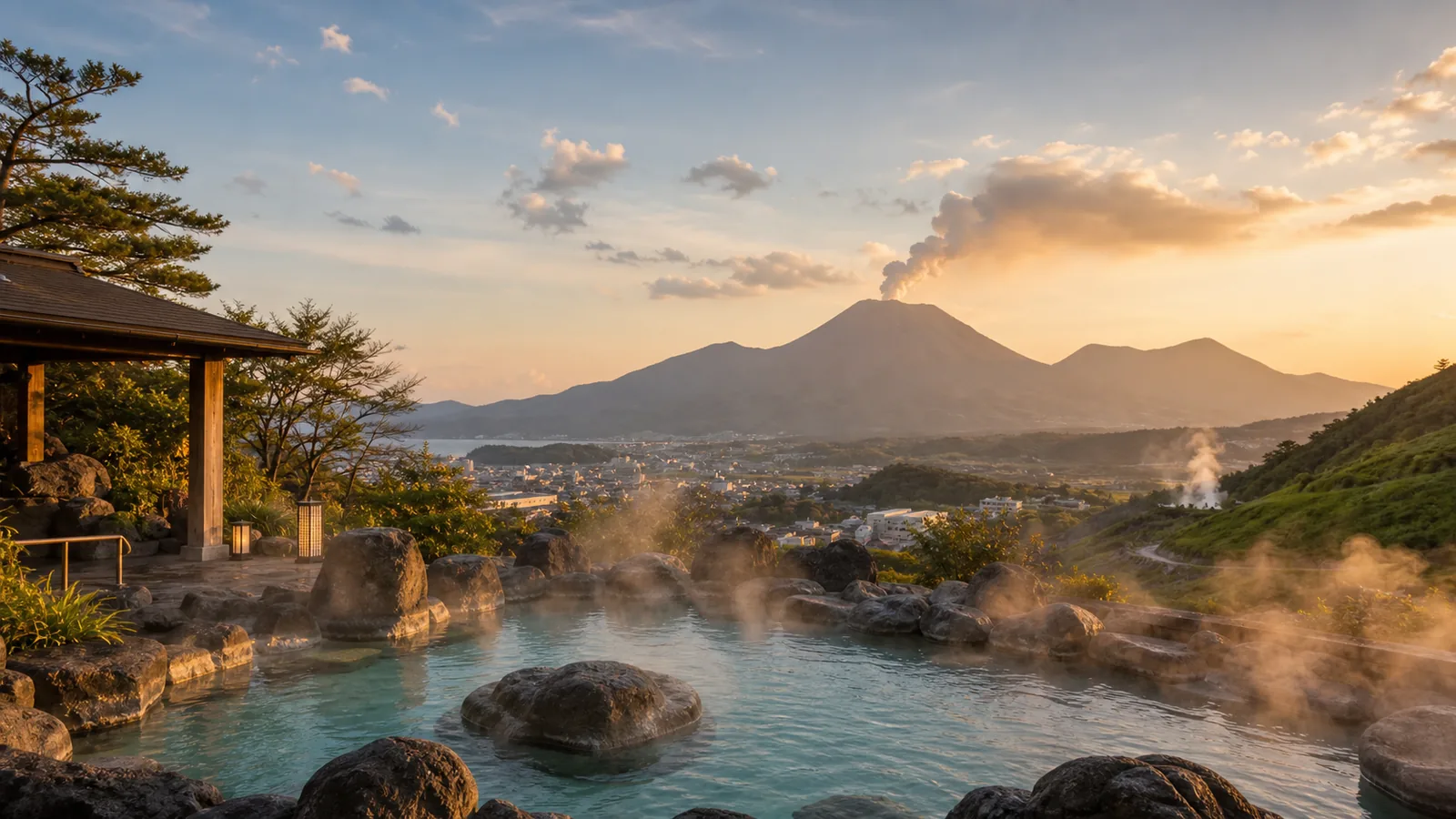
If Hokkaido is Japan’s European outpost, Kyushu is Japan’s "tropical south". The southernmost main island, its 7 prefectures plus Okinawa are collectively called the "8 prefectures of Kyushu" (strictly speaking, Okinawa is separate). Kyushu hosts more than half of Japan’s active volcanoes, the most hot springs, the most extroverted people, and the most distinctive history (the earliest contact point with the West).
Kyushu geography at a glance Located southwest of Honshu, spanning 36,750 square kilometers (about the size of Taiwan plus Hainan Island), with a population of about 13 million. 7 prefectures: Fukuoka, Saga, Nagasaki, Kumamoto, Oita, Miyazaki, Kagoshima.
The climate runs subtropical to tropical, with winter averages around 10°C (Kagoshima at 15°C, similar to Taipei), and humid summer heat (35°C with high humidity). Rainy season rainfall is Japan’s highest (June-July), and typhoon paths also tend to strike Kyushu first.
Geographic character — a volcanic paradise Kyushu has 17 active volcanoes (a quarter of Japan’s total), with Sakurajima (Kagoshima), Mt. Aso (Kumamoto), and Mt. Unzen (Nagasaki) ranking as major eruptive systems.
Sakurajima still erupts small plumes daily, and Kagoshima city residents are accustomed to life under volcanic ash. Mt. Aso contains the world’s largest caldera (18 km east-west by 25 km north-south), inside which 50,000 residents live — a uniquely "city inside a volcanic crater" arrangement.
The byproduct is an explosion of hot springs — Beppu produces 130,000 liters of thermal water per day, second only worldwide to Yellowstone in the United States.
Fukuoka — ramen capital and Kyushu’s largest city Population 1.61 million, Kyushu’s biggest city. Hakata Port has been a continental trade gateway since ancient times.
The birthplace of Hakata ramen (tonkotsu white broth), with Ichiran, Ippudo, and Hakata Ikkousha all originating in Fukuoka. Yatai (street food carts) are unique to Hakata. In Nakasu Kawabata at night, 50+ yatai line up, and locals and tourists alike eat ramen, yakitori, and gyoza together.
Dazaifu Tenmangu: a shrine to Sugawara no Michizane, the god of academics, where Japanese students pray before exams. Visitor numbers reach 2 million during January 1-3.
Fukuoka Airport is Kyushu’s transport hub, just 5 minutes by subway from the airport to Hakata Station (one of the fastest airport-to-city connections in the world).
Saga — small onsen prefecture plus Ureshino tea Population 810,000, the smallest prefecture in Kyushu. Ureshino Onsen ("the bath of beautiful skin"), Arita ware (the cradle of Japanese porcelain with 400 years of history, which influenced European royalty), and the Yobuko morning market (a traditional fishing-village market). Few tourists, ideal for a slow onsen retreat.
Nagasaki — exotic flair and atomic bomb history Population 300,000. During Japan’s sakoku isolation, this was the only port open to foreign trade (1641-1853, the Dutch trading post at Dejima). Highlights include Megane-bashi (Spectacles Bridge), Oura Catholic Church (Japan’s oldest wooden Gothic church), and Glover Garden (the 1863 residence of a Scottish merchant who became "the father of Japan’s industrial revolution").
The Nagasaki atomic bombing: August 9, 1945. The Atomic Bomb Dome and Peace Park rank alongside Hiroshima as atomic memorial sites.
Champon (Nagasaki mixed noodles), castella (honey sponge cake brought by Portuguese missionaries in the 16th century), and Sasebo Burgers (beef burgers shaped by the US military presence) are all local specialties.
Kumamoto — Mt. Aso, Kumamoto Castle, and Kumamon Population 1.73 million. Kumamoto Castle: one of Japan’s three great castles (along with Himeji and Matsumoto), built by Kato Kiyomasa in 1607. Its towering stone walls earned it the nickname "demon castle." It was severely damaged in the 2016 Kumamoto earthquake and remains under a 30-year restoration project (expected to complete in 2052). Parts of the grounds are open to visitors.
Mt. Aso is a must-see — the active Nakadake crater opens for visits when gas levels permit, and surrounding grasslands host cattle and sheep on Japan’s largest pastoral landscape.
Kurokawa Onsen: on the north side of Mt. Aso, a deep-mountain hot-spring village with 28 inns. The "nyuto tegata" (bath ticket) system lets you bathe at 3 different hot springs for 1,500 yen, voted the country’s top onsen by the Japan Hot Spring Association.
Horse sashimi (basashi): a Kumamoto specialty of fresh horse meat dipped in soy sauce and ginger. Foreigners often shy away on first hearing, but the taste is sweet and clean. Kumamon, the cuddly bear mascot launched by the prefectural government in 2010, unexpectedly went viral nationwide.
Oita — Beppu and Yufuin, the twin hot spring kings Population 1.1 million. Beppu Onsen: the "8 hells" feature pools in different colors (the blue Umi Jigoku, the red Chinoike Jigoku, the eruptive Tatsumaki Jigoku, and more), perfect for a single-day visit.
Yufuin: a small town nestled in the Oita mountains, with the misty Lake Kinrin and the boutique-lined Yunotsubo-kaido (coffee, vegetarian food, folk crafts). The most elegantly Japanese atmosphere — more upscale than Beppu, and consistently in the top 3 of Japanese women’s "most-wanted-to-visit onsen towns."
Miyazaki — coastline and the cradle of mythology Population 1.05 million, with the Hyuga Coast stretching 400 km. Takachiho Gorge: in mythology, the sacred site of "Tenson Korin" (where the emperor’s ancestors descended from heaven). Visitors row boats through the gorge to view the waterfalls.
Udo Shrine: a shrine inside a coastal cave, where "undama" (luck balls) are thrown into a hollow in the rock for good fortune — a uniquely local belief.
Miyazaki mangoes: Japan’s sweetest mango region, where premium-grade "Taiyo no Tamago" (Egg of the Sun) sells for 5,000-10,000 yen per fruit, used by the imperial household.
Kagoshima — Sakurajima, Saigo Takamori, and black pork Population 1.59 million, Kyushu’s southernmost prefecture (the mainland’s southernmost point is Cape Sata in Kagoshima). Sakurajima: an active volcano on the sea opposite Kagoshima city, still erupting small bursts daily, reached by a 15-minute ferry.
Sengan-en: the Shimazu family villa, hometown of Satsuma domain lord Saigo Takamori. Saigo Takamori was a central figure in the 1868 Meiji Restoration and appears on Japanese currency.
Kagoshima black pork: the "6 whites" (tips of feet, nose, and tail) pure-blood black pig, a 400-year-old breed comparable to Iberico, exquisite in thin-sliced shabu-shabu.
Yakushima: an offshore island at Kagoshima’s southern tip, a World Heritage Site, home to Jomon Sugi (a 7,000-year-old sacred cedar) that inspired Miyazaki Hayao’s "Princess Mononoke."
Classic 7-day Kyushu route Enter through Fukuoka → Beppu Onsen → Yufuin → Mt. Aso (Kumamoto) → Kurokawa Onsen → Kumamoto Castle → Kagoshima (Sakurajima) → exit through Fukuoka (back north on the shinkansen).
The Kyushu JR Pass costs 10,000 yen for 5 days in Northern Kyushu or 18,000 yen for 5 days across all of Kyushu, both cheaper than Hokkaido. The shinkansen "Sakura" runs from Fukuoka to Kagoshima in 1 hour 20 minutes.
When planning your next Japan trip, if you have already done Tokyo, Kyoto, and Hokkaido, Kyushu offers a completely different sensory experience: the breath of volcanic earth, hot springs wrapped in mist, generous and direct people, and rich, intense food. You need at least 7 days to do it justice. Onsen ryokan run 8,000-15,000 yen per night minimum but are absolutely worth it.