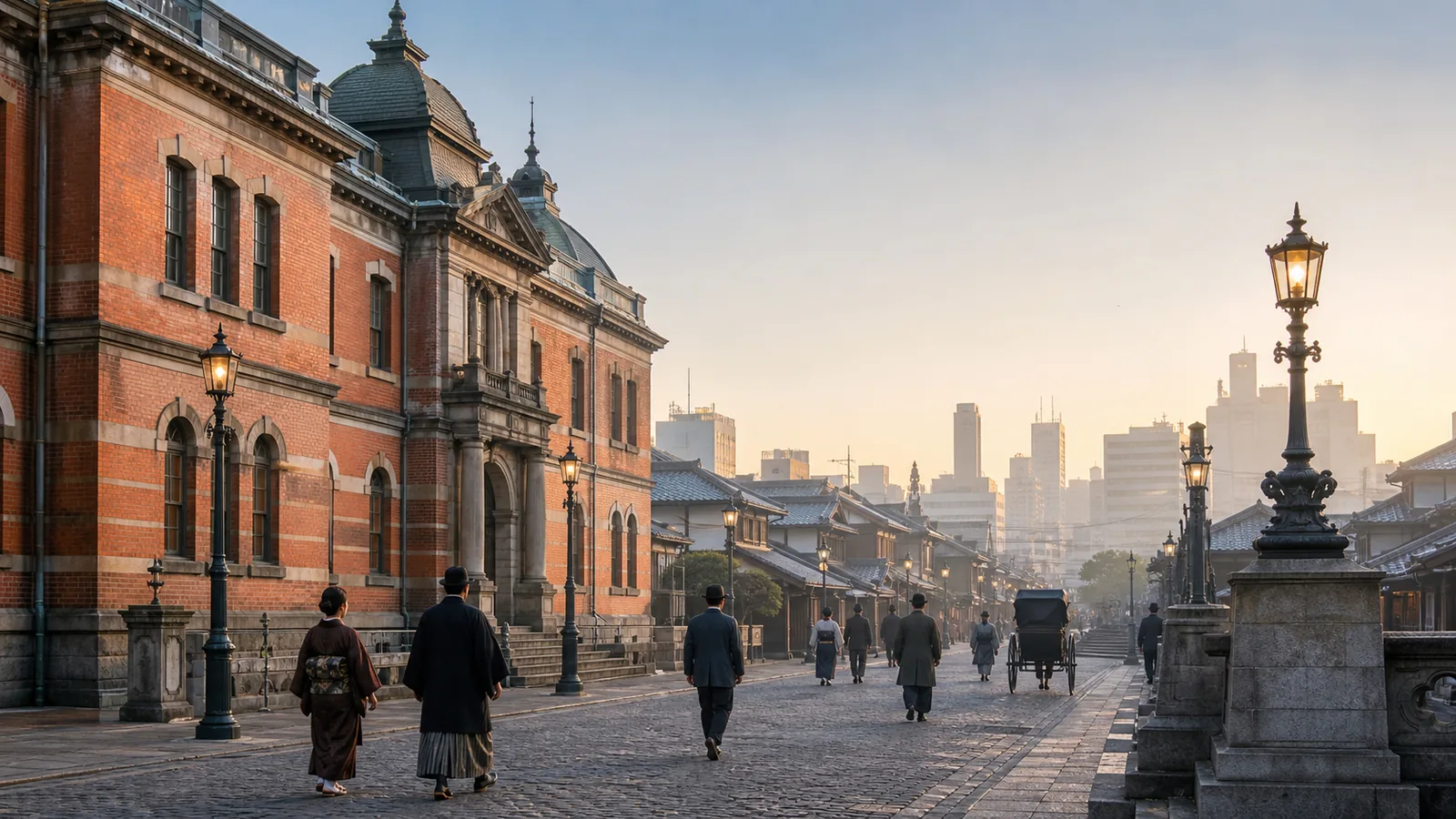
If you had to pick a single event that made Japan the country it is today, the answer is the Meiji Restoration (1868-1912).
The one-line summary: in thirty years Japan went from a feudal shogunate to an industrial power, defeating Qing China in 1894 and Tsarist Russia in 1905, taking its seat among the world powers.
How extraordinary was that pace? The Qing Self-Strengthening Movement (1860s-1890s) tried the same thing and failed; India spent 200 years as a British colony. How did Japan pull it off? This article unpacks the story.
The trigger: the Black Ships of 1853 On July 8, 1853, US Commodore Matthew C. Perry arrived at Uraga (now Kanagawa Prefecture) with four steam-powered warships.
Japan had been sealed off for 212 years, and the Edo shogunate panicked — they had never seen a steamship and described it as a「火を吐く船」(ship that breathes fire). The following year, in 1854, Japan was forced to sign the Japan-US Treaty of Peace and Amity, opening Shimoda and Hakodate as ports.
Why was this the breaking point?
- 200 years of isolation collapsed the shogunate’s authority overnight
- Western technology far outstripped what Japan imagined (steamships, rifles, cannon)
- The country splintered into three camps: the Bakufu loyalists, the anti-foreigners (Joi), and the shogunate-toppling faction (Tobaku)
The next fifteen years were a chaotic mix of civil strife, assassinations, and coups, while the domains each fumbled toward reform.
1868: the return of imperial rule November 9, 1867: Tokugawa Yoshinobu (the 15th shogun) made an unprecedented decision — 大政奉還, voluntarily returning political authority to the emperor. His reasoning: the shogunate had lost its legitimacy and stepping down was better than being overthrown.
January 3, 1868: the Decree of the Restoration of Imperial Rule dissolved the shogunate, and the Meiji Emperor (aged 16) took personal rule.
1868: the Boshin War Bakufu loyalists were not done, and the Boshin War raged from 1868 to 1869. The new government army (a coalition of Satsuma, Choshu, Tosa, and Hizen) faced off against the old shogunate forces. The new government won. The final battle: the Hakodate War of May 1869, where the loyalist Enomoto Takeaki surrendered. The Edo shogunate was officially over.
Aizu-Wakamatsu (Fukushima Prefecture) is the war’s tragic site: the Aizu domain backed the shogunate and was besieged for a month. The Byakkotai — 19 boys aged 16-17 who collectively committed seppuku — is the most retold tragedy of the Boshin War, and you can still visit the memorial at Tsurugajo Castle today.
1868-1889: 21 years of Meiji transformation Once in power, the new government enacted an unprecedented chain of reforms:
Return of Domains (1869): the 280 feudal domains were abolished and their land and people returned to the emperor. Abolition of the Han System (1871): domains became prefectures, and the samurai class was dissolved. 300,000 samurai families lost their livelihoods, receiving meager pensions (秩禄).
Land Tax Reform (1873): taxes shifted from rice to cash, land titles were established, and modern public finance was born.
Conscription Ordinance (1873): every 20-year-old man served three years in the military. The samurai’s monopoly on arms passed to ordinary citizens, dissolving the warrior class entirely.
Education Order (1872): six years of compulsory schooling nationwide (long before this was the norm in Europe or America). By the end of Meiji literacy reached 90 percent — the highest in the world.
Railway opens (1872): the 29 km Shimbashi-Yokohama line was Japan’s first. Within twenty years the national rail network was largely complete.
Annexation of Ryukyu (1879): the Ryukyu Kingdom (modern Okinawa) was forcibly incorporated as Okinawa Prefecture.
Sword Edict (1876): samurai were forbidden from wearing swords. Topknots were cut. In appearance, Japanese people became Westerners.
The Constitution of the Empire of Japan (1889): Asia’s first written constitution, modeled on Prussia’s. The first Imperial Diet convened in 1890. Japan became the first Asian country with a parliamentary system.
Why did Meiji succeed? Five key factors:
1. The samurai overthrew themselves: unlike other Asian states, the Meiji Restoration was the ruling class dismantling itself. Lower-ranking samurai (Saigo Takamori, Okubo Toshimichi, Kido Takayoshi, Ito Hirobumi, Yamagata Aritomo) led the way and brought ready-made administrative skill.
2. A sharp sense of crisis: watching the great powers carve up China, the Japanese collectively believed「change or be colonized」. That anxiety drove breakneck reform.
3. State-led industrialization: foreign engineers from Europe and America were brought in on lavish salaries (British engineers, French soldiers, German scholars), the technology was learned, and then they were sent home. Government-run factories (the Tomioka Silk Mill, the Yawata Steel Works) were built first and sold to private hands later.
4. A unified language plus education: standard Japanese (based on the Tokyo dialect), six years of compulsory schooling, and 90 percent literacy together produced a workforce whose skills rose at remarkable speed.
5. Pressure from unequal treaties: the 1858 treaties (extraterritoriality and the loss of tariff autonomy) drove home that 「without power, there is no sovereignty」. Every reform aimed at scrapping those treaties. Extraterritoriality was abolished in 1894, and tariff autonomy was restored by 1911.
The impact on modern Japan 1. A centralized state: today’s「Tokyo monopoly」(government, economy, and media all concentrated in Tokyo) traces its roots to Meiji.
2. Seeds of militarism: the abolition of domains, conscription, and state Shinto together bent Japan’s entire state apparatus toward military ends. The system only ended with defeat in 1945.
3. Kyoto’s eclipse, Tokyo’s rise: Kyoto lost the capital status it had held for 1,074 years. In the century after Meiji, Kyoto grew from 350,000 to 1.45 million (a four-fold increase), but Tokyo went from 1 million to 9.7 million (ten-fold).
4. Western surface, Eastern core: 「Japanese spirit, Western technology」 became national policy. Outward Westernization (clothing, railways, architecture) coexisted with traditional cores (the imperial system, Confucianism, Shinto). Today’s Japan is still like this — modern on the walls, traditional in the bones.
5. The birth of standard Japanese: modern Japanese (the common language) is an engineered language built on the Tokyo dialect with classical written forms layered in. Without Meiji there is no modern Japanese.
Where to see the Meiji Restoration today
- Tokyo Nijubashi Bridge and the Imperial Palace: the Meiji Emperor moved into Edo Castle from Kyoto in 1869
- Yasukuni Shrine (Kudanzaka, Tokyo): enshrines those fallen since Boshin, with festivals on Feb 11 (National Foundation Day) and Nov 23
- Yokohama「赤レンガ倉庫」: the red brick warehouses, an 1911 Meiji customs building
- Tokyo Station’s red brick building: a 1914 Meiji structure still in use
- Fushimi Momoyama Mausoleum in Kyoto: the tomb of the Meiji Emperor
- Hagi, Yamaguchi Prefecture: the heart of Choshu (the cradle of Meiji idealists), preserving Yoshida Shoin’s home and his Shokasonjuku academy
- Kagoshima: Satsuma (Saigo Takamori’s birthplace), with Senganen Garden and Saigo’s bronze statue
- Glover Garden, Nagasaki: the 1863 home of the Scottish trader Thomas Glover, who supplied weapons to Satsuma and Choshu, 「the father of Japan’s industrial revolution」
The next time you see a Meiji-era building in Japan, walk past the Imperial Palace, or stand at Tsurugajo Castle in Aizu-Wakamatsu, remember the story of Asia’s first successful modernization. Without the Meiji Restoration, Japan might have shared the fate of the Qing. With it, today’s Japan exists. Understand Meiji, and you understand Japan.
Frequently Asked Questions
Was the Meiji Restoration a revolution?
Yes in political and institutional terms, but it was not a single event. It followed years of crisis, conflict, and reform.
Was the Meiji Restoration only a success story?
No. It modernized Japan, but also brought centralization, social disruption, colonial rule, and imperial expansion.
Where can travelers see Meiji history?
Nijo Castle, Tokyo Imperial Palace, Yokohama, Kagoshima, Hagi, Goryokaku, and Aizu-Wakamatsu are good starting points.
Did Meiji affect modern Japanese?
Yes. Schools, publishing, bureaucracy, and media helped form a common language based largely on Tokyo speech.