At noon on August 15, 1945, Emperor Showa announced Japan’s surrender by radio (the 玉音放送, Jewel Voice Broadcast). 2.4 million Japanese had died in the war (military and civilian), and major cities like Tokyo, Osaka, Nagoya, Yokohama, and Kobe had more than 40 percent of their built area flattened. The economy was wrecked.
Eighty years later, Japan is the 3rd or 4th largest economy in the world. Sony and Nintendo are global icons. Japanese cuisine has UNESCO status. Tokyo Disney is the most profitable Disney park on earth. More than 30 million foreign tourists visit each year. How did the country go from ruins to this?
This article unpacks the seven key stages of 80 years of postwar history.
1945-1952: the GHQ occupation — America redesigns Japan
After World War II, General Douglas MacArthur led the GHQ (General Headquarters) into Tokyo and redesigned Japan in seven years:
1. The pacifist constitution (1947): Article 9 declares 「eternal renunciation of war, no maintenance of war potential」. The Self-Defense Forces are technically not a「military」 by the letter of the constitution — a contradiction that has fueled 70 years of debate.
2. The Humanity Declaration (1946): Emperor Showa declared he was not a god, shifting to a symbolic emperor system. A thousand years of belief in the divine emperor was broken.
3. Dissolving the zaibatsu (1945-1947): the four big conglomerates — Mitsubishi, Mitsui, Sumitomo, Yasuda — were broken up. But after the Korean War of the 1950s the policy was loosened and the zaibatsu reorganized as「enterprise groups」(keiretsu), regaining their influence.
4. Land reform (1946): land was expropriated from large landlords and distributed to tenant farmers. Rural Japan was structurally remade as tenants became owner-cultivators.
5. Women’s suffrage, nine years of compulsory education, legal unions: the full Western democratic kit was imported.
6. The Tokyo Tribunal (1946-1948): seven defendants including Tojo Hideki were hanged (Class A war criminals). Another 18 received life or fixed-term sentences.
7. The constitution vs the SDF contradiction: when the Korean War broke out in 1950, the US asked Japan to set up a「National Police Reserve」(later the Self-Defense Forces). On paper not a military, in practice one of the 3rd to 5th strongest armed forces in Asia. The contradiction remains unresolved.
1952-1973: the high-growth era — the economic miracle
On April 28, 1952 the San Francisco Peace Treaty took effect, ending the GHQ occupation and restoring Japan’s independence.
The next twenty years were the 高度経済成長期 (high-growth era):
- From 1955 to 1973 GDP grew at an average annual rate of 9.1 percent (the fastest in history)
- In 1968 GNP overtook Germany, making Japan the world’s second-largest economy
- 1953 saw NHK television go on air, 1958 Tokyo Tower (333 m), 1964 the Tokyo Olympics and the Tokaido Shinkansen (the world’s first high-speed rail), 1970 the Osaka Expo
Why so fast?
- GHQ dissolved the zaibatsu plus land reform: wealth was redistributed and domestic demand exploded
- Korean War demand (1950-1953): US military orders poured in and jump-started the economy
- Cheap oil (around 1 dollar per barrel)
- Cold War protection: with US security, Japan spent only 1 percent of GDP on defense and channeled the savings into industry
- High education levels: 99 percent literacy and a vast pool of engineers
- Government, business, and banks moved together (Japanese-style capitalism): MITI guided industrial policy
- A savings rate above 20 percent: household savings produced abundant capital
Three industries — home appliances, automobiles, and semiconductors — became global leaders. Sony, Panasonic, Toyota, Honda, Nintendo, and SHARP were all founded or matured during this period.
1973-1991: a mature economy and the bubble
The 1973 oil shock: oil prices quadrupled, and Japan faced inflation and recession at once. The high-growth era ended, but Japan reacted quickly, pushing energy efficiency and compact cars — Toyota and Honda actually beat Detroit.
The 1980s were Japan’s second spring:
- Semiconductors took more than 50 percent of the global market (TIDS data)
- 「Japan as Number One」 (Ezra Vogel’s 1979 book, a global bestseller)
- America panicked, and the 1985 Plaza Accord forced the yen up 50 percent (1 dollar from 240 yen to 120 yen)
- The yen soared, exports were hit, the Bank of Japan cut rates to defend the economy, and stocks and real estate exploded
- The land inside Tokyo’s Yamanote loop was valued at more than all of California
- The Imperial Palace grounds were valued at more than all of Canada
- In 1989 the Nikkei reached 38,915 points (its all-time high)
1991-2012: the Lost 30 Years (Heisei stagnation)
The bubble burst in 1991: stocks fell, property fell, banks accumulated bad debt. Recovery was expected to take five years; instead 「the Lost 10 Years」became the Lost 20, then the Lost 30:
- From 1991 to 2012, GDP grew at about 1 percent a year (the Lost 20 Years)
- In 2008 China’s GDP overtook Japan’s, dropping it to third place
- The「Employment Ice Age」 (1993-2005): the university job placement rate fell to 60 percent, producing a whole generation of「dispatch workers and freeters」
- Financial crises: Yamaichi Securities collapsed in 1997, and Long-Term Credit Bank of Japan was nationalized in 1998
- The Great Heisei Mergers (1999-2010): the number of municipalities fell from 3,232 to 1,719 as smaller towns disappeared
- Aging and low birthrate accelerated: fertility fell from 1.7 to 1.3, and the population started shrinking in 2008
The 1995 Great Hanshin earthquake (Kobe, 6,434 deaths) and the 2011 Great East Japan Earthquake plus Fukushima nuclear disaster (15,895 deaths plus ongoing nuclear fallout) were the century’s two great disasters.
2012-2020: Abenomics and the delayed Olympics
In 2012, Abe Shinzo (Japan’s longest-serving prime minister, 2012-2020, eight years and eight months) launched Abenomics:
- Quantitative easing (the Bank of Japan printed 100 trillion yen to buy Japanese equities and government bonds)
- Fiscal expansion
- Structural reform
Results:
- The stock market rose from 8,000 to 28,000 points (3.5x)
- Unemployment fell from 4.3 to 2.2 percent (a historic low)
- But real wages did not rise for 20 years, and the 2 percent inflation target was never met
Reiwa began in 2019: Emperor Akihito of Heisei voluntarily abdicated, Emperor Naruhito ascended, and the era changed to「令和」(Reiwa).
The 2020 Tokyo Olympics were postponed to 2021 due to the pandemic and held without spectators. Japan won a record 27 golds, but the economic payoff fell far short of expectations.
2020 to today: post-COVID, weak yen, tourism reborn
The 2020-2022 pandemic: Japan sealed its borders for two years (foreigners banned), with a major economic hit.
From 2023 the borders reopened, and combined with a weak yen (1 USD went from 100 yen in 2020 to 155 yen in 2024), Japan’s tourism economy went into overdrive:
- 2023: 25.06 million foreign visitors (compared with 31.88 million in pre-pandemic 2019)
- 2024 expected to break 35 million, an all-time high
- Kyoto, Kamakura, Okinawa, and the Mount Fuji area began seeing「観光公害」(tourism pollution) protests
In 2024 the stock market broke through 41,000 points (surpassing the 1989 record, after a 35-year wait). But the lived sense of prosperity is still missing — prices rose while wages did not.
What does Japan face today?
1. Aging and low birthrate: fertility was 1.20 in 2023 (a historic low), and 29 percent of the population is over 65 (the world’s oldest society) 2. Shrinking population: 17 straight years of decline since 2008, projected to fall to 100 million by 2050 (from 124 million today) 3. Center-versus-region divide: the Tokyo monopoly grows while rural towns hollow out, with school and rail line closures 4. Stagnant economy: total GDP grew only 0.5x across 30 years of Heisei, compared with 6x for the US and 50x for China 5. Slipping international standing: 2nd in the world in 1968, overtaken by China in 2010 to become 3rd, overtaken by Germany in 2024 to become 4th 6. Immigration debates: facing labor shortages, Japan opened certain occupations to foreign workers from 2019 under the 「Specified Skilled Worker」 visa
Eighty years of Japan
From the ruins of 1945 to the world’s 2nd-largest economy in 1968 to one of the world’s top tourist destinations in 2024. Japan has lived through:
- Militarism (1900s-1945)
- US occupation (1945-1952)
- The economic miracle (1952-1991)
- The Lost 30 Years (1991-2022)
- Tourism rebound plus weak-yen boom (2023-)
Where to see postwar Japan today
- Hibiya Park and the Imperial Hotel in Tokyo: site of GHQ headquarters (later rebuilt)
- Hiroshima and Nagasaki Peace Memorial Parks: atomic bomb sites
- Tokyo Tower (1958): the symbol of postwar recovery
- The Shinkansen (1964): the symbol of the high-growth era
- Tokyo Station and Marunouchi: the postwar commercial heart
- Osaka Expo Park (the 1970 Expo grounds)
- Osaka Expo 2025 (April-October 2025, Yumeshima)
- Ikebukuro and Shinjuku skyscrapers: legacy of the Heisei bubble
- Tokyo Skytree (2012): icon of the Reiwa era
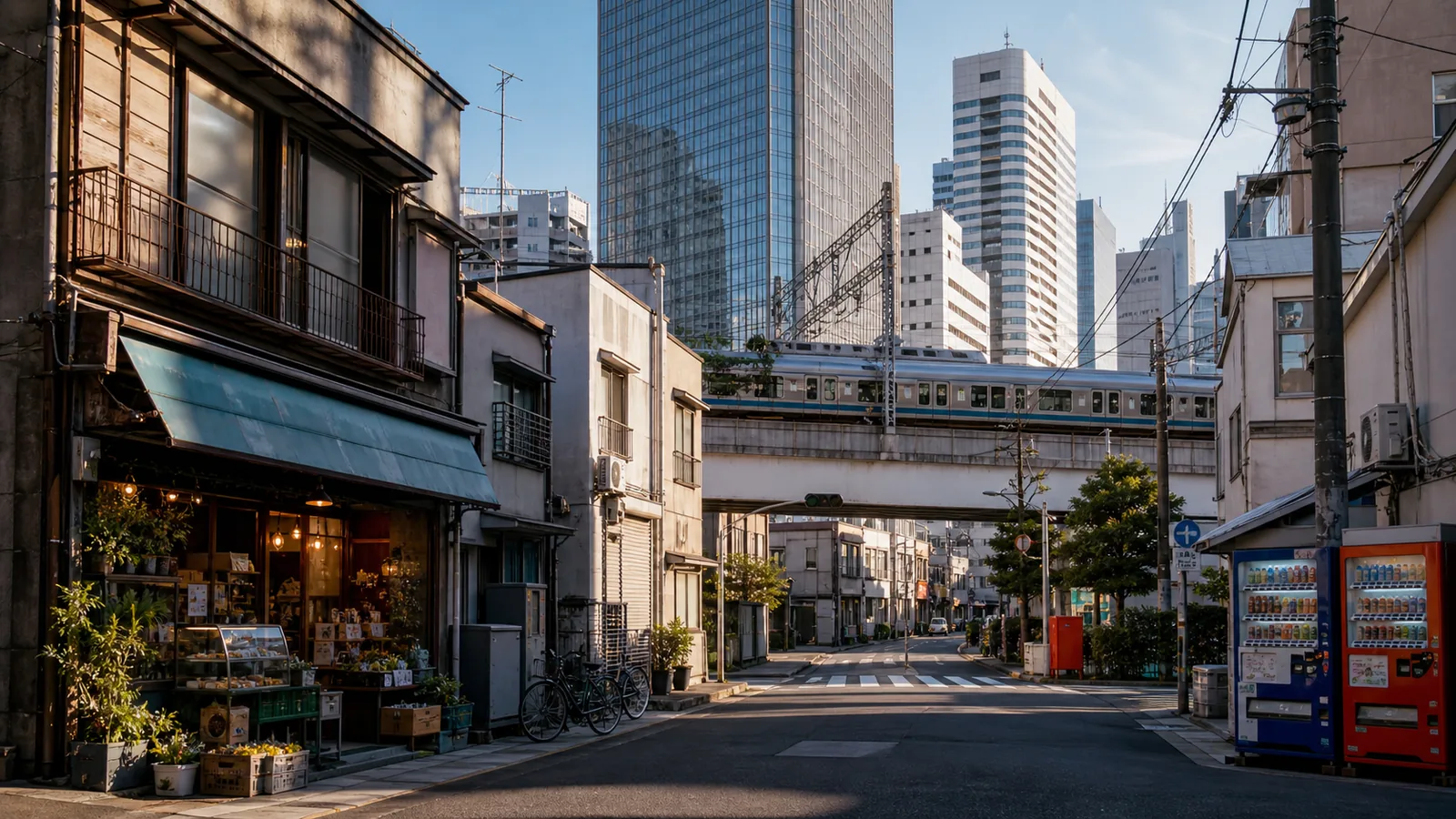
Next time you walk Tokyo’s streets, remember eighty years ago this was rubble, and yet within 25 years it became the world’s second-largest city. The 30-year Heisei stagnation is sobering, but Japan remains a vital cultural, industrial, and tourist force. Without those 80 years of story, today’s Japan would not exist.
Frequently Asked Questions
What shaped postwar Japan most?
Occupation reforms, high growth, the bubble crash, Heisei stagnation, 3.11, aging, and tourism recovery all shaped Japan today.
Is Japan still the third-largest economy?
By nominal GDP, Germany has passed Japan, but Japan remains a highly developed industrial, cultural, and technology power.
How big was Japan tourism in 2025?
JNTO reported 42.68 million foreign visitors in 2025, a record high that also intensified overtourism pressure.
Where can travelers see postwar Japan?
Tokyo Tower, the Shinkansen, Hiroshima and Nagasaki peace parks, Tohoku 3.11 recovery areas, rural rail closures, and vacant houses all tell the story.