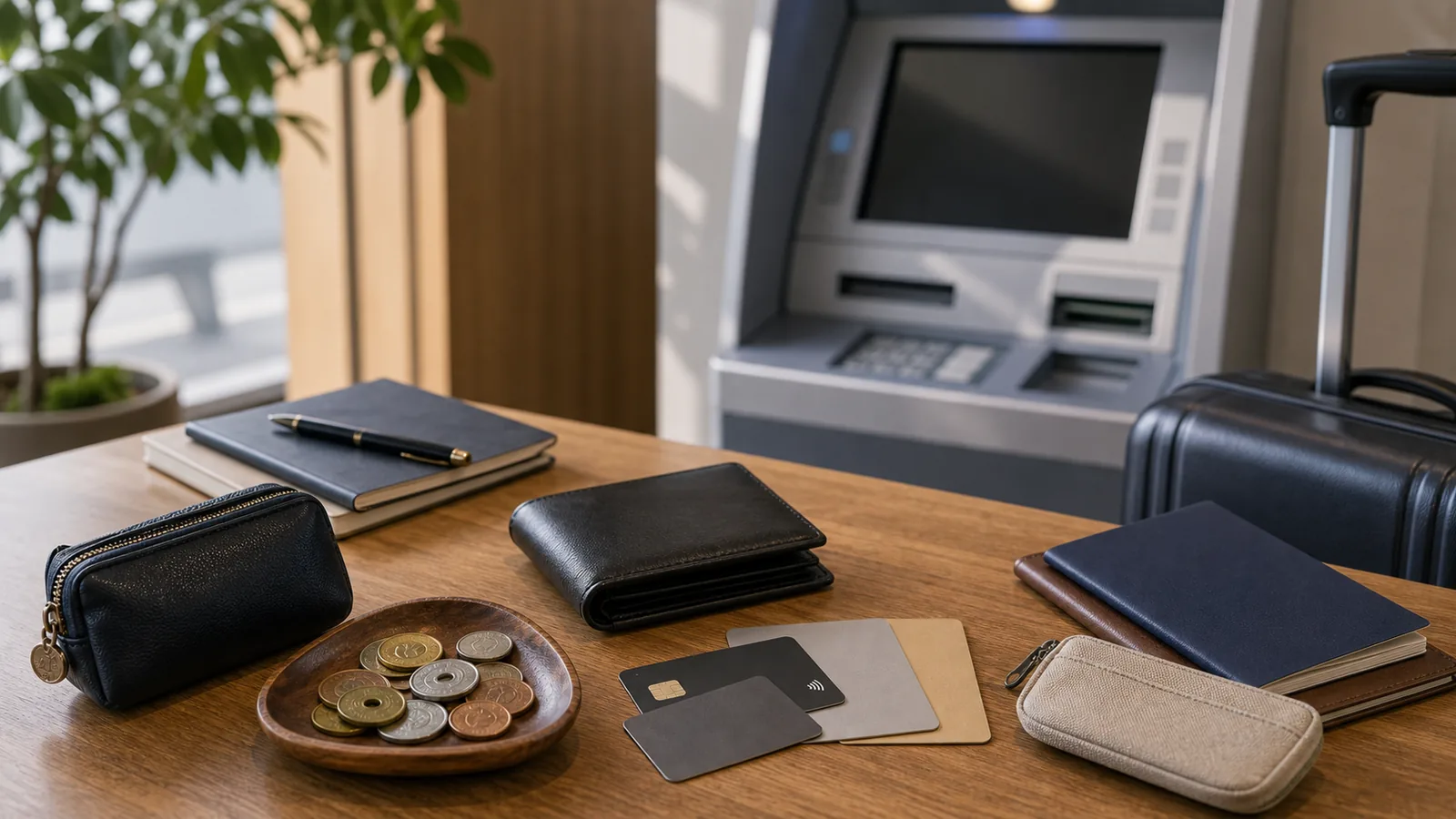
You bring a 100,000 yen budget, but the same「exchange 30,000 yen」transaction can vary 1,500-3,000 NTD between the airport and downtown. This article runs the numbers at real rates and reveals the truth that credit card payments are actually the best deal.
Bottom line first: for big cash conversions, use a downtown ticket shop or major bank. For small amounts, skip the trip — credit cards are cheaper.
Option 1: exchange at a Taiwan, Hong Kong, or mainland China bank before departure
Bank of Taiwan, Mega Bank, CTBC, E.Sun Bank: cash-to-cash rates are the worst, usually 0.3-0.5 yen below the Yahoo spot rate.
Example: if the Yahoo spot rate is 1 NTD = 4.5 JPY (hypothetically), the bank gives 4.2 JPY. Exchanging 10,000 NTD costs you 3,000 yen.
Hong Kong: Bank of China, HSBC, DBS. Similar spreads.
Mainland China: Bank of China and ICBC can exchange yen, but the paperwork is more onerous (appointment plus ID).
Verdict: for small amounts (under 10,000 NTD) it works for convenience. For large amounts the losses are obvious.
Option 2: exchange at the airport after landing
Narita, Haneda, Kansai, and Chubu arrival halls have banks and exchange counters (SBJ, Kyoto Bank, Travelex, and others).
Airport rates are the worst, usually 1 NTD = 3.5-4.0 JPY. Exchanging 10,000 NTD costs an extra 1,000-2,000 yen versus a bank.
Verdict: only exchange a minimum emergency amount (3,000-5,000 yen for cab fare plus a meal), then exchange the rest downtown.
Option 3: downtown ticket shops and banks
In Tokyo’s Shinjuku, Ikebukuro, Ueno, and Ginza there are many 「金券ショップ」 (ticket shops) that specialize in currency exchange.
Major players: Travelex, overseas travel firms, World Currency.
The rate: close to the Yahoo spot rate (a 0.05-0.1 yen spread), making the difference on 10,000 NTD negligible.
Verdict: the top pick for large exchanges. Requires time and geographic alignment — good if your itinerary already passes through Shinjuku or Ueno.
Option 4: credit card (the best effective rate)
Taiwanese Visa, MasterCard, and JCB cards used in Japan settle at the 「MasterCard / Visa international rate」, usually 0.2-0.3 yen per NTD better than physical exchanges.
Example: a 10,000 yen purchase settles around 2,150 NTD (effective rate 4.65 NTD = 1 JPY); a physical exchange of 10,000 yen costs 2,500 NTD.
That is 350 NTD saved per 10,000 yen spent.
Some cards add 1-2 percent overseas cashback (Citi, E.Sun, Taishin), even better.
Option 5: visitors from China, Hong Kong, or Macau — UnionPay or Alipay
China UnionPay cards (China Merchants Bank, ICBC, ABC) can be swiped at major department stores and convenience stores, with low UnionPay settlement costs. Some large stores accept Alipay or WeChat Pay (Tokyo and Osaka shopping districts), using the live yuan rate.
Verdict: for Chinese visitors, default to UnionPay swipes plus Alipay and avoid carrying lots of cash.
A common credit card trap: Dynamic Currency Conversion (DCC)
When you pay, the POS terminal may ask 「Take yen or NTD?」 Choosing 「NTD」 means accepting Dynamic Currency Conversion (DCC), where the merchant sets the rate — usually 3-5 percent worse than the bank rate.
Always choose「yen settlement (JPY)」 so your bank uses the international rate.
ATM withdrawals: 7-Eleven ATMs are the most convenient
If you do not want to exchange large amounts of cash, use your Taiwan, China, or Hong Kong credit or debit card at a Japanese ATM.
7-Eleven (7&i) ATMs: 25,000 nationwide, 24-hour access, accepting Visa, MasterCard, UnionPay, and JCB.
Fees: 220 yen on the 7-Eleven side plus 100-200 NTD from your bank (varies). Drawing 30,000-50,000 yen per transaction is the best deal to amortize the fees.
Taiwanese debit cards (E.Sun, Taishin, Cathay) have higher overseas withdrawal fees (150-300 NTD per withdrawal), so credit cards are usually better.
Lawson Bank ATMs, Japan Post Bank ATMs, FamilyMart ATMs also accept international cards at similar fees.
Pro tip 1: layered currency strategy
Estimate your cash needs before departure:
1. Day-one landing cash (3,000-5,000 yen): exchange at the airport or before departure in Taiwan — just a small amount.
2. Daily pocket cash (15,000-30,000 yen): use a credit card; pull cash from an ATM when needed.
3. Big purchases (restaurants, shopping): credit card — the best rate.
4. Emergency reserve: 5,000-10,000 yen cash in the hotel safe.
Pro tip 2: watch out for misreading small bills
Japanese banknotes come in 1,000, 2,000, 5,000, and 10,000 yen denominations. The 2,000 yen note is rare, so check whether what you received is genuine or a 10,000 yen note. The 10,000 yen bill is the largest (150 mm), the 5,000 yen is next (146 mm), and the 1,000 yen is the smallest (140 mm).
Pro tip 3: department stores and hotels take cards, but small shops, izakaya, and food stalls are cash-only
Japan is a 「cash country」, and rural areas, old shops, food stalls, and vending machines all run cash-only. Plan on 5,000-10,000 yen in daily reserve cash as a baseline.
Pro tip 4: a coin jar
Japanese coins come in 1, 5, 10, 50, 100, and 500 yen. The 5 and 50 yen coins have a hole in the center (traditionally strung on cord).
If your trip ends with 50-300 yen in coins, spend them at a convenience store or vending machine, or drop them in a 「ユニセフ募金箱」 (UNICEF donation box) at a station or airport.
Comparison summary (exchanging 30,000 yen, roughly 6,500 NTD, via different channels)
1. Pre-departure Taiwan bank: 6,800 NTD (300 NTD spread)
2. Airport exchange: 7,000 NTD (500 NTD spread)
3. Downtown ticket shop: 6,600 NTD (100 NTD spread)
4. Credit card spend of 30,000 yen: 6,450 NTD (actual bank settlement, the cheapest)
5. 7-Eleven ATM withdrawal of 30,000 yen: 6,650 NTD (with 220 yen plus 100 NTD in fees)
Next time you go, split your cash needs into 「emergency plus pocket」. Exchange the emergency portion in Taiwan, Hong Kong, or mainland China, and use Japanese ATMs or your credit card for the rest. Always choose yen settlement; refuse DCC.
Data from 2024 — rates and fees vary by bank, so verify before departure.
Frequently Asked Questions
How much yen cash should I bring to Japan?
Bring enough small cash for the first two or three days, then use cards for larger payments and ATMs as backup.
Should I pay by card in my home currency or yen?
Usually choose yen. Choosing your home currency can trigger dynamic currency conversion with a worse exchange rate.
Are Japanese ATM withdrawals a good option?
They are convenient, but check the Japanese ATM fee, your home bank overseas withdrawal fee, and the exchange rate. Frequent tiny withdrawals make fixed fees expensive.
Can I rely only on mobile payment in Japan?
No. Large stores are more payment-friendly, but small restaurants, local transport, temples, shrines, and some ticket machines may still need cash.