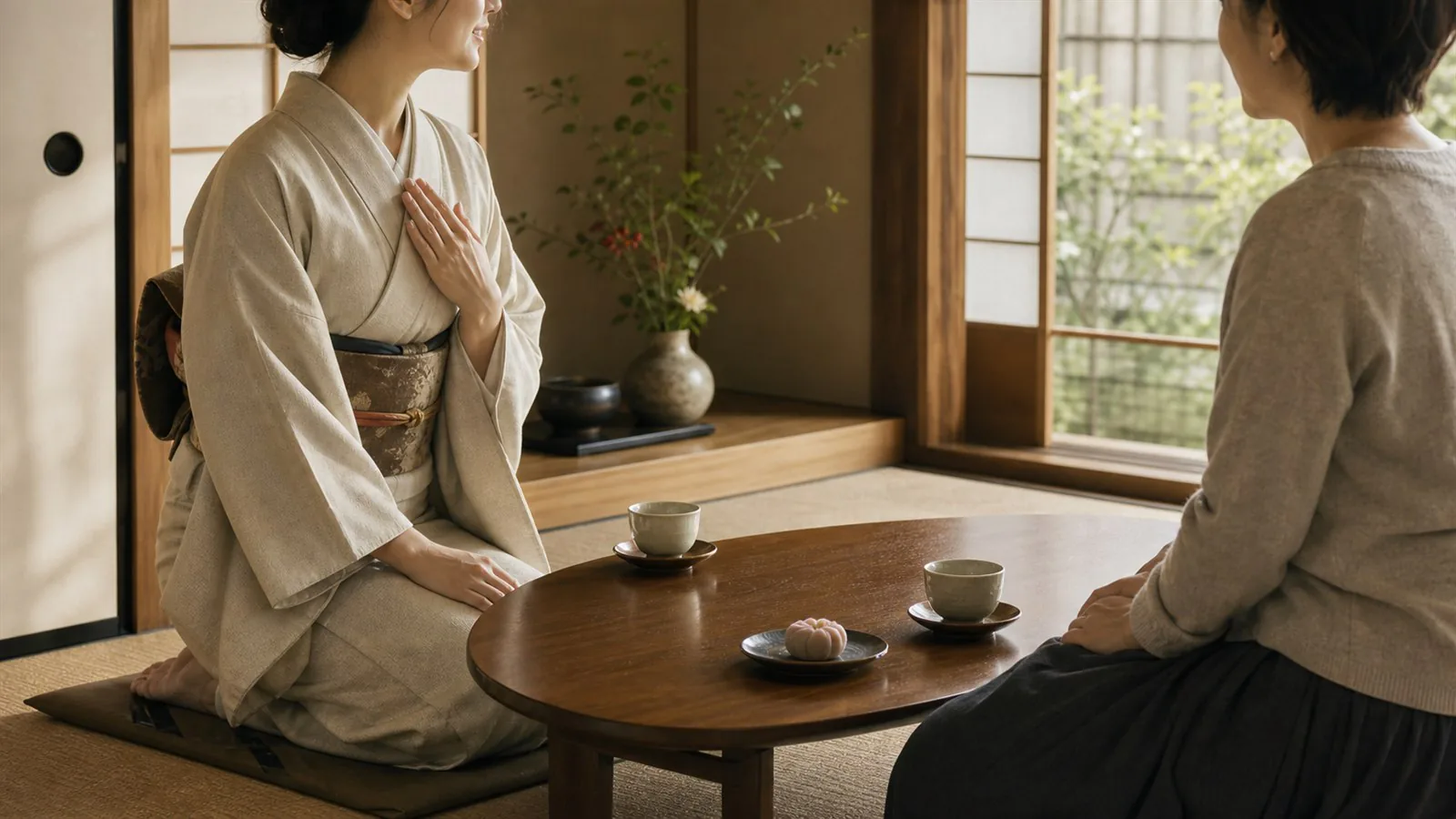
You think 「thank you for the compliment」 is the polite reply? In Japan, accepting praise directly is a breach of etiquette. The standard Japanese response to a compliment is 「いいえ、まだまだです」 (no, no — I am still nowhere close). This humility culture (謙遜, kenson) has 800 years of history and still runs daily interaction today.
The compliment exchange template
Compliment: 「日本語、お上手ですね」 (Your Japanese is excellent) NG response: 「ありがとうございます!毎日勉強してます」 (Thanks! I study every day) OK response: 「いえいえ、まだまだです」 (No, no — I am still nowhere close)
Compliment: 「お子さん、可愛いですね」 (Your child is so cute) NG response: 「そうですよね、毎日かわいいです」 (Right? I think so every day) OK response: 「いえ、いつもうるさくて」 (No, they are always so noisy) — deliberately pointing out the child’s flaws
Compliment: 「素敵な家ですね」 (What a lovely home) NG response: 「ありがとう、頑張ってデザインしました」 (Thank you, we worked hard on the design) OK response: 「いや、狭くて散らかってますが…」 (Oh no, it is cramped and messy)
The logic: elevate the other, downplay yourself
The core of Japanese social behavior: lift the other person up, push yourself down. Praising the other is fine; praising yourself is a breach, and praising your own family is also a breach (family is 身内, your inside group — and the inside group must be humble).
So when a Japanese mother calls her child 「うちのバカ息子」 (my idiot son), she is not actually saying he is dumb — this is social etiquette. Inside, she may believe he is the smartest child in the world.
The「inside」versus「outside」line
Japanese distinguishes 「身内 (uchiuchi)」 from 「よそ (yoso, outside people)」.
The inside group: family, your own company, your own school — must be downplayed in front of others.
The outside group: strangers, other companies, other schools — must be elevated in front of others.
For example, when an employee introduces their manager to a client: 「弊社の山田が…」 (Yamada at our humble company) — no honorific「Yamada-bucho」, because he is uchi and must be downplayed in front of the client.
But when speaking to the manager directly: 「山田部長、お電話です」 (Manager Yamada, you have a call) — add the honorific「bucho」, because at this moment he is a superior, not an inside-group member projected outward.
This is the hardest piece for foreigners to grasp — how you refer to a person depends on whom you are talking to.
Eight hundred years of humility culture
Kamakura-era Zen Buddhism in the 13th century was a major influence. Zen emphasizes 「no-self」 (muga) — setting aside ego, not clinging to「I am great」or「I am good」. Praising yourself reinforces the self, which violates Zen.
Edo-era bushido reinforced it: the truly strong do not need to say they are strong — let the actions speak. The proverb 「実るほど頭を垂れる稲穂かな」 (the more the rice ripens, the lower the head bows) sums it up.
Modernization in Meiji introduced Western notions of「self-confidence」and「self-promotion」, but the underlying logic of humility as virtue did not change.
「いえいえ」is the universal tool
「いえいえ」 (iie iie, no, no) is the standard prefix for receiving praise. It can be followed by:
- 「まだまだです」 (still a long way to go) — the universal version
- 「そんなことないです」 (no such thing) — the strong-denial version
- 「運がよかっただけです」 (just lucky) — attributing the accomplishment to luck
- 「みんなのおかげです」 (all thanks to everyone) — attributing the accomplishment to the team
- 「まぐれです」 (just a fluke) — the deepest self-deprecation
Praising others also has rules
Japanese people praise others too, but they often default to「safe-bet compliments」:
Safe: 「お元気そうで何より」 (Glad to see you in good health) — never wrong. Safe: 「お変わりありませんね」 (You have not changed a bit) — neutral. Safe: 「いつも頑張っていらっしゃいますね」 (You always work so hard) — emphasizing the process.
Avoid: overly specific praise (especially about appearance). For example, 「あなた、本当に綺麗ですね」 (You are really beautiful) — women find this uncomfortable (too direct, feels like a pickup line). Switch to 「素敵な雰囲気ですね」 (You have a lovely presence) — safer.
Scenarios where foreigners compliment Japanese people
First, complimenting a Japanese friend’s work: 「すごいですね、素晴らしいですね」 (Wow, amazing) — they will reply「いやいや」. Do not insist「No, really — you are amazing!」 That puts them in a corner. Let them say「まだまだです」 and move on.
Second, complimenting an inn or restaurant: tell the owner or chef 「とても美味しかったです」 (It was very delicious) — they will reply 「お粗末様でした」 (it was nothing, just humble fare). This is the standard response, meaning「you are too kind」.
Third, complimenting someone’s child: 「可愛いお子さんですね」 (Your child is so cute) — they will reply 「いえ、いたずらばかりで」 (Oh no, they are always making trouble). Do not push「No, really cute!」 — just move the conversation along.
The「humility upgrade」when receiving praise
The advanced version: redirect the compliment to a third party.
Compliment: 「あなたの料理、美味しいですね」 (Your cooking is delicious) Response: 「いえ、母から教わったんです、母の方が上手ですよ」 (Oh no, my mother taught me, and she is much better)
Compliment: 「あなた、英語上手ですね」 (Your English is great) Response: 「いえ、私の妹の方がずっと上手で」 (No, my younger sister is far better)
「Pushing the credit to someone else」is high-level humility.
Is this welcoming to foreigners?
Some Japanese understand that foreigners come from different cultures, and accepting praise directly is also accepted (「Thank you, I learned it for years」). But Japanese friends and colleagues you spend long stretches with will still appreciate it when you learn to reply with humility.
Pro tip: the all-purpose 「いえいえ、ありがとうございます」
If you are unsure how to reply, use 「いえいえ、ありがとうございます」 (No, no — thank you). Humility first, then thanks — a double safety net.
Closing: humility is not low self-esteem
The biggest foreign misunderstanding: 「the Japanese are humble, so they really think they are not good」. No. Japanese people may feel confident inside, but socially must be humble. These are two separate layers.
The next time you spend time with Japanese friends, when you compliment them, watch the reply — 「いえいえ、まだまだ」 is etiquette, not low self-esteem. Inside they may be very proud, just not in front of you.
This is the contemporary expression of 800 years of 「the more the rice ripens, the lower the head bows」.
Frequently Asked Questions
Why do Japanese people often deflect compliments?
It is usually a way to keep the social mood balanced, avoid sounding proud, and make the compliment easier to receive.
How should you respond to compliments in Japanese?
Say thank you, then add a light modest phrase such as “mada mada desu” if the situation calls for it.
Does Japanese modesty mean low confidence?
No. It is often a social technique. Someone can be confident privately while speaking modestly in public.
Do foreigners need to copy Japanese modesty?
Not excessively. A natural thank you, less bragging, and a slightly restrained tone in formal settings are enough.