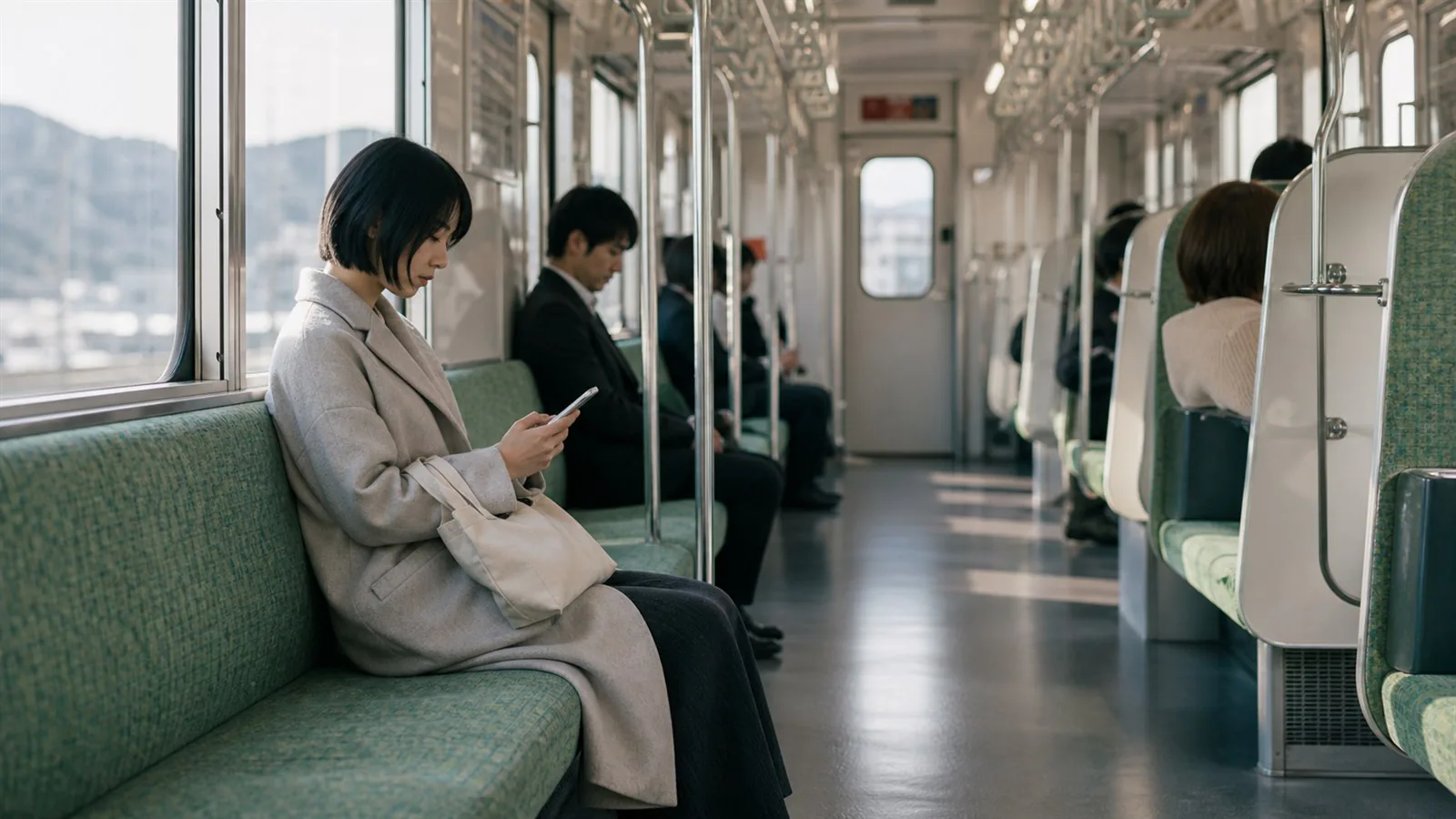
You think Japan’s no-phone-on-trains rule is because 「Japanese people love quiet」? In fact this unspoken rule has three layers: a clear historical cause, a medical-technology concern, and group-oriented culture.
1995: public anxiety and pacemakers
Mobile phones spread in Japan from 1995 to 2000. Second-generation handsets (PDC, PHS) used stronger transmission power, and medical research raised concerns about interference with 「心律調節器」 (pacemakers). In 1997 the rail companies began broadcasting 「優先席付近では携帯電話の電源をお切りください」 (Please turn off your mobile phone near the priority seats). This is the first version of the no-call rule — not「no speaking」but「no power-on」.
Later research found the interference risk to modern pacemakers was actually very small (the Ministry of Internal Affairs and Communications officially relaxed guidance in 2014), but the social habit of「no phone calls on trains」had already cemented, becoming a cultural norm independent of its original cause.
The concept of「meiwaku」in group culture
Japanese society has a core word — 「迷惑」 (meiwaku) — that literally means「trouble」but carries the weight of「inflicting trouble on others is a failed social act」. One person making a call on a commuter train is 「meiwaku」 to the dozens of other passengers in the carriage. The same logic applies to loud talk, strong-smelling food, smoking, and putting your backpack on the seat.
Why are Japanese people so sensitive to this? Historically the 「村社会」 (village society) was a tight collective-farming community, and ostracism by villagers (「村八分」) meant a threat to survival. That genetic memory carries into the present: the commuter train is the modern village, and if you disturb others, everyone will remember.
What is allowed and what is not inside the carriage
Allowed: reading, scrolling your phone (silent), texting, listening to music with headphones (no leak), sleeping, quiet conversation.
Not allowed: phone calls (including LINE calls and video calls), playing music aloud, loud talking, eating hot food (strong smell), applying makeup (somewhat debated), putting your backpack on the seat, leaning on the handrail asleep.
The shinkansen distinction
The shinkansen is a bit more relaxed than commuter trains. Brief answer-the-call moments are tolerated — you can pick up, say 「電車中なので、後でかけ直します」 (I am on a train, I will call back later), and hang up. For longer calls, walk to the 「デッキ」 (vestibule between cars). From 2024 some shinkansen even have 「リモートワーク座席」 (remote-work seats) where calls are allowed.
A real-world example
In 2018 a foreign visitor was on a video call on the Osaka loop line. The volume was reasonable; the surrounding passengers were expressionless. Three stations later an office worker walked over, bowed, and said: 「申し訳ありませんが、車内通話はご遠慮ください」 (I am sorry, please refrain from phone calls in the carriage). Bowing and using polite Japanese to issue the reminder — this is Japan’s collective pressure: gentle, but without compromise.
What to do on your next train ride
First, set your phone to silent (マナーモード) — this is muscle memory before boarding. Second, if a call comes in, briefly say 「電車中なので、後で」 (I am on a train, later) and hang up. Third, on the shinkansen, walk to the 「デッキ」 if you must talk. Fourth, if you really cannot resist, look at the people around you first — no one staring at you does not mean they cannot hear; the silence is them telling you 「あなたは迷惑です」 (you are causing disturbance).
This rule is not Japanese weirdness — it is etiquette that took 30 years to crystallize. Understand it, and you understand one of the core logics of how Japanese society works.
Frequently Asked Questions
Can you talk on the phone on Japanese trains?
As a rule, avoid phone calls inside the carriage. A brief “I will call back later” is usually fine, but long calls are considered disruptive.
Why are phone calls discouraged on Japanese trains?
It is less about law and more about meiwaku, or not bothering others. In a quiet carriage, a phone call forces everyone nearby to hear one side of a conversation.
Can you call on the Shinkansen?
Many long-distance trains have deck or connection areas where brief calls are acceptable. Step away from your seat before calling.
Is texting or using a phone silently okay?
Yes. Keep the phone on silent and avoid speaker audio, game sounds, or loud voice messages.