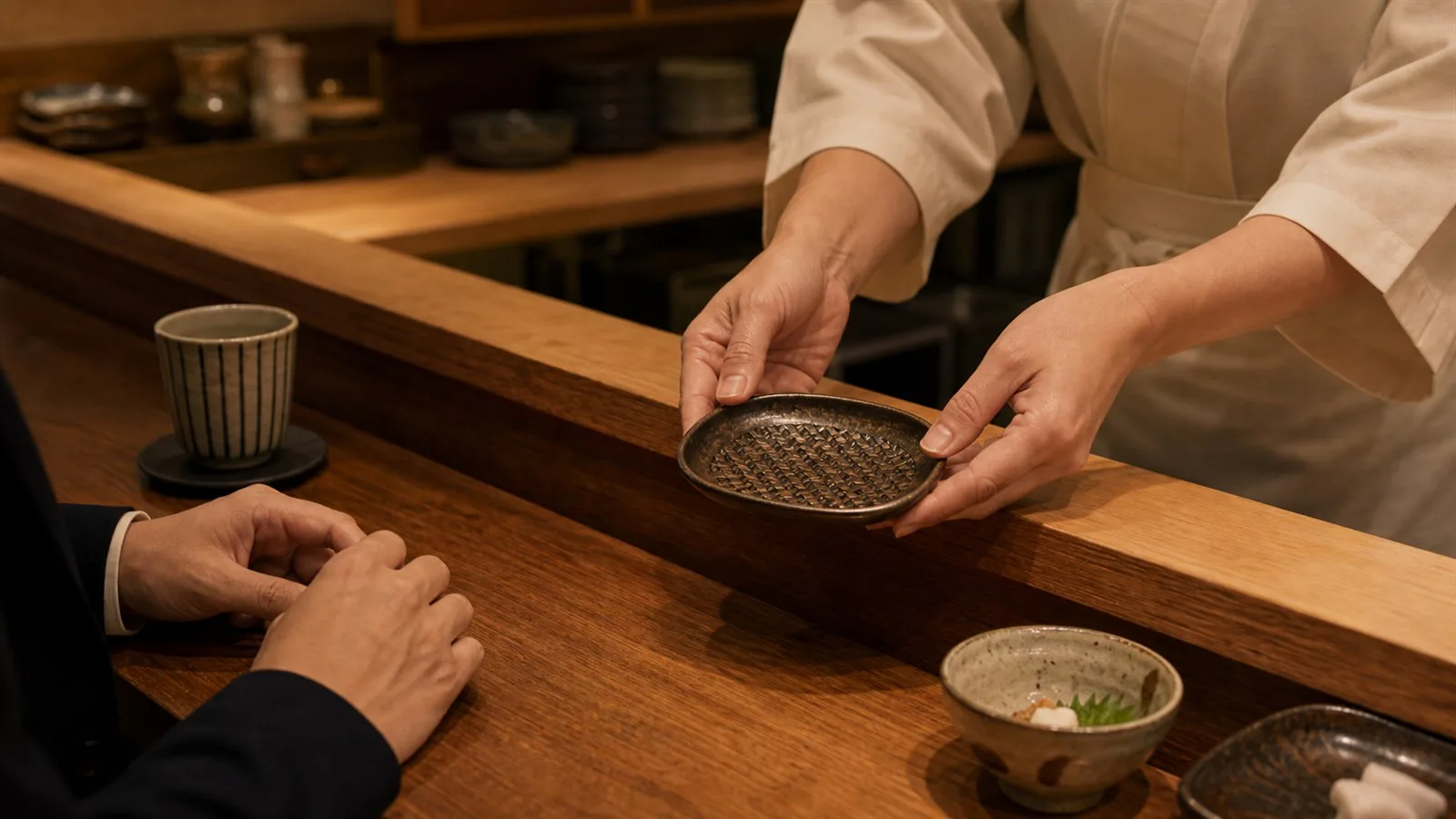
You think leaving a 10 percent tip at a high-end Japanese restaurant is considerate? In Japan, leaving a tip puts staff in a difficult position — and can even be seen as an insult.
American travelers fall into this trap most often. Leaving 1,000 yen on the table at a Michelin restaurant in New York gets a smile and a thank-you; at the same kind of restaurant in Tokyo Ginza, the server will chase you to the elevator, the street, or even the station to return the money. This is not polite ceremony — they genuinely think 「you dropped your money」. If you insist on pressing it into their hand, the smile freezes — because they cannot tell whether your message is 「the service was bad, here is some compensation」 or 「you look like you need money」.
Why is this? How Japanese people see the value of service
The core spirit of Japan’s service industry is called 「おもてなし」 (omotenashi). Translated literally as「hospitality」, the more accurate meaning is 「sincere reception, expecting nothing in return」. The concept goes back to 16th-century tea culture — at the tea ceremonies Sen no Rikyu hosted, the host prepared a single cup of tea for each guest, fussing over everything from water temperature to the placement of the utensils, but never accepting a tip when the guest left. The spirit of tea holds that sincere hospitality is itself the value, and money taints the gesture.
This logic carries into the modern era: the staff hourly wage, the restaurant price, the design of the whole system already builds in 「the proper level of service」. The 3,000-yen set you pay for is 3,000 yen — anything not on the menu should not exist. Extra money breaks the clean aesthetic of the system.
Are there exceptions?
A few situations allow it, but the form is completely different. First, the traditional inn 「旅館」, where you may prepare an envelope of 「心付け」 (kokorozuke, gratuity) — 1,000-3,000 yen, placed in a clean envelope and handed to the 仲居 (room attendant) the first time she lays the futon or brings tea, with the words 「お世話になります」 (thank you for taking care of us). Absolutely not by dropping money on the table after a meal.
Second, high-end geisha venues — the 「お花代」 (flower fee) for accompanying geisha or maiko is also given in an envelope. Third, taxis — but only as「keep the change」 (for example, a 850-yen fare where you pay 1,000 yen and say 「お釣りはいいです」), not as an extra on top.
A real-world example
In 2019 at a sushi restaurant in Osaka, an American tourist pressed 5,000 yen into the chef’s hand as they left. The chef returned it on the spot, but the visitor insisted: 「You earned it.」 In the end the chef bowed and said 「申し訳ありません、お気持ちだけ頂戴します」 (I am sorry, I accept only your good feelings) and returned the money. The owner later said in an interview: 「Money is not why we do this work. Forcing it on me tells me my service is worth only this much.」
What to do next time in Japan
First, never leave a tip at a restaurant. The bill is the total. Second, if the service really impressed you, use words — on the way out, tell the owner or server 「ごちそうさまでした、とても美味しかったです」 (thank you for the meal, it was delicious), and bow once. This makes them happier than any tip. Third, at a traditional inn, prepare a 「心付け」 envelope and hand it to the attendant on arrival (not at checkout).
Japanese service does not need a tip to motivate — that dignity is built into the culture. Understand this, and you will find yourself looked after even better.
Closing: turn the tipping urge into「specific remembrance」
The next time you receive exceptional hospitality in Japan, remember the name of the staff member or the shop, and express gratitude in Japanese when you leave. If you can, send a thank-you card after you get home. This carries more weight than any money — it proves you are not just a 「passing visitor」 but 「a person who knows how to be grateful after being looked after」. The highest level of Japanese service is 「再会を約束する」 (a promise to meet again) — your good manners today may mean you are recognized and welcomed even more warmly on your next visit. This is the invisible contract among Japanese people.
Frequently Asked Questions
Should travelers tip in Japan?
Usually no. Restaurants, cafes, taxis, and most hotels do not expect tips. Pay the bill as shown unless a specific service tells you otherwise.
Why can tipping feel awkward in Japan?
Service is treated as part of the job and the price already covers it. Extra cash can look like a mistaken payment or create confusion about how to accept it.
Is kokorozuke the same as tipping?
Not exactly. Kokorozuke is closer to a discreet gift of thanks, usually in an envelope, and appears only in specific inn or special-assistance situations.
How can travelers show appreciation instead?
A clear “arigatou gozaimasu” is usually best. Accept your change normally unless you can explain very clearly that you do not need it.