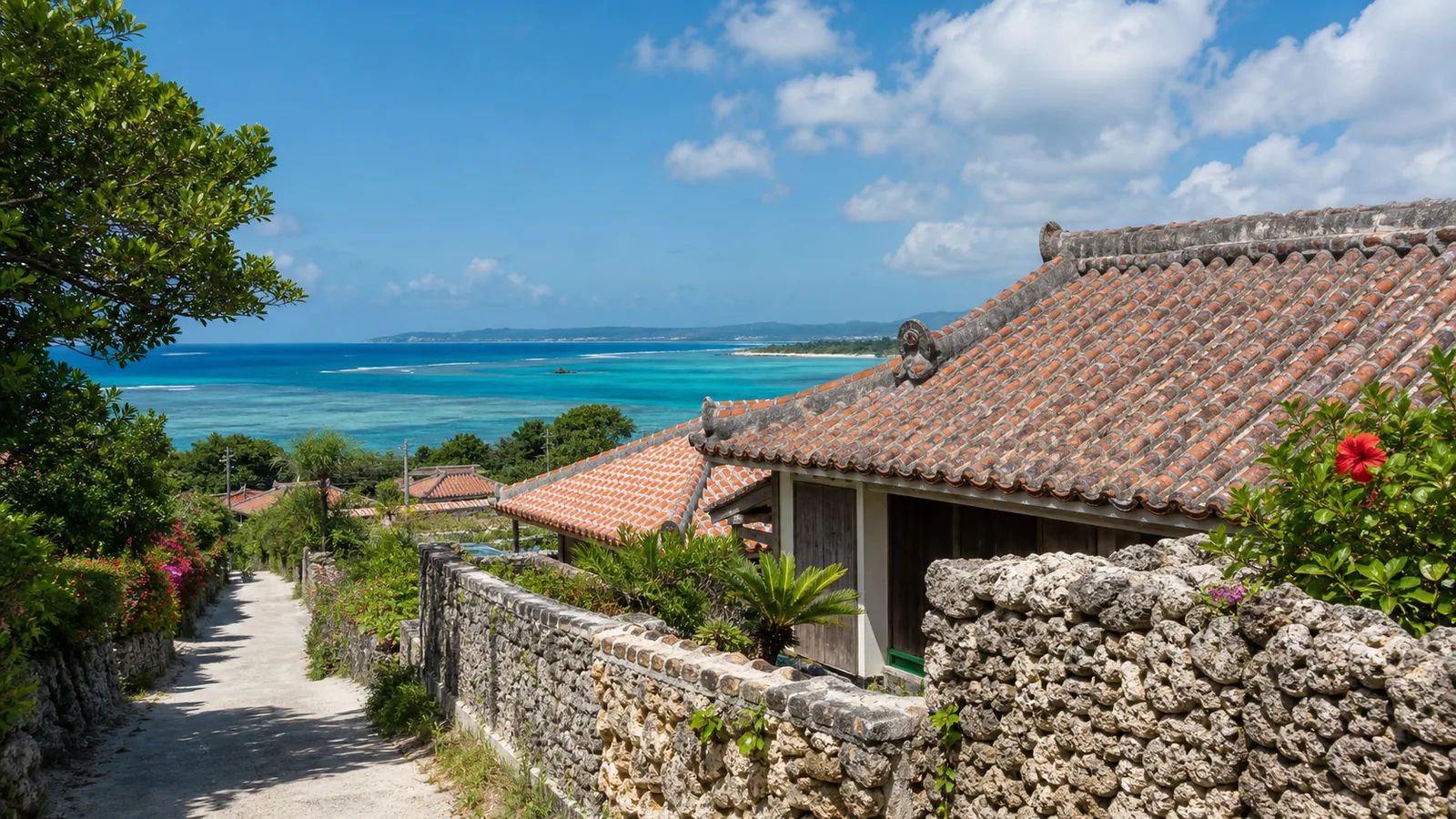
Okinawa is not Japan. At least that is what locals will tell you.
Why? Because Okinawa was originally the Ryukyu Kingdom (1429-1879), 450 years of an independent state that paid tribute to Ming and Qing China, paid tribute to the Satsuma domain of Japan, and traded with Southeast Asia, only forcibly incorporated into Japan in 1879 (the「Ryukyu Disposition」). Culture, language, food, architecture, and religion are all different from Honshu Japan — more like a hybrid of Taiwan, Fujian, and Southeast Asia.
Geography Located southwest of Japan’s main island, a one-hour flight from Kagoshima in Kyushu and 2.5 hours from Tokyo. Okinawa Prefecture consists of more than 160 islands grouped into four main clusters: Okinawa Main Island, the Miyako Islands, the Yaeyama Islands (Ishigaki, Iriomote, Yonaguni), and the Daito Islands.
Area: 2,281 sq km (slightly smaller than Taipei plus New Taipei combined), population 1.46 million — dense but with little land. The southernmost Yonaguni Island sits only 110 km from Hualien in Taiwan, but 1,900 km from Tokyo — closer to Taiwan than to the Japanese mainland.
The climate is subtropical: an average of 17 degrees in January, 28 in August, and no snowfall the entire year. Rainy season May-June, typhoons July-October (Okinawa lies on the typhoon track, so summer flight bookings come with mental preparation).
The history of the Ryukyu Kingdom — 450 years In the 13th century three Okinawan kings divided the islands (Hokuzan, Chuzan, Nanzan). In 1429 Sho Hashi unified the three and founded the Ryukyu Kingdom, with its capital at Shuri (today’s Shuri Castle).
Ryukyu paid tribute to the Ming (then Qing) for more than 400 years (from Hongwu to Guangxu), and from the 17th century also paid tribute to the Satsuma domain in Kyushu — a dual tribute. Writing, Confucianism, and architecture were imported from China; kimono elements and food came from Japan.
1879: the Meiji government abolished Ryukyu and established Okinawa Prefecture, ending the kingdom. China sent an envoy to protest in 1872, but Japan refused to return Ryukyu.
1945: the Battle of Okinawa in World War II ran 82 days of intense US-Japan combat, with one third of Okinawans killed (120,000) — the worst battle on Japanese soil.
1945-1972: 27 years of US military occupation, using US dollars and right-hand-side traffic (later switched back to left). Returned to Japan on May 15, 1972.
To this day US bases occupy 15 percent of Okinawa’s main island land, and 70 percent of US forces stationed in Japan are concentrated in Okinawa. Local 「base issue」 movements continue.
What to do on the main island Naha (population 400,000) is the capital. Kokusai-dori (the Naha shopping street) runs 1.6 km, with Okinawan souvenirs, beni-imo treats, awamori liquor, indigo dye, and Ryukyu glasswork.
Shuri Castle: the Ryukyu Kingdom ruins. The main hall was destroyed by fire in 2019 and is currently being rebuilt (partial reopening mid-2026). You can visit the outer park and Shureimon Gate.
Churaumi Aquarium: in northern Okinawa, one of the world’s largest fish aquariums, with rare displays of whale sharks and manta rays. A two-hour drive from Naha.
Manzamo: a coastal viewpoint shaped like an elephant’s trunk rock formation.
Okinawan cuisine Okinawan food is completely unlike Honshu. Goya chanpuru: bitter melon, tofu, egg, and pork stir-fried — the signature dish. Bitter melon is called 「ゴーヤ」 (in the Okinawan dialect).
Rafute (kakuni): pork belly slow-braised for 3-4 hours in awamori and soy sauce until it melts in the mouth — much like Dongpo pork.
Okinawa soba: not buckwheat (no soba flour) but a wheat noodle, served with pork bone broth, braised pork ribs, and pickled red ginger. Originated with Fujianese Chinese immigrants.
Juushi: Okinawan seasoned rice with pork and seaweed — some say it descends from southern Chinese rice dishes.
Sea grapes (umi-budo): tropical seaweed with a roe-like texture, a fresh garnish in salads.
Beni-imo (purple yam): an Okinawan specialty, made into tarts as a must-buy souvenir, with Okashi Goten the famous maker.
Awamori: Okinawan rice shochu, distillation technique imported from Thailand in the 15th century. Alcohol content 25-43 percent, and aged awamori (古酒 / クース) mellows like whisky.
The outer islands — the real paradise Okinawa’s main island is fine, but the real paradise is the outer islands (Kerama, Miyako, Ishigaki, Iriomote, Yonaguni).
Miyako Island: a 45-minute flight from Naha. The clearest water in Japan — the unforgettable 「Miyako blue」. The Irabu Bridge (3.5 km across the sea), Higashi-Hennazaki Cape, and Sunayama Beach. Snorkeling reveals coral and sea turtles.
Ishigaki Island: a 55-minute flight from Naha, the center of the Yaeyama group. Kabira Bay (one of JTB’s three great Japanese scenic views) and a diving paradise. The closest to Taiwan (270 km in a straight line). During the Japanese colonial period many Taiwanese migrated here, and the island still has Taiwanese descendants (the Ishigaki Taiwanese Descendants Association), with food influenced by Taiwan.
Iriomote Island: a 45-minute boat from Ishigaki. Ninety percent is tropical primary forest, home to the endangered endemic Iriomote wildcat, with mangrove kayaking, river trekking, and waterfalls — extremely raw.
Yonaguni Island: Okinawa’s westernmost point, 111 km from Taiwan (visible on clear days). The underwater ruins (suspected prehistoric artificial structures discovered in the 2000s), the Yonaguni pony (a small breed), and the marlin fishing grounds.
Travel suggestions 4-5 days: the main island (Naha, Churaumi, Manzamo). 7-10 days: main island plus one outer island (Miyako or Ishigaki). Pure island focus: fly direct to Ishigaki or Miyako and skip the main island (the most common style).
Driving: Okinawa has no JR and weak bus service — rental cars are easiest (Ishigaki and Miyako airports both have rental counters). Japanese and international driving permits work, but a Taiwanese license cannot be used in Okinawa (the post-2007 Taiwan-Japan agreement applies, but a Japanese translation is required).
Best seasons: April-June (before the rainy season) and September-October (after typhoons, water still warm). Avoid: July-August (summer crowds plus typhoons) and December-February (sea too cold to swim).
The next time you plan a trip to Japan, if you want a completely different Japan — not cherry blossoms, samurai, and shrines, but tropical ocean, Ryukyu culture, and a US military hybrid — Okinawa (especially the outer islands) is the top pick. Do not treat it as「Japan’s Hawaii」 — it has 600 years of its own story, and it deserves to be known on its own terms.