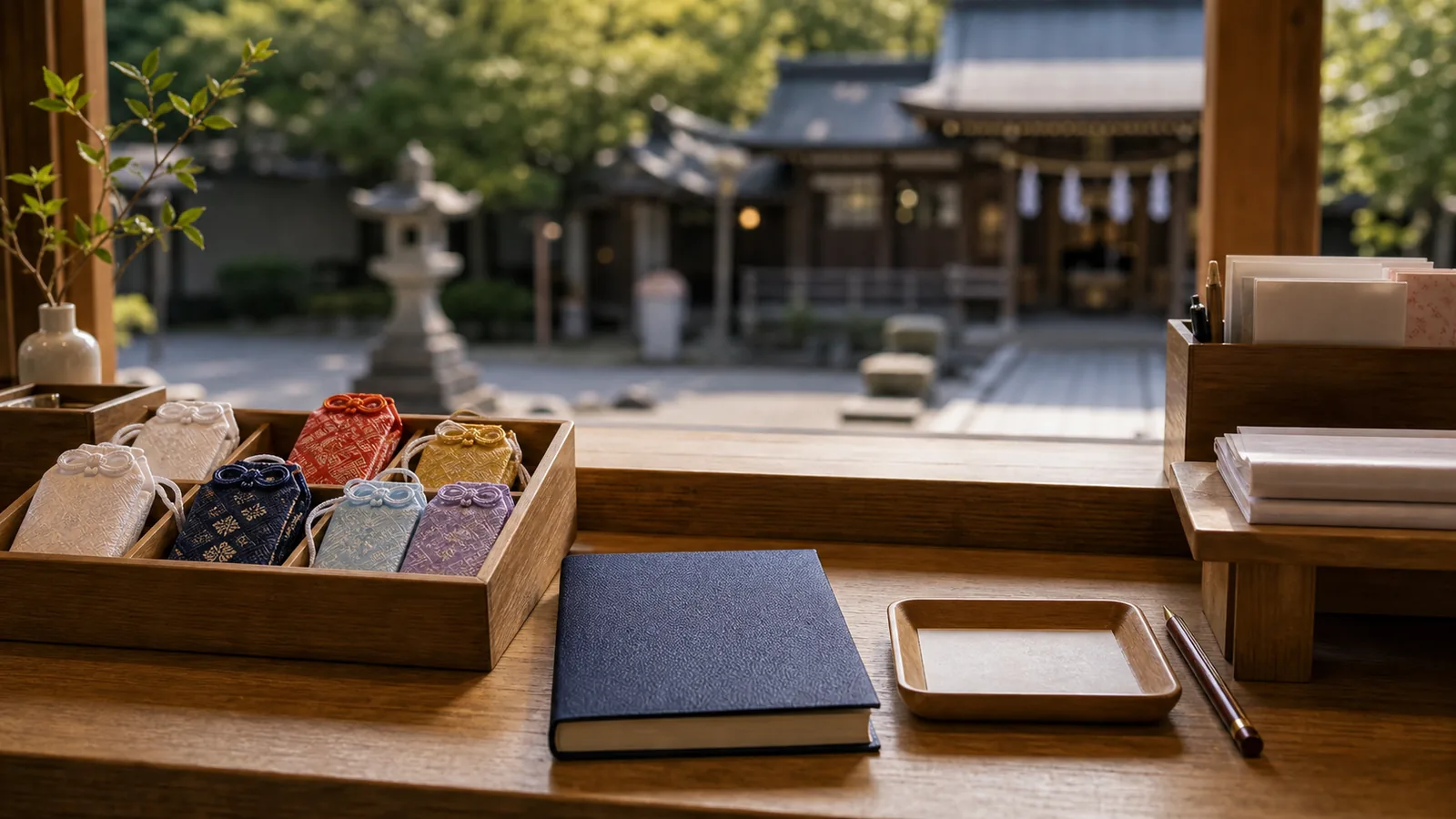
At shrines and temples in Japan, you will see two kinds of「take-home」keepsakes: 「お守り」(omamori), colorful little fabric pouches, and 「御朱印」(goshuin), calligraphy-and-seal mementos. The most common tourist actions are grabbing a pink omamori for a souvenir or pointing a camera at someone’s goshuin book. Neither of these is an ordinary souvenir — they are「portable sacred objects」with a shelf life, a disposal process, and things you must not do. This article explains how to choose, receive, use, and return them.
What is an omamori? An omamori (お守り) is a small fabric pouch containing a「御札」(sacred talisman), worn as portable protection. Each omamori has a theme: — 健康守 (health): bodily safety — 学業守 (study): exam success and academic flow — 縁結び (love): romance, attraction, marriage — the best seller among women — 金運守 (wealth): prosperity and business success — 交通安全 (transit): safe travel and driving — a good pick for tourists — 安産 (safe birth): for expectant mothers — 病気平癒 (recovery): for the sick — 必勝 (victory): athletics, exams, competition — 災難除け (warding off disaster): for avoiding misfortune
How to choose? 1. Pick what you want: this is the core of etiquette — choose the theme that matches your current need, do not buy by color. 2. Match the shrine’s「ご利益」(faith specialty): each shrine has a focus. — Fushimi Inari Taisha in Kyoto: commerce and harvests (Inari is the patron of trade and industry) — Meiji Shrine in Tokyo: longevity and family harmony — Kanda Myojin in Tokyo: love and study (Kanda Myojin is the traditional 「Edo guardian」) — Jishu Shrine in Kyoto: love specialist (next to Kiyomizu-dera, walk right in) — Ise Grand Shrine in Mie: the oldest and most sacred shrine, with the broadest blessings — Yushima Tenmangu in Tokyo: exam success (the top study shrine in the Kanto region, a must for test-takers) 3. Look at color and design: among the same theme, pick the design you like (pink, blue, gold, purple), but theme outranks color.
Rules for using omamori — things not to do — Do not open it — the talisman inside is sacred; opening it equals breaking the sanctity, and the power is lost — Do not wash it — never put it in the laundry — Do not pile up omamori from many shrines — multiple kami in one place are said to「fight」(folk belief, but Japanese habit is to keep them separate) — Shelf life is one year — after one year, return it to the shrine for 「お焚き上げ」 (the burning rite); do not keep it forever
What is a goshuin? A goshuin (御朱印) is a 「proof of visit seal」 from a shrine or temple — a priest or monk writes the shrine or temple name plus the date in brush calligraphy and stamps it with vermilion seals on the spot. Collected in a 「御朱印帳」 (goshuin book), similar to a passport stamp book. Cost: 300-500 yen per entry. The book itself: 1,000-3,000 yen (designs vary by shrine).
Goshuin etiquette — 1. Worship first, then receive — the goshuin is a「memento of having worshipped」, and going straight to the desk without worshipping is rude. Complete the two-bows-two-claps-one-bow at the shrine or the silent prayer at the temple, then go to the 「授与所」 (issuing office) to request the seal — 2. Cash only — no credit cards or IC cards — bring 500-yen coins or notes — 3. Do not watch the brushwork — watching is rude (considered disruptive). Wait quietly for 5-15 minutes, then receive with both hands — 4. Do not request special designs — the goshuin is the official version, you cannot ask 「I want cherry blossoms」 or similar — 5. Buy a fresh book — do not mix shrine and temple goshuin in the same book (Shinto and Buddhism are kept apart). The conservative approach is two books — 6. Do not photograph the brushwork in progress — most shrines forbid photographing the writing (after completion you can photograph your own book)
Special goshuin: limited-time editions Some shrines release 「期間限定」 (limited-time) goshuin — for example during New Year, summer festivals, foliage season, or specific anniversaries — with different designs (more elaborate, sometimes painted). Search 「○○神社 御朱印」 on Twitter or Instagram to see what is current. Note: limited editions usually mean long queues (2-3 hours) — bring patience.
Special omamori: choosing the right goshuin book — Kitano Tenmangu in Kyoto: 「plum」 design with plum blossom motifs, fitting for study prayers — Kanda Myojin in Tokyo: 「festival」 design, multicolored, one of Tokyo’s best sellers — Fushimi Inari Taisha in Kyoto: fox-themed design, cute and practical — Kasuga Taisha in Nara: deer-themed design for the Nara deer — Itsukushima Shrine on Miyajima: the iconic sea torii design, a World Heritage keepsake
Collection strategy — First time in Japan = pick 3-5 important shrines or temples, not 20. Curation beats quantity — Design first = pick limited editions or shrine-signature designs over random small shrines — Itinerary chaining = a Kyoto route can chain Kiyomizu-dera → Yasaka Shrine → Fushimi Inari for 4-5 goshuin in a day — Storage = keep the book upright or flat, do not fold, do not leave in direct sunlight
Handling expired omamori — what to do after a year After one year, omamori must go through 「お焚き上げ」 (the burning rite): — Return to the original shrine: place it in the 「古札納所」 (old-talisman bin) — free, and the shrine burns them in batch — Return to any shrine or temple: it does not have to be the original; a nearby shrine also accepts them — Do not throw it in the trash — extremely rude Goshuin books have no expiration and can be kept indefinitely; when no longer needed, return them to a shrine’s 「お焚き上げ」 station.
Pro tip: buy your first goshuin book at a meaningful shrine Choose your first goshuin book at a shrine that means something to you — for study go to Yushima Tenmangu, for love go to Jishu Shrine in Kyoto, for an all-rounder go to Meiji Shrine. Get your first seal at that shrine, then collect memories from there. A year later, when you open the book, every seal carries a piece of a trip’s story — far more valuable than any pile of ordinary souvenirs. Next time in Japan, do not just take photos — try a full 「worship → seal → collect」 cycle once, and your travel experience will level up.
Frequently Asked Questions
Can I open an omamori?
It is not recommended. The inside is not meant to be inspected as a souvenir. Keep it clean and closed.
Must I return an omamori after one year?
Returning it to a shrine or temple is common, but it does not instantly become disrespectful after one year. Keepsake storage is also common.
Should I worship before receiving goshuin?
Yes. Goshuin is a record of worship, not just a stamp collection. Worship first, then request it at the counter.
Can I photograph goshuin being written?
Follow local rules. If unsure, do not put your phone close to the staff or brushwork area.