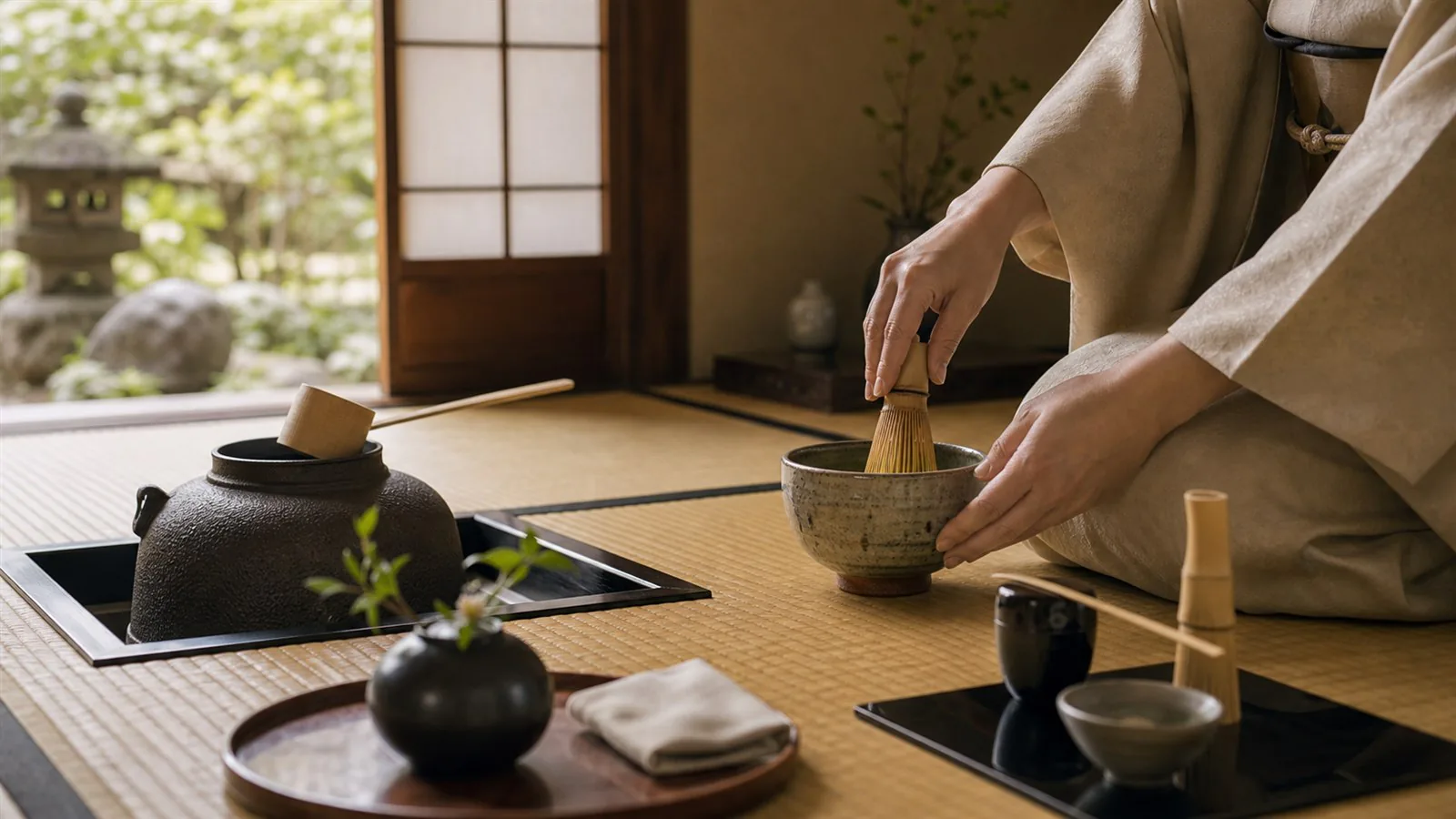
You think Japan has great service because 「service-sector wages are high and competition is fierce」? In fact Japanese service workers’ wages are not particularly high, yet the service level is top in the world. The reason is 「おもてなし」 (omotenashi, the spirit of hospitality) — a service philosophy with 500 years of history, rooted in the way of tea.
The etymology of「おもてなし」
There are two readings of 「おもてなし」: first, 「お持て成し」 — combining 「持つ」 (to hold) and 「成す」 (to complete) — meaning 「to complete the hosting with what one wholeheartedly holds」. Second, 「表無し」 — combining 「表」 (surface) and 「無し」 (none) — meaning 「no distinction between surface and reality; heart and action are one」.
Both point to the same core: sincere hospitality, expecting nothing in return, treating inside and outside the same.
The 16th century: the foundations of tea
Tea master Sen no Rikyu (1522-1591) is the foundational figure for the modern meaning of omotenashi. The tea ceremonies he hosted followed four principles, summed up as 「和敬清寂」 (harmony, respect, purity, tranquility):
Harmony: harmony between host and guest. Respect: mutual respect. Purity: tea utensils, tea room, and heart all clean. Tranquility: aesthetic expressed through simplicity and quiet.
Every detail of the tea gathering — the timing of sprinkling water in the garden, the angle of turning the bowl, the orientation of the guest’s seat — was arranged so the guest could feel「the host did this for me」. 「Done for one person」 is the core.
The four characteristics of omotenashi
1. Anticipating needs unprompted: providing without being asked. For example, an inn attendant notices the guest is tired and brings a hot towel without being asked.
2. Detail taken to the extreme: plating, room temperature, lighting, a folded paper crane — nothing is casual.
3. No expectation of reciprocity: even if you will never return, the service level does not change. A Japanese server does not cut corners because 「this customer will not be back」.
4. The invisible part matters most: the distance between plates, the warmth in a tone, the timing of a bow — these「unseen」details are the core.
Modern manifestations of omotenashi
Scene 1: the shinkansen cleaning crew The world-famous 「seven-minute miracle」 — within seven minutes after a shinkansen pulls in, the cleaning crew enters, empties the carriage, flips the seats, mops, tidies, then lines up and bows together. Each carriage has 22 rows of seats, and every small detail is completed. The bow is not a performance — it is genuine respect for the next wave of passengers.
Scene 2: the department store opening Before 10 a.m., employees line up at the entrance. At 10 a.m. on the dot, staff bow to greet the first customer. Even if you are just passing by, you will receive a bow. This is not marketing — it is ritual.
Scene 3: the water at a soba shop You sit down, and the owner brings a glass of cold water unprompted (hot tea in winter). No ordering needed, automatically provided. Once you finish, the owner refills it without you noticing.
Scene 4: the taxi door The rear door of a Japanese taxi is a driver-operated automatic door. The guest never opens the door themselves. This is「never make the guest do work」 made concrete.
Scene 5: the inn attendant’s note After you check in, you mention 「we depart at 6 a.m. tomorrow」. At 5:30 a.m., outside your door appears a handwritten note saying「お早うございます、今朝のお発ち、お気をつけて」(good morning, please take care on your departure today) plus hot tea. This is not procedure — it is heart.
The difference between omotenashi and「service」
English「service」is a contractual exchange — you pay, I deliver. It is reciprocal.
「Omotenashi」 is a gift — I do this for you, regardless of what you give me. There is no reciprocal obligation.
That is why Japanese service workers do not accept tips (the other party feels you misunderstood the relationship), do not rank customers (VIPs and passers-by receive the same bow), and do not skimp (even the free water is thoughtful).
Pitfalls: common foreign tourist misunderstandings
First, taking omotenashi to mean「they are polite, I can demand whatever I want」 — NG. Japanese people respond to「greedy customers」with surface politeness and inner refusal, and the next time you come, service「subtly」 drops a notch.
Second, reacting to unprompted service with「why? I did not ask」 — NG. This is a gift; accept it with a bow of thanks.
Third, excessive thanks (bowing ten times in a row) — NG. A single 「ありがとう」 suffices; repeated bowing puts the other party in a bind.
The cost of omotenashi
This system is not free. Japanese service workers shoulder extreme workloads with little personal time. Many young workers leave the service sector because the「never make a single mistake」 pressure is too much. After 2010 the labor shortage in service became serious, and a tension emerged between maintaining omotenashi and being a worker-friendly workplace.
From 2025, some new firms have started reducing excess omotenashi, freeing staff from worrying about minor details. But traditional inns, Michelin restaurants, and the shinkansen still hold the extreme standard.
The traveler’s response: be「a guest worth hosting」
First, accept, do not demand — when unprompted service comes, smile and accept; do not refuse with 「I do not need it」 (the other party will be troubled).
Second, return the bow — when someone bows to you, return a shallow bow.
Third, thank on departure — 「ありがとうございました、ご馳走様でした」 (thank you, thank you for the meal) — the full form.
Fourth, respect their property — the inn bedding, the restaurant’s plating, the museum’s display — do not touch or move them carelessly.
Fifth, follow unwritten rules — queue, keep your voice down, clean up your own trash. Your respect will be noticed, and staff will remember you.
Pro tip: thanks that exceed expectations are remembered
If a particular inn looked after you, mail a card from home noting the date, room number, attendant’s name, and your thanks. The letter will be passed around the entire inn. The next time you visit, they will remember you and give you the best room.
Closing: omotenashi runs both ways
The omotenashi Japanese people show foreign tourists is a gift, but it requires the other party to understand that「receiving plus respect equals true hospitality」. One-sided demands for service are not the object of omotenashi — they are the object of「entitled customer」.
The next time you are in Japan, feel the bow of the shinkansen cleaning crew, the note from the inn attendant, the automatic taxi door — these are not「service」, they are the concrete expression of 500 years of tea-room spirit.
Frequently Asked Questions
What does omotenashi mean?
It is often translated as hospitality, but it means anticipating needs gracefully before the guest has to ask.
How is omotenashi different from ordinary service?
Ordinary service completes requests. Omotenashi emphasizes foresight, detail, and care without expecting an extra reward.
Does good service mean customers can demand anything?
No. Japanese service still has rules. Thoughtful help does not mean staff must accept requests that break the system or bother others.
How should travelers respond to omotenashi?
Thank people clearly, follow the rules, and do not treat thoughtful service as automatic entitlement.