Many travelers head to a Japanese onsen for the first time, see the big bath, and want to jump straight in — then get stopped by staff, or receive a wordless stare from the grandfather sharing the tub. Japan’s onsen「お風呂」comes with a complete etiquette, and every step has a reason. The Japanese are not being picky — it is a combined matter of public hygiene and cultural respect.
Step 1: get fully naked, really naked Almost all Japanese onsen are fully nude — wearing a swimsuit into the bath will earn a scolding. Men and women are separated (the「男湯」and「女湯」curtains), so do not worry. A small number of mixed-gender baths allow a wrap towel, but these are increasingly rare. The changing area has baskets or lockers — put all your clothes inside, taking only a small towel into the bath area. Underwear comes off too — do not try to keep it on. People really have tried.
Step 2: rinse with「掛け湯」before entering As you walk from the changing room into the bath area, you will see a small basin or a nearby faucet called 「掛け湯」 (kake-yu). Wet your small towel and rinse yourself starting from your feet and working up to your torso, letting your body adapt to the temperature. This is not decoration — it prevents cardiac shock from going straight from a cold body into hot water, and it rinses off surface dirt.
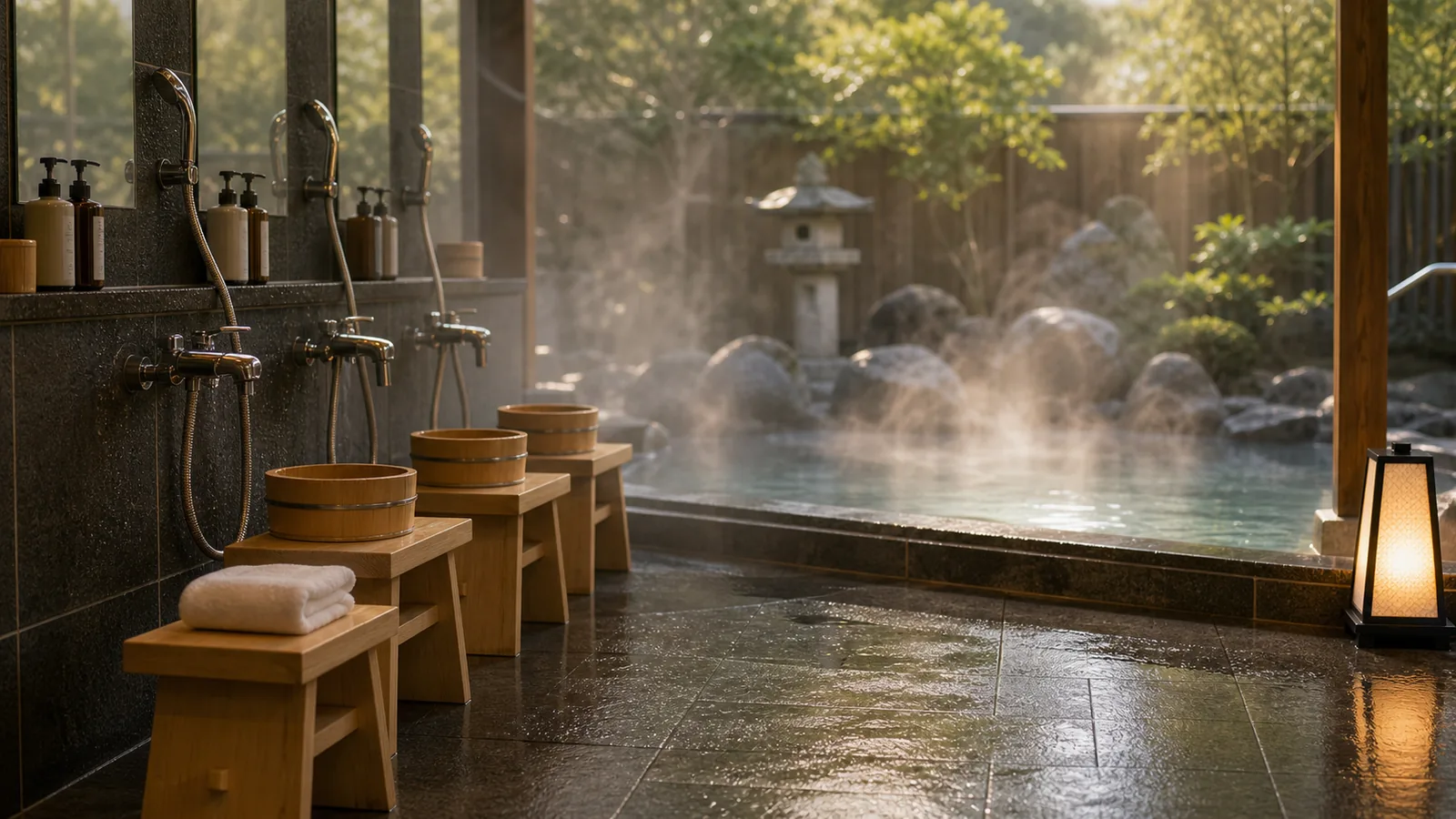
Step 3: sit at a washing station and clean yourself with soap Along the wall of the bath area is a row of 「洗い場」 (washing stations) — each with a showerhead, a small stool, soap, and shampoo. You must wash here first before entering the big bath. Sit down to wash (do not stand and spray onto people next to you), soap up your whole body, wash your hair, and rinse clean before walking to the onsen pool. Skipping the wash is a major breach — everyone shares the same pool, and bringing in dirt ruins the water for everyone.
Step 4: before getting in, keep the towel out of the water The small towel is for modesty and for washing — it does not go into the onsen pool. Before stepping in, fold the towel and set it on the rim, or balance it on your head (the classic image). If someone’s towel goes in the water, Japanese people will not say anything but will quietly move to a different tub.
Step 5: ease in, no swimming, no loud talk Step in slowly to let your body adjust. No swimming, no diving, no scrubbing yourself in the tub. The tub is for relaxing, not a pool. Conversation is fine, but keep the volume low — the atmosphere of an onsen is quiet. If you have long hair, tie it up so it does not touch the water.
Rinse off after? Two schools After getting out, there are two camps: one says rinse with fresh water (to wash off the mineral water and avoid dry skin), the other says let the minerals stay on the skin (since that is the point of the onsen). In most cases no rinse is needed — just towel off and head back to the changing room. People with dry skin or sensitivity to sulfur springs can take a quick rinse.
What about tattoos? A big issue. Most traditional onsen refuse entry to tattooed guests, because tattoos are traditionally associated with organized crime in Japan. With more tourists, attitudes have loosened. You can look for 「Tattoo Friendly」 onsen, or choose 「貸切風呂」 (private rental baths). Small tattoos can be covered with skin-tone patches (sold at drugstores), but large areas really cannot get in. Before you go, Google 「○○ onsen タトゥー」 to check the policy.
Pro tip: for your first time, a「貸切風呂」is the safest If you are new to onsen, book a night at an inn with a 「貸切風呂」 — a pressure-free private space where you can practice the full flow once before taking on the big bath. Hakone, Izu, and Kusatsu all have many such options. When booking on Booking or Rakuten Travel, search for 「貸切露天風呂付き」 to filter. Next time in Japan, do not skip the experience — once you have soaked in a proper onsen, you will see why Japanese people are so devoted to it.
Frequently Asked Questions
Do I wear swimwear in Japanese onsen?
Most gender-separated public baths are nude. Mixed baths, swimsuit baths, and themed facilities may have different rules.
How clean should I be before entering the bath?
Wash your body and hair thoroughly at the washing area, rinse off all soap, then enter the shared bath.
Can my towel go into the onsen water?
No. Put the small towel on your head or beside the bath. Keep long hair tied up and out of the water.
Can people with tattoos use onsen?
It depends on the facility. Some ban tattoos, some allow covers, and some are tattoo-friendly. Check before going.