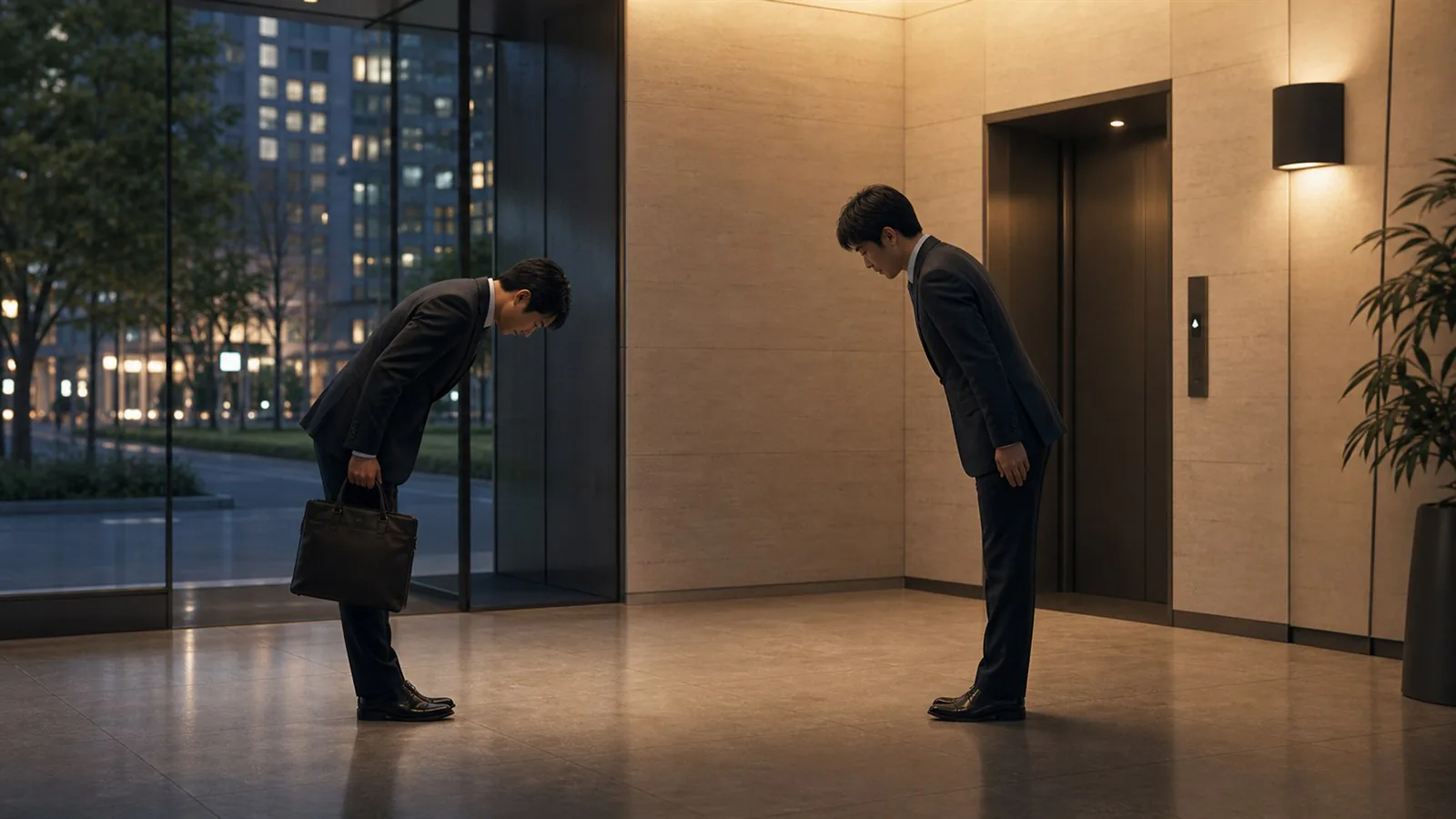
You think 「good work」 in Japanese is just 「お疲れ様」? In fact there is a near-synonym, 「ご苦労様」 (gokurosama), but using it on the wrong person instantly marks you as someone who does not know the rules. The difference: top-down versus peer / bottom-up.
The rule in one line
「お疲れ様」 (おつかれさま, otsukaresama): usable with anyone — peers, superiors, clients, shop staff. It is modern workplace Japan’s universal「good work」.
「ご苦労様」 (ごくろうさま, gokurosama): only top-down — a boss to a subordinate, an elder to a junior, an owner to a staff member. The reverse direction is rude.
If you are a junior employee saying 「ご苦労様です」 to a director, the director will frown — it implies 「I see you worked hard today」, a top-down posture that you do not have the standing to take.
Why the distinction? Historical origin
「ご苦労」 originally referred to a task assigned by a lord to a retainer. In Edo-era Japan, when samurai returned from a mission, the lord would say 「ご苦労であった」 (well done), and the retainer bowed in acceptance. This usage inherently carries the power structure of「I gave the task, you completed it, I commend you」.
By contrast 「お疲れ様」 only became widespread after the Meiji era. It lacks that hierarchical sense and is used reciprocally to acknowledge effort. In the postwar push for workplace equality「お疲れ様」took over and became the default. But the old 「ご苦労様」 lingered as a fossil meaning「strictly top-down」.
Typical scenarios: which one to use?
First, leaving the office at the end of the day: tell colleagues 「お先に失礼します、お疲れ様でした」 (I am heading off — good work). To a director still working overtime, also 「お疲れ様でした」. Never use ご苦労様 with a director.
Second, a convenience store clerk after checkout: 「ありがとうございます」 is enough — you do not say お疲れ様 to clerks. But if you are the owner stepping out to check on your employees, 「ご苦労様」 is fine.
Third, a delivery person handing you a parcel: the most common tourist trap. The delivery worker is not your subordinate, so 「ご苦労様」 is rude. The right reply is「ありがとうございます」or「お疲れ様です」. That said, some older Japanese people do say 「ご苦労様」 to delivery workers — they see themselves as the「paying party」with a lord-like stance, and the older generation still accepts this. Younger generations do not use it this way.
Fourth, a taxi driver after a ride: after paying, say 「ありがとうございました」. Do not say ご苦労様.
A third option:「お世話になりました」
There is also 「お世話になりました」 (osewa ni narimashita) — literally 「I have been in your care」, used when leaving someone who has looked after you for a stretch (a landlord, a long-term partner, an internship site). More formal than 「お疲れ様」. When checking out of an inn, a tourist can say 「お世話になりました」 — the inn staff will be deeply moved, because the phrase carries 「I took these days as you taking care of me」.
「お疲れ」 — the shortened form
Close friends drop the formal ending, going straight to 「お疲れ」 (without the 「様」「です」 suffixes). This is a very intimate form, used only with very close colleagues or friends. Using 「お疲れ」 with seniors or strangers comes across as too casual.
A real-world misstep
A Taiwanese exchange student on internship in 2022 said to her department head on her last day: 「ご苦労様でした、お世話になりました」. The director went silent for half a second, then politely said 「あ、ありがとう」 (oh, thank you). Later her Japanese supervisor told her privately: 「ご苦労様でした is what a boss says to a subordinate. Saying it to a senior comes out like「you worked hard, well done」, in a top-down tone. Use お疲れ様でした instead.」
Pro tip: when in doubt, use 「お疲れ様」
If you cannot tell where the other person stands, always pick 「お疲れ様」. It cannot go wrong — it covers peers and top-down; people above you accept it too. 「ご苦労様」 is high-risk usage, so dodge it without certainty.
The next time you find yourself in a Japanese office or workplace setting, listen to how Japanese people use these phrases. You will notice that young workers almost never use 「ご苦労様」 — you only hear it from managers to their subordinates. The choice of phrase is your read on the other person’s standing — that is the heart of Japanese honorific language.
Frequently Asked Questions
What is the difference between otsukaresama and gokurosama?
Otsukaresama is broadly safe. Gokurosama often sounds like a higher-ranked person addressing someone below them.
Should foreigners use gokurosama?
Usually no. Unless you are certain about hierarchy, use otsukaresama desu or arigatou gozaimasu.
Can you say otsukaresama to staff or drivers?
You can, but travelers are usually fine with arigatou gozaimasu. Otsukaresama carries a workplace-like recognition of effort.
Can otsukaresama desu be a greeting?
Yes. In workplaces it can work as greeting, closing phrase, or message opener among colleagues.