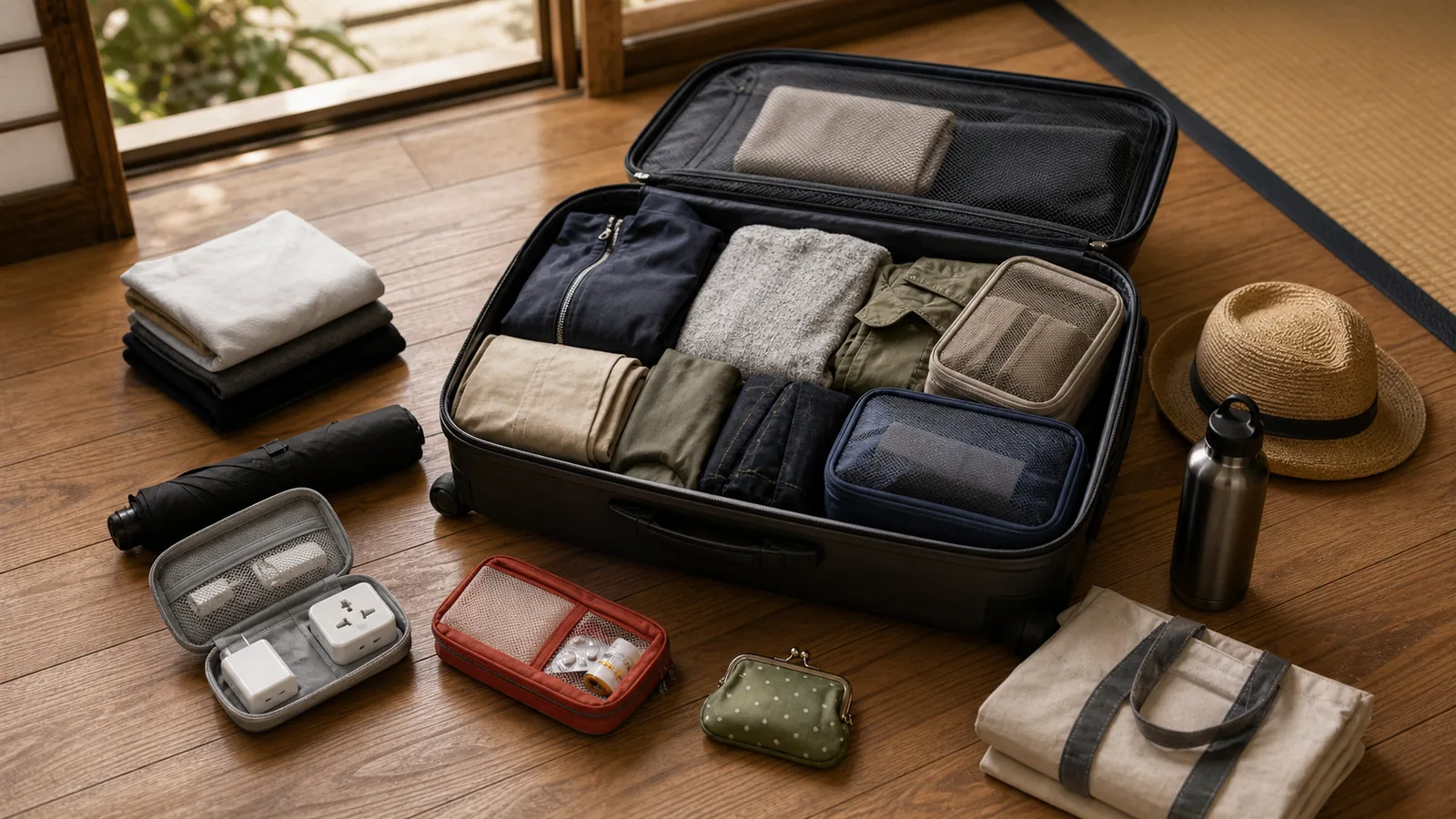
Packing for Japan has two classic traps: leaving behind what you needed (and paying triple to buy it locally) and bringing what you did not need (and paying 10,000 yen in overweight fees). This guide draws on real traveler mistakes to lay out what to bring, what to skip, and what to buy after you land.
The must-bring list (Top 12)
1. Personal medication, especially cold and stomach remedies. Japanese drugstores label everything in Japanese, and without the language you will struggle to pick the right product. A Taiwanese cold medicine pack weighs under 100 grams; if you do not bring it and get sick, you will end up miming symptoms at a pharmacist. Same goes for stomach remedies.
2. A universal adapter (even though Japan uses Type A). Japanese outlets are Type A (two flat prongs, identical to Taiwan), so most Taiwanese travelers do not need an adapter at all. However, if your laptop or phone charger has three round prongs, you will need a three-to-two adapter to fit the local sockets. The universal Type-A adapter itself is usually a waste of space.
3. A power bank under 10,000 mAh. Japanese hotel rooms tend to have few outlets, and you will want backup power during long days of sightseeing. Airline rules cap power banks at 100 Wh, carry-on only, no checked luggage.
4. Face masks. Japanese society still wears masks routinely (a post-pandemic norm). In crowded trains or when you feel a cold coming on, your own stash saves you from paying convenience-store prices (about 100 yen per mask in Japan versus 5 yen in Taiwan).
5. Bandages and waterproof plasters. Blisters from walking are extremely common, and Japanese convenience stores charge 200 yen for eight bandages — four times the Taiwan price.
6. A reusable water bottle. Every vending machine sells cold or hot water, but one 110-yen bottle a day adds up to about 1,000 yen over three days. With a bottle you can refill at fountains everywhere.
7. A compact umbrella or rain jacket. Essential during rainy season and typhoon season. Convenience-store folding umbrellas cost 500 to 700 yen, but bringing your own saves money.
8. Passport photocopy plus a digital backup. If your passport is lost, the photocopy speeds up emergency reissue at your country’s representative office. Take a phone photo and email yourself a copy.
9. 10,000 to 20,000 yen in cash. Small shops, shrine offerings, and food stalls still favor cash. JR Pass exchange counters and some fare-adjustment machines require cash too.
10. PDF of your travel insurance. Proof that the policy is active, plus an emergency contact number. Keep it on your phone.
11. A foldable shopping bag. Japan started charging for plastic bags (2 to 5 yen) in 2020. Bringing your own saves money and is more eco-friendly. The bag also comes in handy for hauling souvenirs back from Kyoto or Tokyo.
12. Broken-in walking shoes. As mentioned, footwear can make or break your trip.
The do-not-bring list (Top 8)
1. A universal adapter (if all you have are Taiwan-standard Type-A plugs). Japan and Taiwan match exactly, so it is dead weight.
2. A kettle. Every Japanese hotel provides one as standard equipment. Bringing one is heavy and pointless.
3. Towels and bath towels. Hotels supply them. Even Airbnb listings flagged as “no towel provided” are easily solved with a 200-yen towel from a 100-yen shop.
4. Shampoo and body wash. Hotels provide them, and Japanese hotel products are generally high quality.
5. Large amounts of cash (over 50,000 yen). Japanese convenience stores, supermarkets, and big department stores all accept credit cards and digital payments. Carrying too much cash is actually a safety risk.
6. Too many outfits. Hotels have coin laundry at 100 yen per load, and you can bring your own laundry bag or buy one for 200 yen at a 100-yen shop. A seven-day trip needs three outfits plus one laundry run.
7. More than a 30-day supply of medication. Customs limits personal use to a 30-day supply; beyond that requires a prescription. Heavy medication users who exceed this get questioned at customs.
8. Books and magazines. Heavy and bulky. A Kindle on the plane is plenty.
The buy-in-Japan list (cheap and high-quality)
1. Souvenir snacks. Don Quijote and the station 「お土産」 shops have transparent pricing, 30 to 50 percent cheaper than Japanese specialty stores in Taiwan.
2. Nail clippers and skincare. 100-yen shops (Daiso, Seria) carry excellent quality at Taiwan prices or below.
3. Hand warmers. 「カイロ」 eight-packs sell for 200 yen at FamilyMart or 7-Eleven, with quality far above what you find in Taiwan.
4. Reusable shopping bags and tumblers. Muji and Loft offer reasonable prices.
5. Glasses and contact lenses. Zoff and JINS make prescription glasses same-day from 5,000 yen — about 50 percent cheaper than Taiwanese chains.
Real reader mistakes
Case 1: “I brought seven outfits and three pairs of shoes for a five-day trip. My luggage was two kilos over and cost me 8,000 yen in fees, and four of those outfits never got worn.”
Case 2: “I did not bring cold medicine. The drugstore clerk did not understand Chinese, so I randomly grabbed a 1,500-yen product that tasted awful and did nothing. I ended up at a clinic and paid 8,000 yen.”
Case 3: “I did not bring a power bank. My phone died mid-afternoon in Tokyo and I could not pull up Google Maps. I got lost in Shinjuku for two hours, then paid 2,200 yen for a power bank at a convenience store.”
Case 4: “I brought a universal adapter I never used (Japan equals Taiwan, Type A), but I forgot the three-to-two adapter. My iPhone would not charge, so I paid 1,500 yen for one at an electronics shop.”
Pro tip
Do two things when packing. First, make a list and check off each item — do not rely on memory. Second, the night before, try on every outfit and walk in every pair of shoes to confirm they fit and do not pinch. Skip these steps and you will live the tragedy of two out of three pairs of shoes going unworn or clothes that no longer fit. The golden rule: if you can buy it in Japan, do not bring it (medication and long-term thermal underwear excepted). Travel light and you will actually enjoy the trip.
Frequently Asked Questions
Can I put a power bank in checked luggage for Japan?
No. Power banks and spare lithium batteries should go in carry-on baggage. Check the Wh rating and your airline rules for quantity, protection, and in-flight use.
Do I need a plug adapter in Japan?
Japan uses 100V and mostly Type A outlets. Two-flat-pin chargers marked 100-240V usually work, but grounded plugs and high-wattage appliances need extra checking.
Can I bring my own medicine to Japan?
Reasonable personal-use medicine is often possible, but some ingredients, psychiatric medication, injections, or larger prescription quantities may require Import Confirmation.
How many outfits should I pack for Japan?
For city travel, reusable layers and laundry access are better than one full outfit per day. Comfortable broken-in shoes matter more than extra clothing.