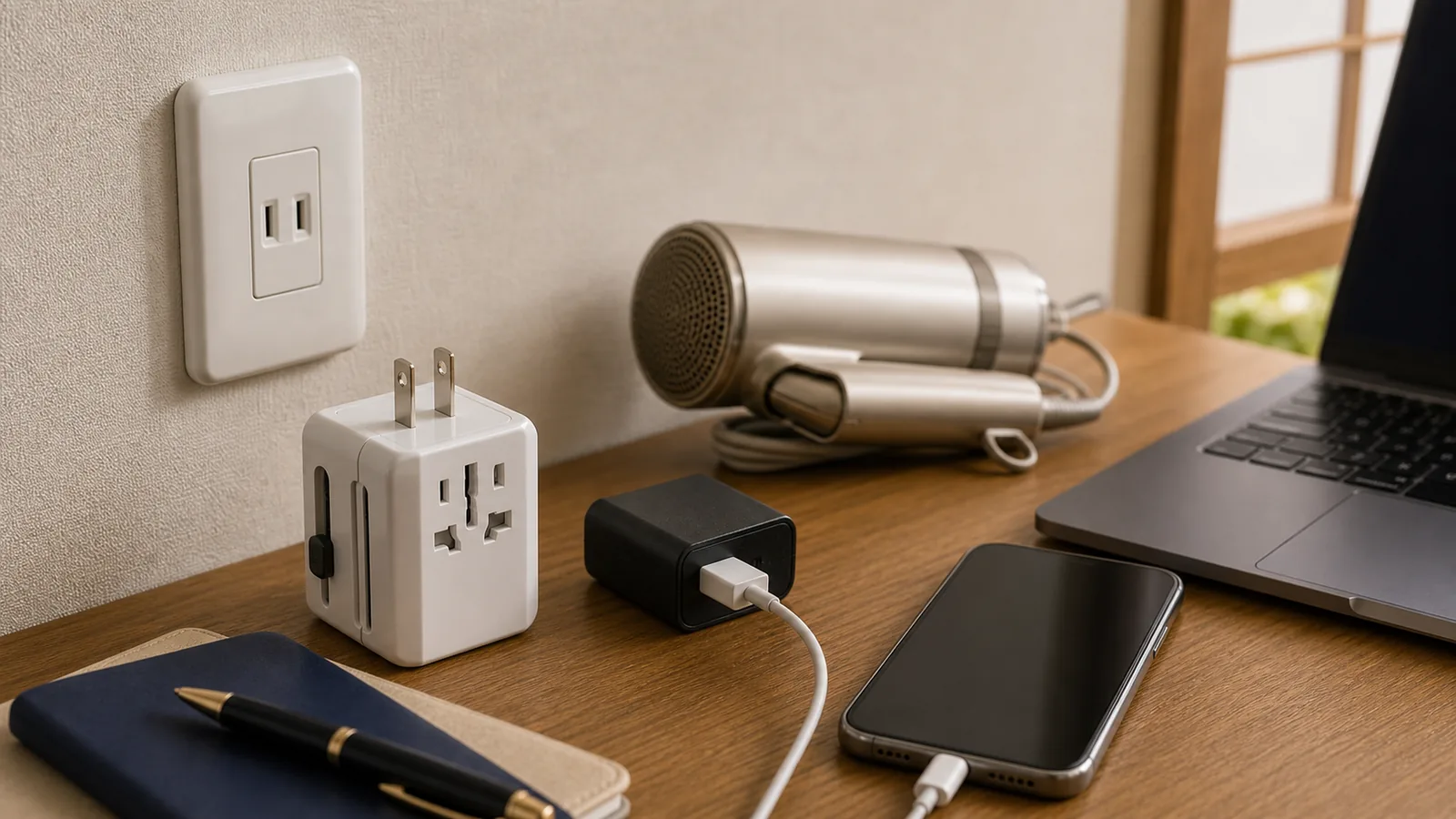
You Google “Japan chargers” before your trip and end up with a fog of conflicting advice — one site says you need an adapter, another says your phone plugs in just fine. So do you need an adapter? Do you need a voltage converter? This guide answers by appliance category, no more guessing.
Bottom line: most modern electronics plug in directly, but watch out for three categories
Japan uses AC 100V (the lowest voltage in the world; most countries run 220 to 240V, the US and Canada run 120V), at 50 or 60 Hz (50 Hz in eastern Japan, 60 Hz in western Japan, divided by the Fuji River). Outlets are Type A flat-prong plugs (identical to US and Taiwan standards).
Bringing devices from Taiwan or Hong Kong?
Taiwan: same plug (Type A, two flat prongs), 110V (Japan is 100V, basically interoperable). Most Taiwanese devices work directly in Japan.
Mainland China: different plug (China uses Type I with three slanted prongs), 220V. You need an adapter and you need to confirm your device handles dual voltage.
Hong Kong, Singapore, Malaysia: Type G plug (three square prongs), 220V. You need an adapter and a dual-voltage device.
US and Canada: same as Japan (Type A plus 120V), fully compatible.
Category 1: phones, tablets, laptops (dual-voltage devices) — plug in directly
Check your charger label. If it reads “INPUT: 100-240V,” it is dual voltage. Smartphones (iPhone, Samsung, Xiaomi), tablets, laptops (MacBook, Surface), and camera chargers are 99 percent dual voltage and plug into Japanese outlets without issue.
Differences for Taiwan, Hong Kong, and mainland users: Taiwanese plugs fit directly, while Hong Kong and mainland users need an adapter (converting three-prong to Japanese flat prongs), running 100 to 300 NTD.
Category 2: hair dryers, curling irons, electric kettles, electric toothbrush bases — read the label!
High-wattage devices like these are the easiest to fry. If the label reads “INPUT: 220V” (common in China, Hong Kong, Singapore, Malaysia), plugging it into Japan’s 100V outlet will cause malfunction or burn out the transformer.
You would need a step-down converter, but they are rare in Japan (since Japan’s voltage is low, locals do not need one), so you have to buy one before leaving. However, converters are heavy and bulky and not worth carrying. A better plan: just buy a Japanese “100V-compatible” hair dryer or curling iron locally (drugstores and Yodobashi carry them, 1,500 to 5,000 yen).
For Taiwanese users: Taiwan runs 110V, Japan runs 100V — a small gap. High-wattage devices like hair dryers will work but at slightly reduced power (a bit slower), and they will not break, though long-term heat buildup may shorten their lifespan. For new purchases, buy locally in Japan.
Category 3: specialty devices (electric shavers, electric toothbrushes) — dual voltage
Most electric shavers (Braun, Philips, Panasonic) and electric toothbrushes (Oral-B, Philips Sonicare) are dual voltage (100-240V) and plug in directly. But some charging bases are fixed voltage — check the label.
Category 4: beauty devices, flat irons, travel kettles — high-risk zone
Taiwanese beauty devices (LED beauty wands, magnetic massagers, small irons) are often 110V fixed voltage. While Taiwan’s 110V and Japan’s 100V look close, extended continuous use can cause overheating. Short use (drying hair for five minutes) is fine; long use (ironing clothes for 30 minutes) is risky.
Frequency: 50 Hz versus 60 Hz
Eastern Japan (Tokyo, Hokkaido, Tohoku) runs 50 Hz; western Japan (Kansai, Kyushu, Shikoku) runs 60 Hz.
What does this affect? Motor-driven devices (clocks, mechanical timers) will run slightly slower in the 60 Hz region if designed for 50 Hz. Phones, laptops, and cameras are unaffected (they run on DC power).
Where to buy adapters
Before departure: airports, electronics retailers (Tsannkuen, EZprice), hardware stores, PChome, Taobao. 100 to 300 NTD.
Emergency post-arrival: Narita and Haneda airport 7-Elevens, drugstores, and airport convenience stores sell Type A adapters for around 800 to 1,500 yen (relatively expensive).
Pro tip: a multi-port USB charger plus cables is the easier path
Rather than packing every original charger, bring one 65W multi-port USB-C charger (Anker, Baseus, Belkin). One outlet powers four or five devices — phone, laptop, camera. Modern multi-port chargers are universally 100-240V dual voltage and travel anywhere. Taiwan and US plugs go straight into Japan; Hong Kong and mainland plugs need an adapter.
Hotel outlets are limited — bring a power strip
Japanese business hotels often have only one or two outlets by the bed and one or two in the living area. If you have a phone, laptop, camera, power bank, and tablet, bringing your own three-way power strip (with USB ports) is the smoothest setup. Note: choose a 100V-spec power strip or a dual-voltage one. Be careful with Chinese 220V-spec strips — they will work at the lower voltage but extended use will heat up.
Taiwanese 110V power strips work in Japan, and local 100-yen shops also sell cheap four-outlet strips for 330 yen if you need one in a pinch.
Before your next trip, check the “INPUT” field on your charger labels — 100-240V plugs in directly, 220V only needs a converter or local replacement, and 110V only depends on the use case.
Frequently Asked Questions
What voltage does Japan use?
Japan uses 100V nationwide. Chargers marked INPUT 100-240V usually work; high-wattage heat appliances need separate checking.
Do I need a plug adapter for Japan?
Two-flat-pin Type A plugs often fit directly. UK, EU, Australian, China three-pin, or grounded plugs usually need an adapter.
Can I bring a hair dryer or curling iron to Japan?
Check the label. Devices marked 100-240V are safer. Products fixed at 220-240V or high-wattage single voltage should not be plugged directly into Japan 100V.
Does Japan 50Hz or 60Hz affect charging?
Phones, laptops, and USB chargers are usually unaffected. Old clocks, motors, or specific appliances are the main frequency-sensitive items.