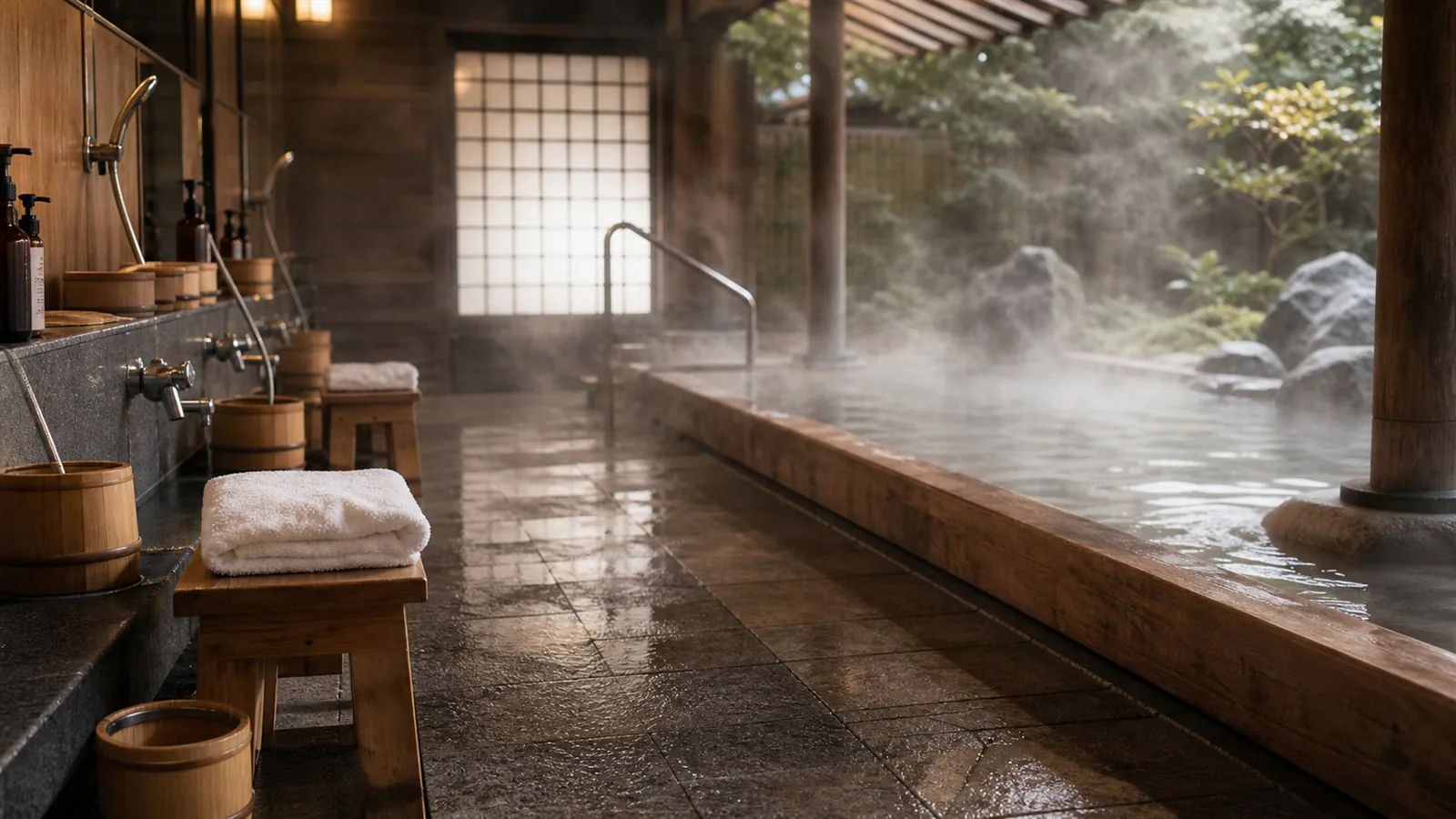
You might think wearing a swimsuit into a Japanese hot spring is the polite choice. In fact, you will be asked to leave if you do. Japanese 「銭湯」 (sento, public bathhouses) and 「温泉」 (onsen) insist on full nudity for hygiene, cultural, and legal reasons — and the placement of your towel also follows rules.
The law: nudity is the default
Japan’s Public Bath Law (enacted 1948) requires public baths to maintain sanitation. Each prefecture’s implementing regulations prohibit bathing while wearing “clothes.” Swimsuits count as clothes (since the fabric retains sweat, dirt, and chemical residue) and contaminate the bathwater. A small number of tourist-friendly hot springs (parts of newer facilities in Hakone and Kusatsu) allow 「湯着」 (yuugi, sterile thin bathing garments), but they remain rare exceptions.
Hygiene reasons
Onsen water temperatures run 38 to 42°C, where sweat, skin oils, and hair contaminate the water. That is why Japanese onsen mandate a “pre-bath wash” — before entering the pool, you must wash thoroughly at the wash station with the provided showerhead and soap. Full nudity is what allows that cleaning system to function completely.
Cultural reason: hadaka no tsukiai
Japanese has a concept called 「裸の付き合い」 (hadaka no tsukiai), literally “naked association.” It means that once clothes are off, everyone is equal in status — no boss and subordinate, no rich and poor. A company executive and a new hire sharing a bath are, in that moment, on the same level. This is one of the rare “spaces of equality” in Japanese society, achieved through nakedness.
Correct towel placement
When you enter the bathing area, you will have two towels: a large bath towel (湯上りタオル) and a small washcloth (湯ふきタオル).
Large towel: leave it in the changing room or in the basket at the wash station. Do not bring it into the bath.
Small towel: bring it to the wash station to clean your body and back. When entering the bath, place it on your head (the common move) or on the stone edge of the pool. Never put it in the water. Why on the head? Because the head sweats easily during a soak and stray hairs can fall in. The towel on top absorbs sweat and keeps hair out of the water.
Order at the wash station
Upon entering the bathing area, go to the wash station first. There you will find a low stool, a showerhead, and a mirror. The sequence:
- Sit on the low stool (you cannot stand and shower, since water will spray onto others).
- Use the showerhead to rinse your head, body, and feet, washing thoroughly with the provided soap and shampoo.
- When finished, rinse the showerhead off (so the next person uses a clean one).
- Rinse the stool and place it upside-down back where you found it (so the next person has a clean stool).
- Wring out your body with the small towel, then walk to the pool.
Unwritten rules for entering the bath
- Pour water over yourself again before entering (using 「かけ湯」 kakeyu, scooping water from the pool with a small bucket) — to adjust to the temperature and rinse a second time.
- Enter slowly, no jumping or splashing.
- Stay quiet — a bath is not a swimming pool, and swimming, diving, and horseplay are forbidden. Quiet conversation is fine.
- Tie up all hair or wrap it in a towel. Hair must not touch the water. Women with long hair must clip it up.
Tattoo restrictions
Many Japanese onsen and sento ban tattoos — historically because tattoos were associated with yakuza. Tattooed tourists may be refused entry. Workarounds:
- Choose a 「タトゥーOK」 (tattoo-friendly) onsen (parts of Hakone, Kusatsu, and Beppu openly accept them; Googling “tattoo friendly onsen” yields lists).
- Small tattoos can be covered with waterproof tape (drugstores sell 「タトゥーカバーシール」).
- Reserve a private bath (kashikiri-buro) to avoid the issue entirely.
Gender-separated and mixed baths
Japanese onsen default to separate men’s (otoko-yu) and women’s (onna-yu) baths, with the entrance distinguished by curtain color — blue for men, red for women. Some traditional onsen offer 「混浴」 (konyoku) — mixed-gender bathing, usually during weekend daytime hours or specific windows, sometimes requiring a bath wrap. Mixed bathing is increasingly rare today, but Takaragawa Onsen in Gunma and Sukayu Onsen in Aomori still maintain the tradition.
Common tourist misunderstandings
First, “Underwear is fine, right?” — No, underwear is also clothing. Second, “I will just cover myself with a towel and go in.” — No, towels cannot enter the pool. Third, “I showered at the hotel, so I do not need to wash again?” — No, once in the bathing area, you must wash again. Fourth, “I will smoke at the poolside.” — Smoking is absolutely forbidden in the bathing area. Fifth, “Can I take photos as a souvenir?” — Photography in the bathing area is strictly forbidden (others are nude).
Pro tip: start with an ashiyu for your first experience
If you cannot bring yourself to go fully nude, try an 「足湯」 (ashiyu, foot bath) first. Stay clothed, sit down, and put your feet in the onsen water. Kinosaki, Izu, and Beppu all have free public foot baths. From foot bath to full body, you will find that shame is a cultural construct — once you step in, you actually relax.
Next time at a Japanese onsen, do not miss out because of shyness — this is one of the most unique experiences in Japan. Once you have soaked in a 38°C sulfur spring under a night sky with snow falling, you will understand why the Japanese call hadaka no tsukiai real equality.
Frequently Asked Questions
Why are Japanese public baths nude?
The main reasons are hygiene and shared rules. Swimwear can bring outside dirt into the bath and breaks the common bathing system.
Can towels go into the bathwater?
No. Small towels can enter the bathing area but should not touch the bathwater. Large towels stay in the changing room.
Do you have to wash before entering an onsen?
Yes. Wash your body and hair at the washing area before entering the bath. This is the core rule.
Can you take photos in Japanese public baths?
No. Bathing areas involve privacy. Keep phones in your locker or bag.