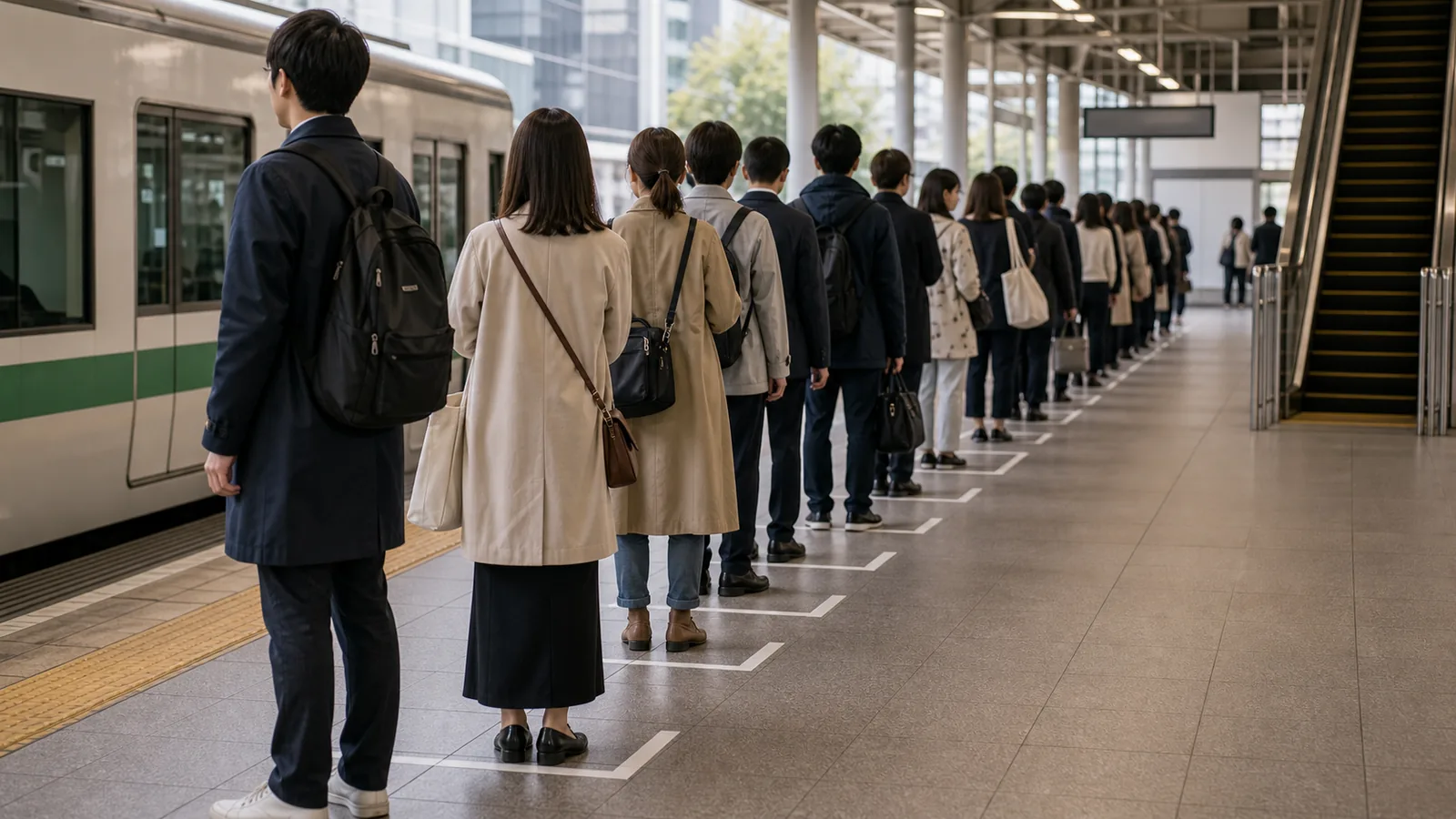
At Tokyo’s Shinjuku Station at 8 a.m., you will see this scene: hundreds of people lined up in two neat columns behind the floor markings, the train pulls in, everyone leaves the center clear for disembarking passengers, and then they board in order. Even bathroom queues form automatically. To foreign travelers it looks miraculous. This is not government-enforced — it is Japanese culture operating at a deep level. Understanding the queue logic makes traveling in Japan far smoother.
The origin: the Edo-era “junban” concept Lining up is not a modern Japanese invention. During the Edo period (1603-1868), Edo’s explosive population growth led merchants to manage customers by 「順番」 (junban, order). The habit carried through industrialization, postwar reconstruction, and the rapid-growth era, gradually internalizing into the social consensus that not cutting in equals basic morality.
Unwritten rule 1: the floor markings are the rule Platform floors, restaurant entrances, ATM areas, and storefronts all carry floor markings (colors, arrows, or footprint icons). The line forms behind the marking. You do not need to ask “is this the queue?” — the markings tell you. At Shinjuku, Ikebukuro, and Shibuya stations, every train-door position on the platform has two lines forming two columns, with the center kept clear for disembarking passengers.
Unwritten rule 2: no cutting, no matter how urgent Japanese tolerance for line-cutting is zero. Being in a rush, or being a foreigner who does not know the rules, is not an excuse. A person who gets cut in front of usually will not curse you out, but they will signal their displeasure with a cough and a stare, and bystanders will help glare. If you genuinely must cut (say, an emergency bathroom run), clearly say 「すみません、急いでいるので」 (Excuse me, I am in a hurry) and bow, asking the person in front if they would let you through. Most Japanese are kind and will allow it.
Unwritten rule 3: keep distance When queueing, maintain 30 to 50 cm between people, do not stand too close. After COVID this distance opened up further. Standing too close is treated as a personal-space violation.
Unwritten rule 4: restaurant queueing has extra rules Popular restaurants (Ichiran, tsukemen shops, famous Ginza sushi places) have additional protocols: — At the entrance there is a numbered slip or sign-in sheet where you write your name and party size; numbers are called in order. — Some places display a 「待ち時間」 (estimated wait time), such as 「30分待ち」 (about 30 minutes). — Leaving the line for more than 10 minutes may remove you from the order. Tell staff before stepping away for the bathroom or photos. — Brunch hot spots (like Omotesando’s pancake shops) sometimes have waits of one to two hours.
Unwritten rule 5: cafes and drugstores — one extra step for machine ordering More and more Japanese establishments use tablet and ticket-machine ordering: first buy a ticket at the entrance’s ticket vending machine → take it inside → hand it to staff. In this format the queue is at the machine, not at the seating area. Newcomers most often trip up here — seeing an empty seat, they sit down, only to be reminded by staff to “buy a ticket over there first.”
Unwritten rule 6: large events — the “seiriken” system For concerts, store openings, limited releases, and fireworks festivals, Japanese people start queueing one to three hours ahead (sometimes the day before). 「整理券」 (seiriken, ordering ticket or entry sequence ticket) are issued, with numbers governing the order. No ticket means you go to the back.
Unwritten rule 7: elevators and escalators are also queue culture In Tokyo, on escalators you stand on the left, walk on the right (Kanto convention); in Osaka it is reversed, stand on the right, walk on the left (Kansai convention). The dividing line falls roughly around Nagoya. Elevator queueing: first come, first in; exit by floor order; the person nearest the door exits first.
Unwritten rule 8: bathroom “occupied” indicators Public restrooms typically have indicator lights or door colors: green or open means you can go in; red or occupied means you wait. Japanese people wait about 1.5 meters from the door, not right up against it. With multiple stalls, everyone forms a single line for the first one to open up, rather than standing at individual stall doors.
Pro tip: Disneyland is the fastest way to learn If you want to experience “queue culture at its peak,” line up for a popular attraction at Tokyo Disneyland or Universal Studios Japan. The Japanese will queue 80 minutes in a winding line, not even looking at their phones, just waiting patiently, with the whole line eerily quiet and orderly. Next time in Japan, when you see a long line, first check if it is behind a floor marking — when joining, make brief eye contact with the person in front and nod, and you are “in.” Before leaving the line (for the bathroom or to grab a drink), remember to tell the people in front and behind 「すぐ戻ります」 (I will be right back).
Frequently Asked Questions
How do I find the end of a line in Japan?
Look for floor markings, arrows, waiting lists, or “最後尾” signs. If unsure, ask “saikobi wa doko desu ka,” meaning where is the end of the line.
What should I do when boarding trains in Japan?
Stand behind platform markings, let passengers exit first, then board in order. On crowded trains, move bags to the front or by your feet and step inside.
Do I stand left in Tokyo and right in Osaka on escalators?
That is a common local habit, but safety signs come first. Many places now ask riders to stand still, hold the handrail, and not walk on escalators.
Can I leave a queue briefly?
Tell your group, nearby people, or staff before leaving briefly. At popular restaurants, limited releases, or events, leaving too long may mean losing your place.