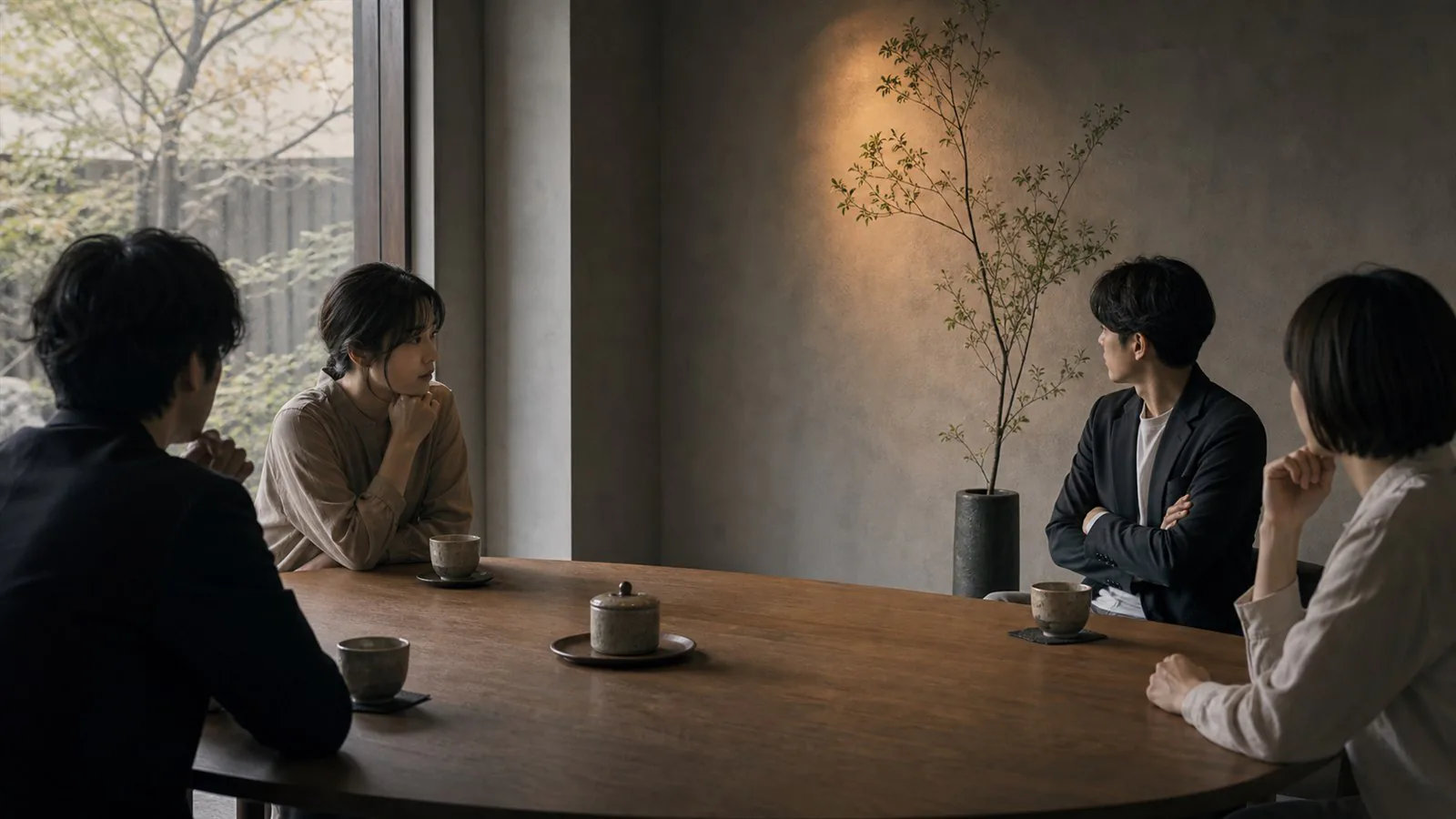
You might think the Japanese habit of not stating things directly is repression or dishonesty. In fact, it is the “satsushi culture” (the culture of sensing), developed over 1,500 years of close-quarters island life — communication that relies on atmosphere, expression, and pauses rather than words. Understanding this layer means understanding the operating system underneath Japanese society.
What 「空気を読む」 means
Literally “read the air” (kuuki o yomu), the phrase means reading the atmosphere of the moment and reacting correctly on your own, without anyone spelling it out. For example: the meeting ends and everyone stands up but you stay seated — you did not read the air. Your friend glances at their watch and frowns while you keep talking — you did not read the air. The restaurant owner places the bill on your table after the meal and you order another drink — you did not read the air.
The opposite term is “KY” (kee-wai), short for 「空気が読めない」 (cannot read the air). It is a label-style criticism in Japanese society, meaning “this person does not know how to behave.” Among younger generations, “KY” functions as a social rating.
The history of 1,500 years of island cohabitation
Japan is an island nation with frequent earthquakes, typhoons, and tsunamis where villages had to cooperate tightly to survive. Medieval villages (Heian and Kamakura periods) had under 200 people, where everyone knew each other for life and direct conflict would destroy village viability.
So indirect communication became a survival skill. The sentence “we have a noisy neighbor” would never be spoken aloud — it was expressed through silence, distance, and avoidance. If the other party read it, they corrected. If they did not, village isolation set in naturally.
This carried through the Edo townspeople culture, post-Meiji workplace culture, and postwar family enterprises. Speaking plainly is a failed mode of communication.
Satsushi culture in the modern workplace
A division head tells a subordinate 「この件、もう少し考えておいて」 (Think about this matter a bit more). Real meaning: this proposal does not work, redo it. Literal: think a bit more.
A subordinate tells the division head 「申し訳ないですが、その日はちょっと…」 (I am sorry, but that day is a bit…). Real meaning: that day does not work, or I do not want to go. Literal: that day is a bit… (sentence trails off).
A client says 「検討させていただきます」 (I will look into it). Real meaning: we are not buying. Literal: I will consider it.
In a meeting, your proposal gets no response and the room is silent for five seconds. Real meaning: the proposal is rejected. No one says “we do not like your idea.”
Why this works for Japanese people
Because Japanese people are trained from childhood to sense. Family, school, and workplace all reinforce this sensing capacity. Watch a Japanese child of four or five and they already read parents’ expressions to decide their next move. This is not a cultural quirk; it is the core competency of socialization.
The challenge for foreigners
The scenarios non-Japanese trip over most:
- In a meeting you make a proposal, no one objects, you assume it passed — but everyone has actually rejected it through silence.
- A friend invites you to a gathering and you bluntly say “I do not want to go,” and their expression changes (in Japan you would say 「あの日は予定が」 or 「ちょっと厳しいかも」).
- At a shop you ask 「これ、いくらですか?」 (how much is this?) five times, and the clerk grows distant — it is not about the money; you failed to read the shop’s mood (the clerk is busy, other customers are around).
- They say 「お疲れ様」 and you reply 「うん」 (a casual sound) — the proper reply is 「お疲れ様です」 (full form), and your casual response makes them feel disrespected.
The advantages of satsushi culture
- Conflict reduction — the violence of direct refusal is greatly diminished.
- Face protection — neither side has to say something harsh.
- Emotional support — you do not have to verbalize pain; people around you will sense it and offer company. The “emotion in the silences” aesthetic in Japanese films comes from this.
- High social efficiency — no long explanations needed; once the mood shifts, everyone knows the next step.
The disadvantages of satsushi culture
- Outsiders cannot easily enter — anyone not raised in Japanese society needs five to ten years to learn the cues.
- Emotional suppression — real feelings have no outlet, and mental health problems stay invisible. Japan’s persistently high suicide rate is connected to this.
- Innovation is suppressed — those who voice dissent get labeled KY, and group decision-making falls easily into the “everyone agrees” trap. Japanese corporate innovation decline ties to this.
- Sexual harassment and workplace bullying are hard to report — victims “cannot say it directly,” and perpetrators “pretend not to read the cues.”
After 2010, Japanese companies began emphasizing 「アサーティブ・コミュニケーション」 (assertive communication), and the new generation is gradually learning to balance the two.
Strategies for tourists
First, observe more, speak less. Sixty percent of conversation between Japanese people happens outside the words; if you do not understand the language, watch the expressions.
Second, 「あれ?」 (ah?) is the universal opener. When you see someone’s eyes shift, say 「あれ?」 (oh?) first — they will read you as “you noticed,” and the mood eases.
Third, direct communication needs packaging. Instead of “I do not like it,” say 「もう少し違うアプローチを試してみたい」 (I want to try a slightly different approach).
Fourth, do not fear long pauses. A pause in Japanese conversation means the other person is thinking or sensing — it is not awkward silence. Rushing to fill the pause is KY.
Pro tip: silence is Japan’s “emphasis mark”
After you say something, if the other person is silent for two or three seconds, those two or three seconds are part of the message. It could mean “I am thinking seriously,” “I do not quite agree,” or “I need time to process.” Foreigners tend to respond immediately, but Japanese use silence to emphasize a point.
Practice method: converse with a Japanese friend and wait five seconds after asking a question before saying anything else. You will find their answers run deeper and feel more sincere.
Next time in Japan, stay quiet for ten minutes and watch a real conversation between Japanese people unfold. You will notice that they do not need to say much, yet they all understand. That is the crystallization of 1,500 years of island wisdom.
Frequently Asked Questions
What does kuuki wo yomu mean?
It literally means “read the air”: understanding the mood, timing, and shared expectations of a situation before speaking or acting.
What does KY mean in Japanese?
KY comes from kuuki ga yomenai, meaning someone who cannot read the room. It can be playful, but it can also be real criticism.
Is indirect speech in Japan dishonest?
Not necessarily. It often protects face and avoids open conflict, though it can be hard for outsiders to interpret.
How can visitors avoid missing the mood?
Watch for silence, topic changes, and vague repeated phrases. If unsure, ask gently instead of forcing a blunt answer.