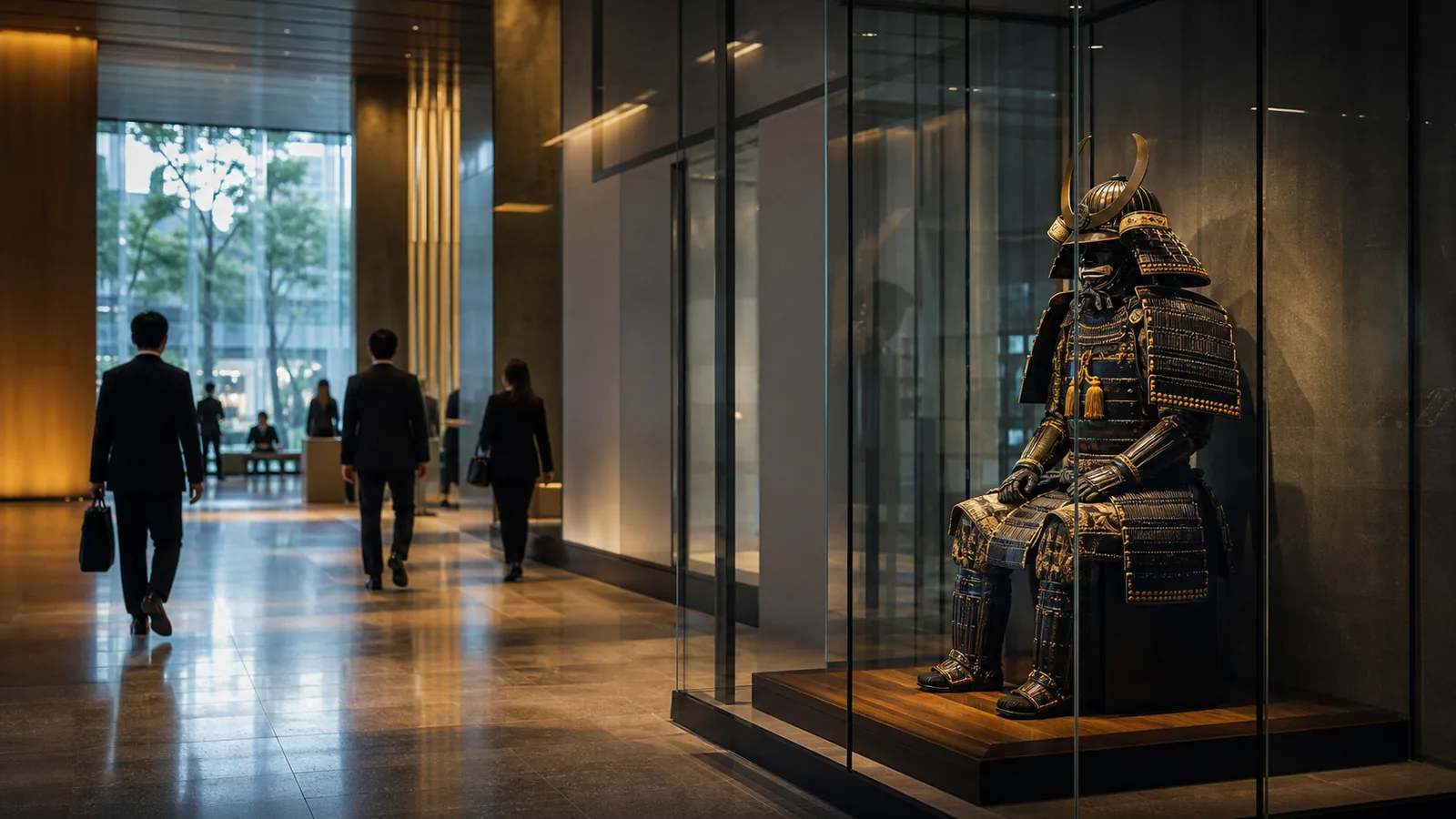
You may have noticed that Japanese work culture differs sharply from other countries — lifetime employment, seniority-based promotion, overwork culture, karoshi (death from overwork), the universal 「お疲れ様」, the rigid hierarchy, the 90-degree bows from new hires. Where does all this come from?
The answer: bushido — the warrior code that evolved over 700 years starting with the 12th-century Kamakura shogunate. After the 1868 Meiji Restoration abolished the samurai class, its spirit was grafted onto corporate organizations, becoming the invisible DNA of the modern Japanese salaryman.
This article unpacks the eight core virtues of bushido and how each lives on in Japanese offices today.
What is bushido? 「武士道」 (bushido) literally means “the way of the warrior.” But the term itself was rarely used in old times — Edo-era samurai called it 「侍道」 or 「弓馬の道」. “Bushido” entered popular vocabulary through a single book:
Nitobe Inazo’s *Bushido: The Soul of Japan* (published in English in 1899). By the end of the Meiji era, the samurai had been gone for 30 years; Nitobe wrote the book to explain “the Japanese spiritual tradition” to Westerners, articulating eight core virtues. The book remains influential today — even Donald Trump has read it.
The eight core virtues of bushido (Nitobe version)
1. Gi (義) — righteousness, moral duty Doing what is right without being swayed by profit. Modern version: the salaryman puts the company’s interests above his personal career.
2. Yu (勇) — courage Facing danger without flinching. Modern version: few people dare to publicly disagree with a superior, but those who do are respected.
3. Jin (仁) — compassion, benevolence The strong caring for the weak. Modern version: the senpai’s responsibility to look after the kohai (junior).
4. Rei (礼) — courtesy, etiquette Outer form expressing inner respect. Modern version: the 90-degree bow, business-card exchange protocols, and the calibrated depths of the bow.
5. Makoto (誠) — sincerity, honesty Unity of words and actions; the samurai saying 「武士に二言は無い」 (a warrior does not speak twice). Modern version: a verbal agreement counts, and signing the contract is mere formality.
6. Meiyo (名誉) — honor Death before dishonor. Modern version: suicide after public exposure of wrongdoing (Japan has numerous politician and executive suicides), resignation to take responsibility, and CEO public bowing apologies.
7. Chugi (忠義) — loyalty Loyalty to one’s lord without wavering. Modern version: lifetime employment, staying at one company for life, and treating job-hopping as betrayal.
8. Kokki (克己) — self-control Suppressing emotion for the greater good. Modern version: the satsuru (sensing) culture, refusing to directly express dissatisfaction, and the divide between honne (true feelings) and tatemae (public face).
How does each of these live on in Japanese companies today?
Case 1: lifetime employment plus seniority-based promotion (chugi plus jin) The big-company tradition: enter the company straight out of university and stay until retirement at 60 (35 to 40 years). Promotion follows age (nenko joretsu), not ability. Why? It is an extension of samurai loyalty to a lord. The company is the lord, the employees are vassals, and both have father-and-son obligations.
Current state: collapsing in the 2020s. Younger generations (Gen Z) job-hop frequently, foreign firms and venture capital have broken the seniority system, and Fujitsu, Hitachi, and similar giants have begun layoffs. But traditional conglomerates (Mitsubishi, Mitsui, Sumitomo) still retain it in part.
Case 2: karoshi (death from overwork) (chugi plus kokki) A Japanese term that has entered English: Karoshi = 過労死 = “worked to death.” It peaked after the 1990s economic bubble burst, with 100 to 200 recognized cases per year. A primary cause: employees who could not bear to be disloyal to their lord (spirit overriding body).
The 2015 Dentsu employee suicide: a 25-year-old female employee who logged over 100 hours of overtime per month killed herself on Christmas, leaving the message “living for the company — when does it end?” This triggered national reflection, and in 2016 the 「働き方改革」 (Work Style Reform) Act was passed, setting a 100-hour monthly overtime cap (still high, but a limit nonetheless).
Case 3: morning meetings, company mottos, and group rituals (rei plus makoto) Japanese firms commonly hold chorei (morning meetings): everyone gathers at 8:30, chants the company motto in unison, performs radio calisthenics (rajio taiso), and disperses to work. This is an extension of samurai han-school practice — the ritual of collectively chanting “the great virtues of lord and vassal” every morning.
Big firms like Panasonic still recite their seven principles at daily morning meetings (industry serving the nation, fairness and honesty, harmony and cooperation, struggle for progress, courtesy and modesty, adaptability, and gratitude).
Case 4: the angle culture of ojigi (bowing) (rei) Japanese bowing has three depths, directly inherited from samurai etiquette:
- Eshaku (15 degrees): everyday greetings.
- Keirei (30 degrees): formal business settings.
- Saikeirei (45 to 90 degrees): profound apology or respect to elders or clients.
The CEO public apology: a familiar TV scene — a 90-degree bow held for over 10 seconds, where the longer the bow, the deeper the apology. It is the modern, non-bloody version of samurai seppuku.
Case 5: honne versus tatemae (kokki) Honne (本音) = true feelings, real thoughts. Tatemae (建前) = public face, surface position.
In the workplace, Japanese people always speak tatemae, reserving honne for after-work drinking (nomikai). This is an extension of samurai self-control — personal emotion is not displayed in organizational settings.
What foreigners struggle with most: hearing 「考えておきます」 (I will think about it) and assuming there is hope, when 80 percent of the time it is a polite version of “no.”
Case 6: ringi documents and the hanko culture (gi plus rei) Japanese corporate decision-making is collective consensus (ringi): a document moves up from junior staff through 5 to 10 layers, each stamping with a hanko, before becoming binding. No one is solely responsible = no one bears risk alone. An extension of samurai gi — collective decisions protect individual honor.
In 2020, Kono Taro declared 「印鑑廃止」 (the abolition of hanko), but five years later 50 percent of traditional firms still use them.
Case 7: company funerals, retirement bonuses, and employee trips (chugi plus jin) Big-company tradition treats employees with “family-like” care:
- When an employee dies, the company holds a kaisha-so (corporate funeral).
- Retirement comes with a taishokukin (severance, sometimes 10 to 30 million yen).
- Annual shain-ryoko (employee trips) strengthen group bonds.
This extends the samurai notion of “the lord caring for his vassals until death.” It is collapsing in the modern era, but traditional big firms still retain it.
Case 8: apology and resignation (meiyo) When a company errs, the public bowing apology plus CEO resignation is uniquely Japanese:
- Food safety incidents (the Snow Brand and Fujiya cases).
- Data falsification (Kobe Steel, Mitsubishi Materials, Nissan).
- Data breaches (NTT, Rakuten).
The CEO bows and resigns to take responsibility, sometimes even commits suicide (less common since the 2000s). It is the modern version of the samurai code 「腹切らねば名誉を保てぬ」 (without seppuku, honor cannot be preserved).
Can this culture survive into the 2020s? Challenges come from:
- Gen Z: a culture of job-hopping, refusing overtime, refusing drinking sessions.
- Foreign firms and venture capital: breaking the seniority system, judging on merit alone.
- An aging, shrinking population: labor shortages mean companies cannot afford to be picky.
- Remote work: weakening morning-meeting and nomikai rituals.
But the roots of tradition (loyalty, collectivism, hierarchy, etiquette) remain deeply embedded in Japanese society. They will not vanish soon, only change shape.
Practical takeaways for tourists and business visitors
If you are meeting with Japanese counterparts:
- Arrive five minutes early (makoto plus rei).
- Prepare business cards, present them with both hands, and study the received card with a 90-degree gaze (rei).
- Do not interrupt (kokki).
- 「考えておきます」 = a soft no (honne versus tatemae).
- Slow decisions mean consensus-building is underway, not lack of seriousness (gi plus collective decision-making).
- Always attend dinner invitations (chugi plus relationship-building).
Next time you see a salaryman, cashier, or taxi driver in Japan bow at 90 degrees, remember that behind it lies 800 years of accumulated samurai spirit. The swords are gone, but the spirit remains. Understand bushido, and you understand the Japanese workplace.
Frequently Asked Questions
Is Japanese corporate culture all caused by bushido?
No. Bushido is an important vocabulary, but modern corporate culture also comes from bureaucracy, postwar employment, education, and high-growth company communities.
Was Nitobe Inazo bushido an ancient rulebook?
No. It was a modern narrative explaining Japanese ethics to Western readers, influential but not the whole historical reality.
Why is ringi decision-making slow?
It values prior coordination and consensus, distributing risk and avoiding public conflict. Slow does not mean unserious.
Is bushido useful for business travelers?
Yes, if not mythologized. Be punctual, prepared, respectful of internal coordination, and careful with indirect language.