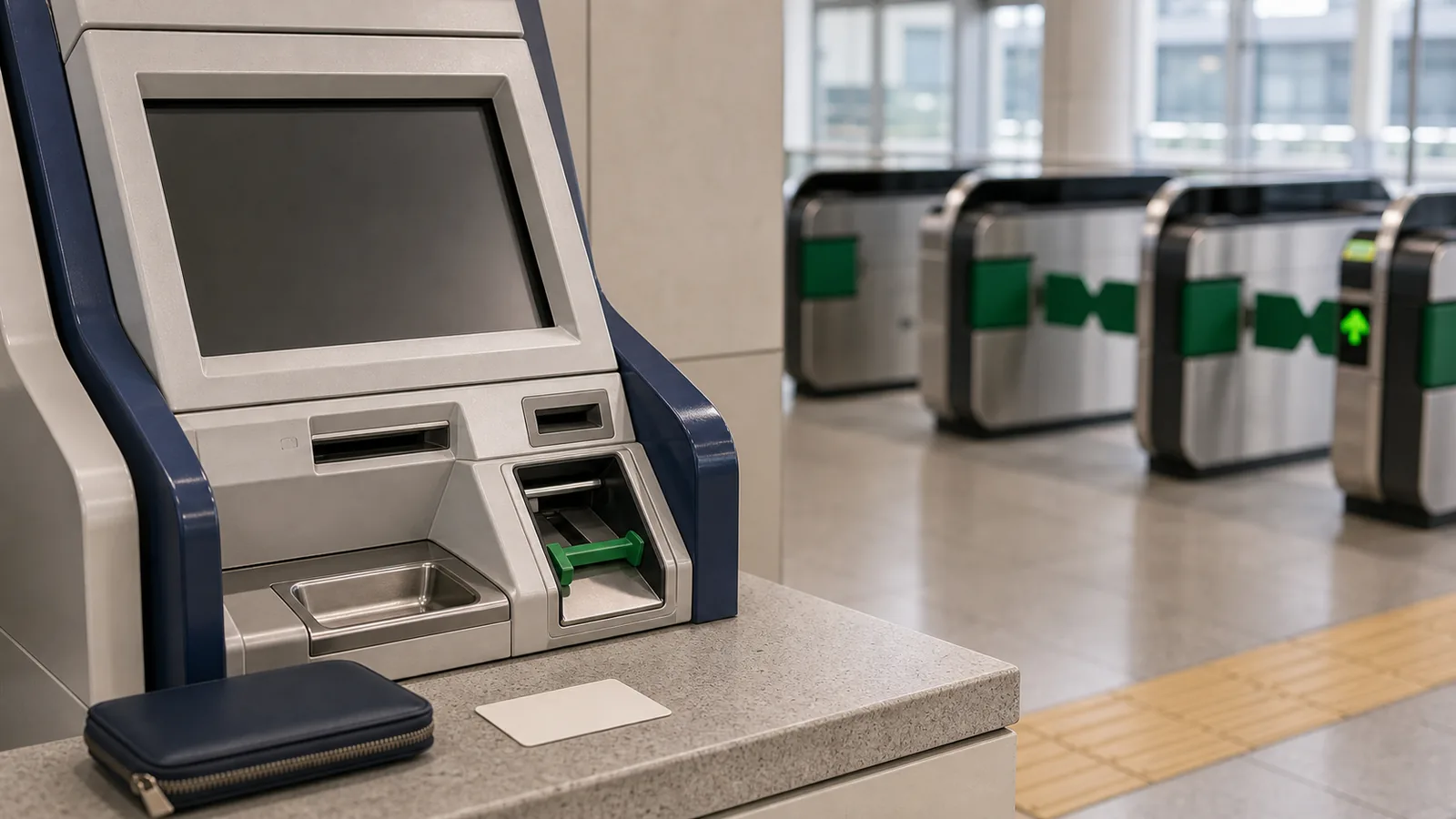
You boarded with a 200-yen ticket and ended up at a station that requires 320 yen — at the gate, the turnstile blinks red and beeps while commuters pile up behind you, glaring. Do not panic. Japanese stations have 「自動精算機」 (jido seisanki, the fare-adjustment machine) dedicated to exactly this situation. Here is a single-article rundown: how to use it, when you will encounter it, and whether IC cards let you skip the whole thing.
Bottom line: overshot your stop = visit a fare-adjustment machine to pay the difference; IC card users get charged automatically and skip the step
Japanese rail fares are distance-based. When you buy a ticket, you choose the destination (or nearest station) at the machine, and it prices the trip by distance.
Examples: Shinjuku to Shibuya is 170 yen, Shinjuku to Tokyo is 200 yen, Shinjuku to Ueno is 220 yen.
This is how overshoots happen
Common scenarios:
1. Not checking the route before buying: the ticket machine pops up “cheapest 170 yen,” you tap it, but you are actually going further.
2. Wrong train after a transfer: switching from line A to line B, the destination on line B falls outside the original ticket’s range.
3. Missing your stop and riding one or two stations past.
What to do when the gate flashes red and beeps
- Do not force your way through.
- Tell the station attendant (ekiin-san) 「精算したいです」 (I need to settle the fare).
- The attendant will point you to the nearby fare-adjustment machine (near the gate, in the ticket-machine area).
The four-step fare-adjustment machine workflow
Step 1: Insert your ticket (きっぷ挿入口). The screen displays the 「不足金額」 (fusoku kingaku, shortage amount).
Step 2: Insert coins or bills. The slot accepts 10, 50, 100, and 500 yen coins as well as 1,000, 5,000, and 10,000 yen bills. The machine deducts automatically and gives change for over-insertion.
Step 3: Take the adjustment ticket (seisanken) and any change.
Step 4: Use the adjustment ticket to pass through the gate (the red light turns green). Exit complete.
The whole flow takes 30 to 60 seconds, though peak times may add three to five minutes of queueing.
Cannot read the screen? The machines have English buttons
Since 2018, most newer fare-adjustment machines have an “English” button (upper right of the screen) that switches the interface to English, Chinese, or Korean. Older machines are Japanese only, but the icons are intuitive — just follow the lights.
Do IC card users encounter this?
Usually not. The IC card records your entry station, and on exit the system automatically calculates the actual distance and deducts the fare. As long as the balance is sufficient, you just walk through.
Exceptions:
1. IC card balance too low: the gate flashes red and beeps, and you need to top up at a fare-adjustment machine (charge). The machine has a 「チャージ」 (Charge) button — insert cash to add value.
2. Forgot to tap in: on exit, the IC card has no entry record and the gate flashes red. You need a station attendant (who will check your origin station and settle manually).
3. Cross-company transfer with unpaid difference: when transferring from JR to a private rail line or subway, some transfers require a separate connecting ticket. If you did not handle this, you get stuck at exit.
Fare-adjustment machines do more than just settle overshoots
At big stations, the machines are multi-function:
1. Norikoshi seisan (paying for an overshoot) — the focus of this article.
2. IC card charge — top up by 1,000, 2,000, 3,000, 5,000, or 10,000 yen.
3. Kaisuken refund — coupon-ticket refunds, rarely used by tourists.
4. Tokkyuken changes and refunds — limited-express ticket changes or refunds, mainly at major JR stations.
Pro tip: fare-adjustment machines are usually outside the gates
Machines are mostly located outside the gates (kaisatsu-soto), with a few at large stations placed inside. If your gate flashes red while you are still inside, press the gate intercom to ask the attendant to let you out, then settle outside before re-entering.
Smaller rural stations may lack machines, requiring a station attendant to handle it manually (cash settlement).
Payment methods at fare-adjustment machines
1. Cash (coins and bills): every machine accepts these.
2. IC card (some newer machines): tap the sensor to deduct the adjustment fee from your IC card.
3. Credit card (newer machines at large stations): a feature available at major JR East stations.
Special case 1: switching from a limited express or express to a local train
You bought a 「特急券」 (tokkyuken, limited-express ticket) but rode a local. Strictly, tokkyuken are non-refundable, but station attendants will usually accommodate you (since you did not actually use the express service). Shinkansen tokkyuken refunds have stricter procedures and require visiting the window.
Special case 2: from a local to a limited express or express
The reverse: you bought a 100-yen local ticket but rode the express. The fare-adjustment machine on exit will show shortage amount plus tokkyu surcharge, requiring 100 to 2,000 yen depending on distance. JR Pass holders can get confused here: a JR Pass covers limited expresses, but the Pass must be exchanged before entering. If you entered on a local ticket and try to exit with a JR Pass, the machine will block you.
Pro tip: check the actual fare in advance with Navitime or Google Maps
The simplest way to avoid overshoots: before departing, use the Navitime app (English) or Google Maps to look up the destination station and the actual fare. Google Maps in Japan shows train routes with fares baked in: “Shinjuku → Tokyo, 200 yen, 18 minutes.”
Pro tip 2: getting lost is common at big stations
Shinjuku, Ikebukuro, Tokyo, and Namba are Japan’s largest stations, where gates from multiple companies cluster densely (JR, Tokyo Metro, private lines, buses). Exiting through company A and trying to transfer to company B means using the wrong gate will lock you out. Best to find the nearest 「みどりの窓口」 (Midori no Madoguchi, JR ticket office) or 「駅員室」 (station office) to ask before getting lost.
Fare-adjustment machine versus station attendant
Simple overshoot: use the machine (30 to 60 seconds). Complex situations (lost IC card entry record, cross-company transfer issues, need English help): find an attendant (two to five minutes, but it resolves everything).
Next time you overshoot, do not panic — walk near the gate and look for the “fare adjustment” sign, usually a 30-second fix. Japanese people overshoot every day, and absolutely no one will laugh at you.
Frequently Asked Questions
What is a Japanese fare adjustment machine?
It is a station machine for short paper-ticket fares, missed-stop adjustments, and sometimes IC card charging.
Do I always need station staff if I ride too far?
No. Paper tickets can often be adjusted at the machine. IC cards usually just need enough balance. Ask staff for transfer or record issues.
What if my IC card balance is too low?
Use a nearby charge or fare adjustment machine, add balance, then tap again at the gate.
What should I say if I need help?
Show your ticket or route screen and say 「精算したいです」, meaning you want to adjust the fare.