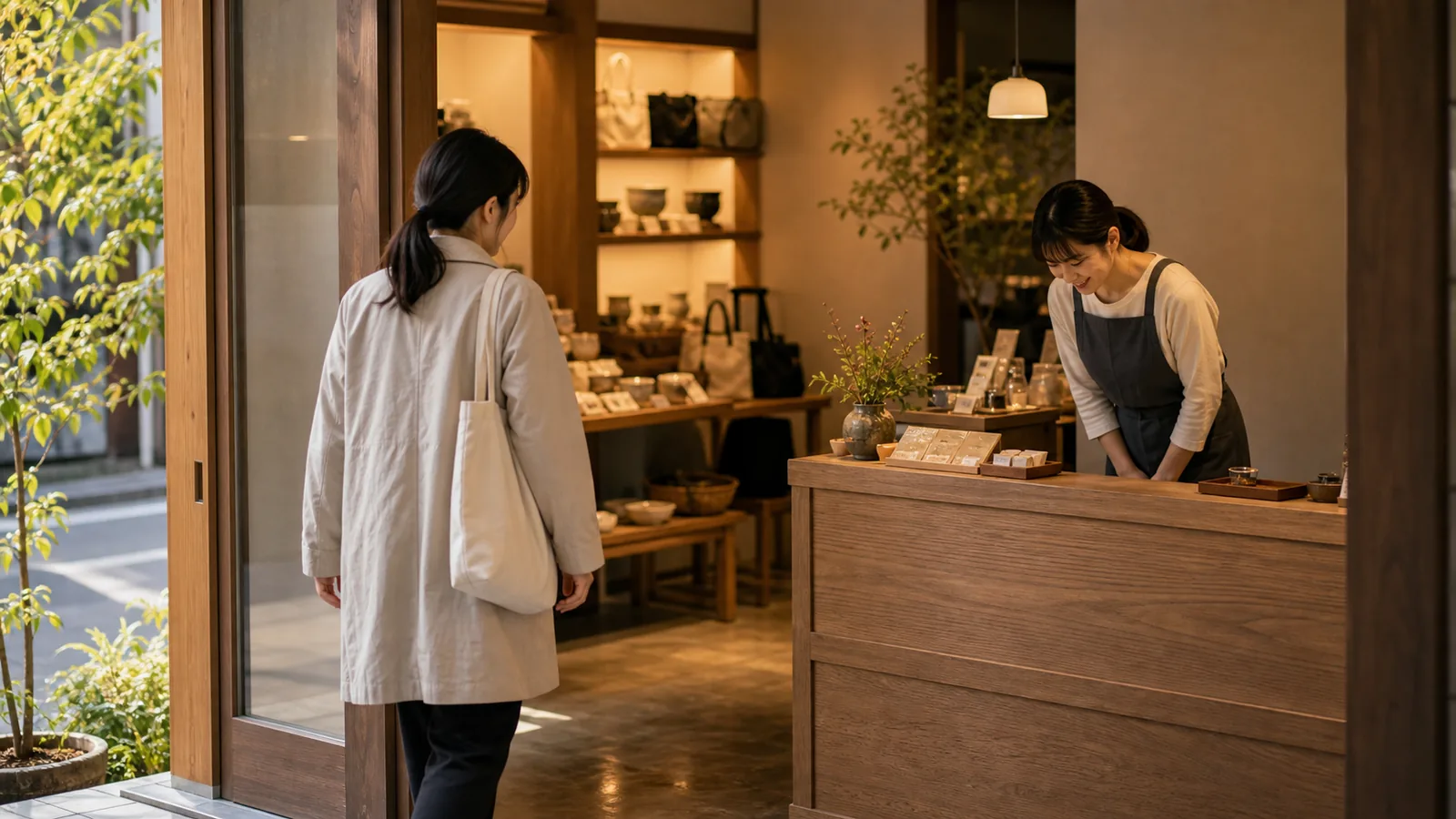
Walk into any shop in Japan — a convenience store, drugstore, restaurant, department store — and the staff will call out a loud 「いらっしゃいませ!」 to welcome you. The tourist’s first reaction is usually: “What do I say back?” “Can I just pretend I did not hear?” “Does a nod count?” The answer may surprise you — this phrase is not actually asking for a response.
What does 「いらっしゃいませ」 mean? Literally “welcome,” it is the keigo form of 「いらっしゃる」 (the honorific for いる, 来る, and 行く) plus the imperative ending 「ませ」. This is the standard greeting Japanese shops offer every customer, not directed at you personally. Convenience store clerks shout it every time the automatic door chimes — even when you are only passing through to throw away trash or use the bathroom, you will get one.
The correct response: actually none This is the most counterintuitive answer — you do not need to say anything back. In Japanese culture, 「いらっしゃいませ」 is a one-way service phrase, and customers have no obligation to respond. Watch Japanese people: they usually enter shops in silence, perhaps with a slight nod or brief eye contact at most. Never reply with 「いらっしゃいませ」 — that is the staff’s line to customers; a customer using it treats the other person as a customer, and the mood becomes awkward.
So, should you nod? A slight nod and a faint smile is perfect. It is the most natural reaction, signaling “I heard you, I appreciate your welcome,” without interrupting the clerk’s workflow. If you are just passing through and not buying anything, no response is fine either — the staff will not consider it rude.
Convenience store clerks call it out many times; you do not need to respond every time 7-Eleven, Lawson, and FamilyMart staff shout 「いらっしゃいませ!」 and 「ありがとうございました!」 all day, like NPC dialogue on loop. They yell when you enter, you hear 「ありがとうございます」 at checkout, and 「ありがとうございました!毎度!」 as you leave. Throughout, you only need to interact briefly at checkout — no response needed for entering or exiting.
Restaurants do need a reaction At restaurants, 「いらっしゃいませ!」 is usually followed by 「何名様ですか?」 (How many people?). At this point you need to answer — either holding up fingers or saying 「○人」 (○ nin, the number of people). For example, you can say 「ふたり」 for two, or simply hold up two fingers. The Japanese will read the fingers, communication works.
Drugstores and department stores: a nod is enough At Tokyo drugstores (Matsumoto Kiyoshi, Don Quijote) and department stores (Isetan, Takashimaya), staff sometimes call out to customers from outside the entrance. In this context it is pure marketing, and you do not need to engage. Eye contact and walking on is enough. If a salesperson corners you with a pitch, the phrase 「見ているだけです」 (I am just looking) gets you out gracefully.
Special establishments: Ginza sushi or upscale ryotei When entering a high-end sushi restaurant, ryotei, or traditional kappo, 「いらっしゃいませ」 is usually delivered personally by the proprietress (okami). In this case, return a formal greeting: a slight bow plus a phrase like 「お世話になります」 (Thank you for having me) or even an English “Thank you” works. The atmosphere is far more formal than at chain stores.
The standard checkout dialogue A step further: the checkout flow usually goes: — Clerk: 「○○円になります」 (That will be ○○ yen.) — You: hand over cash, IC card, or credit card. — Clerk: 「○○円お預かりします」 (Received ○○ yen.) — Clerk: 「○○円のお返しです、ありがとうございました!」 (Your change is ○○ yen, thank you.) You can stay silent throughout, or say 「ありがとう」 at the end — both are sufficient. When taking change, do not grab from inside the cash tray (現金トレイ) — wait for the clerk to finish placing the money, then pick up the tray and pour it into your hand. That is also etiquette.
Pro tip: a single 「すみません」 is plenty If you want to feel a bit more natural, when the clerk calls out 「いらっしゃいませ!」 you can nod slightly and say 「すみません」 (literally “excuse me,” though in this context it conveys “sorry to bother you” or “may I come in”). This goes over especially well at Kyoto’s traditional shops and small regional stores, and the Japanese will read it as polite. Next time you walk into a Japanese shop, stop stressing about what to say back — a nod and a smile is a perfect score.
Frequently Asked Questions
Do I need to answer irasshaimase?
Usually no. It is a store welcome phrase. You can enter naturally, nod, or smile.
Can I say irasshaimase back?
No. It is said by staff to customers, so repeating it back sounds strange.
What should I say when entering a restaurant?
When staff ask how many people, answer the number or show it with your fingers.
What should I say when leaving?
Arigatou gozaimasu, a nod, or gochisousama deshita after a meal all work naturally.