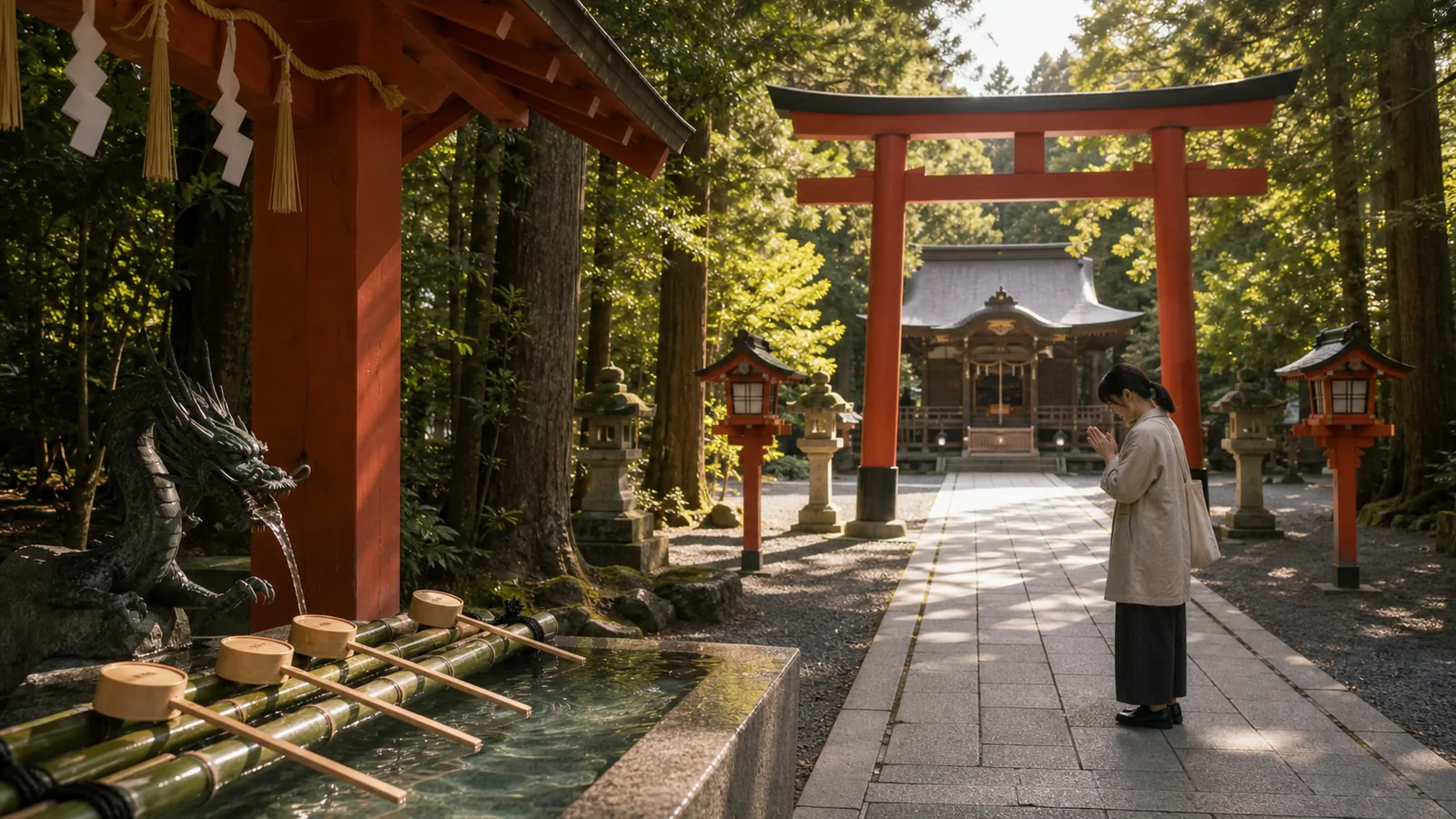
You might think visiting a shrine is just tossing in some coins, clapping, and making a wish. In fact, if the order is wrong, locals will see “rude tourist.” The full flow actually has six steps, and each has its own protocols. I have seen too many travelers walk straight up to the worship hall, clap randomly three times, and leave — even chucking coins into the offering box. Honestly, it does not look good.
Step 1: pause at the torii and bow lightly Before entering a shrine, stop under the 「鳥居」 (torii) gate. The torii is the boundary between the sacred and the mundane, so a bow before entering is basic etiquette. Walking down the middle of the approach path is a no — the center is 「神様の通り道」 (the path of the deity), so always keep to the left or right. At a large shrine like Meiji Jingu, you will notice all the Japanese naturally avoiding the center, while only tourists march straight down the middle.
Step 2: purify your hands at the temizuya Along the path you will see a small water basin called the 「手水舎」 (temizuya). The standard sequence: take the ladle with your right hand → wash the left hand → switch the ladle to the left hand → wash the right hand → switch back to the right hand, pour water into the left hand, and rinse your mouth (do not touch the ladle to your mouth) → finally stand the ladle upright and let the remaining water run down the handle to clean it. The whole sequence is done with a single ladle of water, and do not put the ladle to your mouth directly. Spit the rinse water outside the basin into the drainage gutter, not back into the basin. Many shrines removed the ladles after the pandemic and now have water flowing directly from bamboo spouts; the rules are the same, just without the ladle.
Step 3: arrive at the worship hall and gently offer your coin When offering 「お賽銭」 (shrine offering), there is no fixed amount. A common lucky choice is 5 yen (read “go-en,” meaning forming a bond), and many people deliberately avoid 10 yen (read “to-en,” sounding like distant bonds). 45 yen is also popular — “shijuu go-en” (a bond throughout). Do not throw the money; place it gently or slide it into the offering box. Hurling it is disrespectful and the coin may bounce out.
Step 4: ring the bell (if present) Large shrines have a 「鈴緒」 (suzuo) rope hanging in front of the worship hall. Pull lightly to ring the bell once, announcing your arrival to the deity. Smaller shrines without a bell skip this step. The bell is not “louder is better” — one clear chime is enough.
Step 5: two bows, two claps, one bow The core ritual: bow deeply twice (around 90 degrees) → bring your hands together in front of your chest, clap twice (right hand slightly lower, left hand slightly higher, signifying humility) → keep hands joined and make your wish → bow one final time. The entire sequence takes about 30 seconds, and do not drag it out while people wait behind you. When wishing, make the wish silently in your mind, not out loud.
Step 6: bow once more when leaving After leaving the worship hall and passing back through the torii, turn around and bow once toward the worship hall to complete the full etiquette. Many travelers forget this step, but it is what completes the entire flow.
Temples are different — never mix the two The sequence above is for shrines. If you are visiting an 「お寺」 (otera, a Buddhist temple), absolutely do not clap — simply place your hands together and pray silently. Kyoto’s Kiyomizu-dera, Tokyo’s Senso-ji, and Nara’s Todai-ji are all temples, where two-bow-two-clap-one-bow would be awkward. How to tell them apart? Entrances with a torii are shrines; entrances with a sanmon (the main gate often inscribed with a mountain name) are temples. If still unsure, look at the roof — shrine roofs often have crossed 「千木」 (chigi) finials, while temples usually do not.
Pro tip: the small shrines at Fushimi Inari also follow these rules Next time you climb to the summit of Fushimi Inari Taisha, you will see hundreds of mini 「お塚」 (otsuka) shrines along the way. The same etiquette applies — offer a coin, perform the two-bows-two-claps-one-bow ritual, and bow on departure. Many travelers hurry past, but if you take the time to perform the full ritual at one quiet, uncrowded shrine, you will find the whole experience transforms — that becomes the Kyoto memory truly your own.
Frequently Asked Questions
Do all shrines use two bows, two claps, one bow?
Most do, but some shrines such as Izumo Taisha use different customs. Follow posted instructions when available.
Do I have to rinse my mouth at the purification basin?
It is traditional, but do not touch the ladle with your mouth or spit back into the basin. Follow the current setup on site.
Do I need to offer exactly 5 yen?
No. Five yen is a good-luck wordplay, not a rule. Offer quietly and gently without throwing coins.
Should I clap at temples?
Usually no. Buddhist temple worship is generally done with hands together in silence, without clapping.