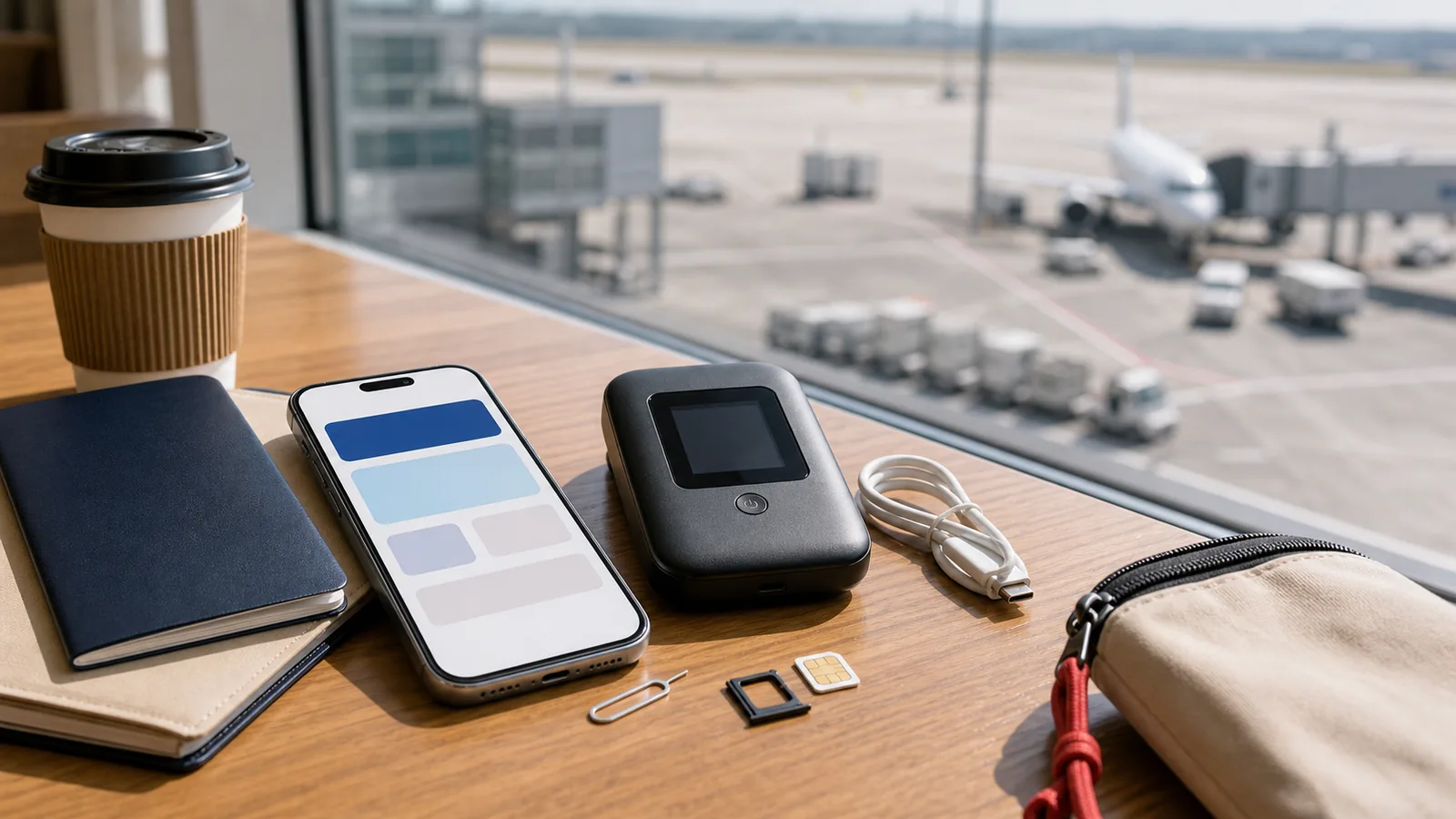
Heading to Japan and stuck on “should I buy a SIM card, rent a pocket Wi-Fi, or just roam with my Taiwanese or Chinese carrier?” This guide breaks it down by real cost, trip length, group size, and device compatibility, with the best choice for six realistic scenarios.
Bottom line: solo and short trip (under 7 days) → SIM card or eSIM; group or long trip → pocket Wi-Fi; iPhone users prioritize eSIM
Option 1: physical SIM card
Purchase at the airport or convenience store on arrival, or online before departure. Major providers:
1. Sakura Mobile: 6 GB for 5 days at 1,500 yen, 30 GB for 30 days at 4,500 yen.
2. Mobal: daily plans from 1 to 30 days, 1,000 to 5,000 yen.
3. Japan Welcome SIM: free SIM card (tourists only) plus top-up fees, 1,000 yen for 7 days.
4. Bic Camera SIM and Bic Camera Travel SIM: 30 days with 5 GB for about 3,500 yen.
Pros: mid-range price, stable signal, no Wi-Fi device to carry.
Cons: phone must be SIM-unlocked (Taiwan-spec iPhones from Chunghwa Telecom, Taiwan Mobile, or Far EasTone may be locked); requires physically swapping SIMs (keep your original safe).
Option 2: eSIM (virtual SIM, QR code activation)
Works with iPhone XS/XR or newer, Galaxy S20 or newer, Pixel 4 or newer, plus other eSIM-capable phones.
Major providers:
1. Airalo: 7 days with 3 GB for about 350 NTD (8.50 USD).
2. Holafly: 7 days unlimited for about 1,500 NTD.
3. Ubigi: flexible multi-day plans.
4. Sakura Mobile eSIM and Mobal eSIM.
Pros: fastest (scan a QR code, usable in 5 minutes); no physical SIM swap; original SIM continues working in parallel (dual SIM); keeps your Taiwan or mainland number active for incoming calls.
Cons: not every phone supports it; many plans but complex.
Option 3: pocket Wi-Fi device
Reserve online before departure, pick up at the airport, hotel, or by courier, and return at the airport mailbox or to the vendor at trip end. Major providers:
1. Japan Wireless: 250 yen per day for 5 days, 200 yen per day for 30 days, unlimited data.
2. Wifi-Hire (WiFi-BB): common in group-tour partnerships, 200 to 300 yen per day.
3. Sakura Mobile Wi-Fi: 1,500 yen for 5 days, 8,000 yen for 30 days.
4. Taiwanese travel-agency bookings (Lion Travel, Cola Tour, ezTravel): from 600 NTD for 4 days.
Pros: multi-user sharing (up to 5 to 10 devices connect simultaneously, one rental for the whole party); relatively stable signal; no SIM swap.
Cons: an extra device plus charging cable (200 to 400 grams, slightly heavier luggage); must be returned; lost devices cost 5,000 to 15,000 yen.
Option 4: carrier roaming (turning on roaming with your Taiwan, mainland, or Hong Kong number)
Taiwan’s Chunghwa Telecom, Taiwan Mobile, and Far EasTone: 199 to 399 NTD per day depending on plan, with 5G roaming costing more. China Telecom: 30 yuan per day with 1 GB, or 6 yuan per day for unlimited low-speed.
Pros: simplest (one-touch roaming before departure); the original number can still receive calls.
Cons: most expensive, around 1,500 to 2,500 NTD for 7 days, or 200 to 1,000 yuan for mainland; strict data caps (cut off after exceeding).
Comparison table (7-day trip, 2 people)
1. Physical SIM card (one per person): 2 × 3,000 yen = 6,000 yen (about 1,200 NTD).
2. eSIM (one per person): 2 × 350 NTD = 700 NTD.
3. Pocket Wi-Fi (one device shared by 2): 1,500 to 2,000 yen (about 350 NTD).
4. Roaming (per person): 2 × 1,500 NTD = 3,000 NTD.
Verdict: eSIM is cheapest (700 NTD for two people), pocket Wi-Fi is best value per person (350 NTD for two). Roaming is most expensive and data-limited.
Best choice across six scenarios
Scenario 1: solo, 5-day business trip → eSIM (Airalo or Holafly) with 5 GB, solved at 350 NTD.
Scenario 2: 2 to 3 people, 7-day sightseeing → One pocket Wi-Fi device (unlimited data), shared by the family at 350 NTD per person.
Scenario 3: solo, 14-day backpacker → Sakura Mobile 30-day SIM (physical or eSIM) at 4,500 yen, deep-travel without signal worries.
Scenario 4: 4 to 6 people, family trip with kids → One pocket Wi-Fi device (supports 10 devices) at 400 yen per day, best value.
Scenario 5: business use, needing Office, Slack, or Zoom → Sakura Mobile eSIM with a large data plan (15 GB for 30 days at 6,500 yen), or pocket Wi-Fi unlimited as insurance.
Scenario 6: deciding after arrival → Buy a Bic Camera Travel SIM at the airport 7-Eleven or Lawson, ready to use immediately at 3,000 to 3,500 yen — fast signal but not cheap.
Signal comparison: Japan’s three major carriers
1. docomo: widest national coverage, best signal in mountains and rural areas. Sakura Mobile, Mobal, and Bic Camera SIM mostly run on docomo.
2. au (KDDI): strong in urban areas, slightly weaker in countryside. Some budget SIMs run on au.
3. SoftBank: broad coverage, weaker offshore and along coasts. Most pocket Wi-Fi vendors run on SoftBank.
Big cities (Tokyo, Osaka, Kyoto) work well on all three. For deep-mountain destinations like Shirakawa-go, Mount Koya, or Yakushima, docomo-based options are most reliable.
Pro tip 1: confirm whether your phone is unlocked before departure
Certain iPhones purchased from Taiwan’s Chunghwa Telecom, Asia Pacific Telecom, or PChome 24h have a SIM lock (restricted to that carrier’s SIM), and inserting another SIM in Japan yields no signal.
How to check: iPhone → Settings → General → About → scroll to “Carrier Lock.” “No SIM restrictions” means unlocked; “Restricted” means locked.
Locked phones need to visit the carrier’s store for a paid unlock (free, or 200 to 500 NTD).
Pro tip 2: eSIM is the smartest modern choice
If your phone supports eSIM (iPhone XS+, newer Galaxy or Pixel), eSIM wins decisively over physical SIM:
1. Set up in 5 minutes before departure, ready to use the moment you land (no queueing for a SIM card).
2. Original SIM remains active, so your Taiwan or mainland number can still receive calls (family emergencies).
3. After returning home, just delete it — no physical return required.
Recommendations: Airalo (cheap), Holafly (unlimited data but pricier).
Pro tip 3: do not forget to return your pocket Wi-Fi
Wi-Fi rental contracts specify return locations (Narita Airport mailbox, Haneda Airport service counter, courier back to vendor). Put the device back in its bag the night before departure to avoid morning rush forgetfulness. Failure to return counts as a lost device, costing 10,000 to 15,000 yen.
Before your next trip, check your scenario: solo and short with eSIM support → Airalo; group and long → pocket Wi-Fi. Roaming only when there is no time to prepare. (Data from 2024; verify the latest plans before departure.)
Frequently Asked Questions
Is eSIM or pocket Wi-Fi better for solo Japan travel?
If your phone supports eSIM and you mainly travel in cities, eSIM is usually easiest. For groups or multiple laptops, consider pocket Wi-Fi.
Are unlimited Japan eSIM plans truly unlimited?
Not always. Many plans have fair-use thresholds and reduce speed after a daily or total data amount. Read the throttling rules before buying.
What are the downsides of pocket Wi-Fi?
It needs charging, must be returned, and only works for people near the device. If the group splits up, others may lose internet.
What if I need SMS on my home number?
Keep home-carrier roaming active for reception, then use eSIM or Wi-Fi for data. Check roaming fees, SMS rules, and dual-SIM settings before departure.