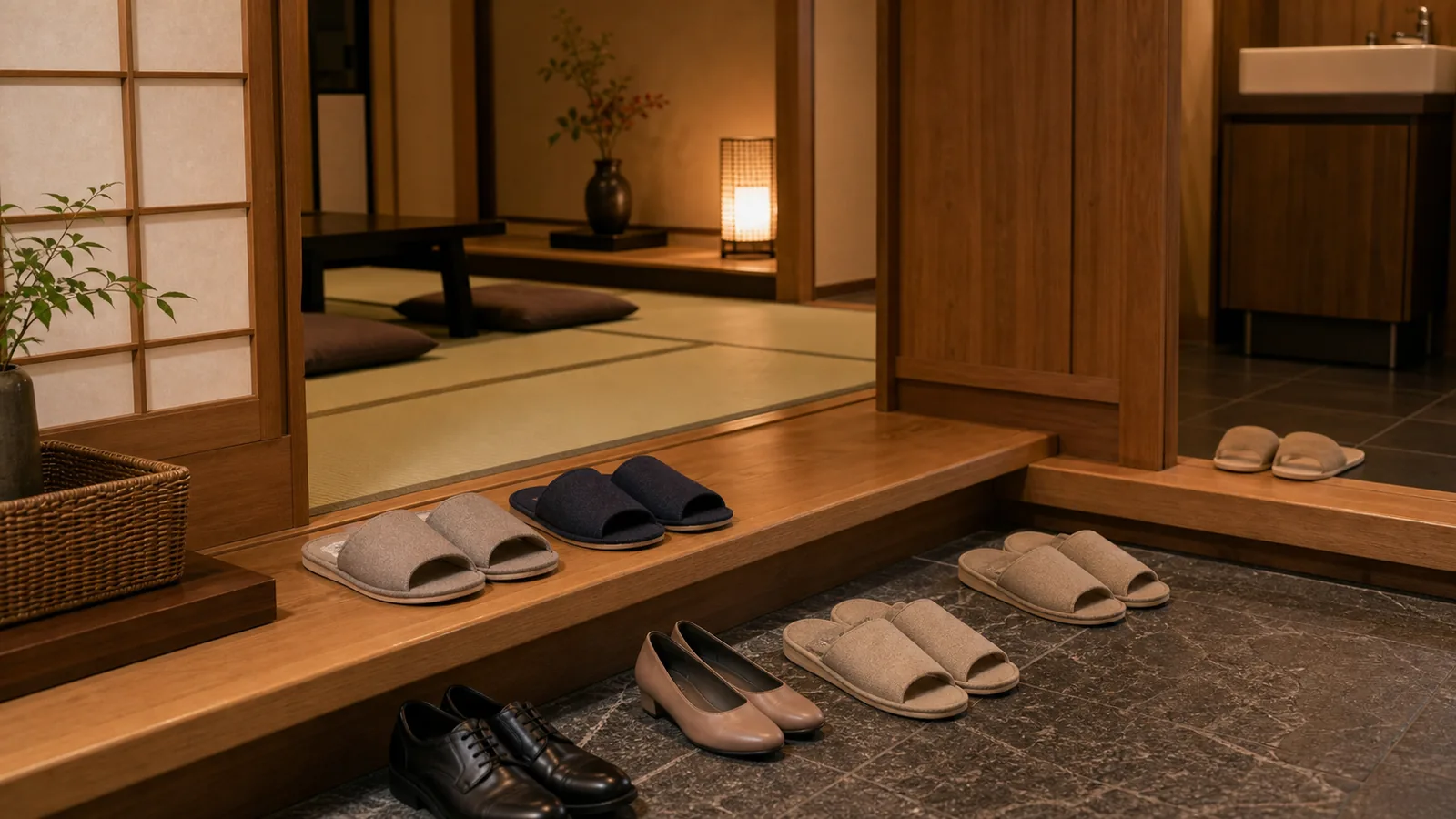
In Japan, footwear is its own discipline. You change shoes entering a guesthouse, change again at an izakaya, change yet again to use the bathroom, and remove them entirely on tatami. The most common tourist mistakes are stepping into the genkan still wearing outdoor shoes, or walking onto tatami in regular slippers — both major faux pas. This article explains the slipper rules for four key situations.
Situation 1: the genkan — remove shoes before entering Entering any traditional building — a guesthouse, ryokan, traditional restaurant, someone’s home, specific areas of a shrine (rest spaces, the inner offices), the shoin halls of a temple — you will first encounter a 「玄関」 (genkan). The genkan floor sits slightly below the interior floor; shoes go in the genkan and people step up to the interior floor. The procedure: —
- Walk to the genkan and crouch down to remove your shoes. —
- Arrange them neatly with the toes pointing outward (a uniquely Japanese courtesy — making it easy to slip them on cleanly when leaving). —
- Step up onto the higher wood or tatami floor, putting both feet up in sequence (do not awkwardly hop with one foot socked and one foot bare). —
- The entrance may have 「室内スリッパ」 (indoor slippers) waiting for you. Common mistakes: leaving shoes toes-inward and disorderly — creates work for others. Wearing socks indoors (especially clean ones) is most natural; bare feet are considered too casual (until you reach a tatami room).
Situation 2: the bathroom — switch to toilet slippers Upon entering the bathroom, you will find a dedicated 「トイレスリッパ」 (toilet slipper) — usually plastic or synthetic leather, in a different color from the indoor slippers (often green, blue, or gray). The rules: — Switch to toilet slippers before entering the bathroom, leaving the indoor slippers outside the door. — Always switch back to indoor slippers before leaving the bathroom. — The most common mistake: walking out of the bathroom still wearing the toilet slippers — a major breach (toilet slippers in the living room = hygiene problem). Why so strict? Traditional Japanese thinking treats the bathroom as “unclean” space, and shoes that have touched the bathroom floor absolutely cannot step into living areas. The rule is especially strict in private homes, traditional ryokan, and upscale restaurants. Modern hotels and chain restaurants may not have toilet slippers at all, in which case no switching is needed.
Situation 3: tatami — remove all slippers When entering a room floored with 「畳」 (tatami), all slippers come off, leaving only socks or bare feet. Why: —
- The 「い草」 (rush grass) in tatami wears easily, and slipper soles leave marks. —
- Tatami is the traditional “sacred and pure” floor, and the “mundane” nature of slippers should not tread on it. Where you encounter this: — Inside the guest rooms of traditional ryokan. — Tea rooms, washitsu (Japanese-style rooms), and shoin-zukuri rooms. — Certain interior spaces at shrines and temples (with especially strict shoe-removal rules). — Some traditional Japanese izakayas with horigotatsu (sunken seating) or zashiki (tatami-floor seating). Note: when stepping onto tatami, do not tread on the cloth border edges (畳縁, tatamiberi) — these are the “seams” of the tatami, and stepping on them shortens its life. Japanese people instinctively step around them.
Situation 4: the ryokan guest room — three sets of footwear to swap At traditional ryokan (the upscale ones in Hakone, Izu, or Kyoto), you may swap footwear three or four times in a single night: —
- Remove shoes at the ryokan’s genkan and switch to “in-house slippers.” —
- Entering the guest room, leave the in-house slippers outside the door, then walk on the tatami in socks or bare feet. —
- For the bathroom, switch to the room’s own “toilet slippers,” then switch back to the in-house slippers when leaving. —
- For dining or the communal bath, wear the in-house slippers. —
- Before entering the communal bath, remove the slippers in the changing area and step in barefoot. It sounds complex, but after a few rounds it becomes natural. The standard for in-house slippers: the ryokan entrance provides men’s and women’s styles, choose your size, and place them neatly when leaving the room.
Special settings: factories, schools, hospitals If you have the chance to tour a Japanese factory, school, or hospital, the entrance will have guest slippers (「来客用スリッパ」) that you must switch into to enter. Return them to their original spot on the way out.
Details foreigners most often forget — See a genkan, remove your shoes — regardless of whether you see slippers waiting. — Toes pointing outward — crouch down and turn your shoes around after stepping inside. — Do not stride too widely in slippers — Japanese slippers run small, and heavy steps make them slip off; take small steps. — Indoor slippers do not go on tatami — as soon as you see tatami, take them off. — Walking out of the bathroom in toilet slippers is the most common mistake — always switch back before leaving the bathroom.
Pro tip: pack clean, attractive socks Japan is a country where “socks get noticed.” Staying at a traditional ryokan, sitting in a washitsu, or visiting shrine interiors means you will spend a lot of time walking around in socks alone. Pack several pairs of clean socks with no holes, in cute designs or with good fabric quality. Socks with holes really will be noticed. Tuck two extra pairs of attractive socks into your suitcase before your next trip, and you will move around the ryokan with extra confidence.
Frequently Asked Questions
Do I always remove shoes indoors in Japan?
Not everywhere, but if you see a genkan step, shoe shelves, slippers, or everyone removing shoes, leave outdoor shoes at the entrance.
Can toilet slippers be worn back to the room?
No. Toilet slippers stay in the toilet. Change back to indoor slippers or your own footwear before leaving.
Can I wear slippers on tatami?
No. Leave slippers at the doorway and step onto tatami in socks or bare feet to avoid wear and dirt.
Should I pack good socks for Japan?
Yes. Ryokan, washitsu rooms, temple interiors, and some restaurants may require shoe removal, so clean socks without holes are useful.