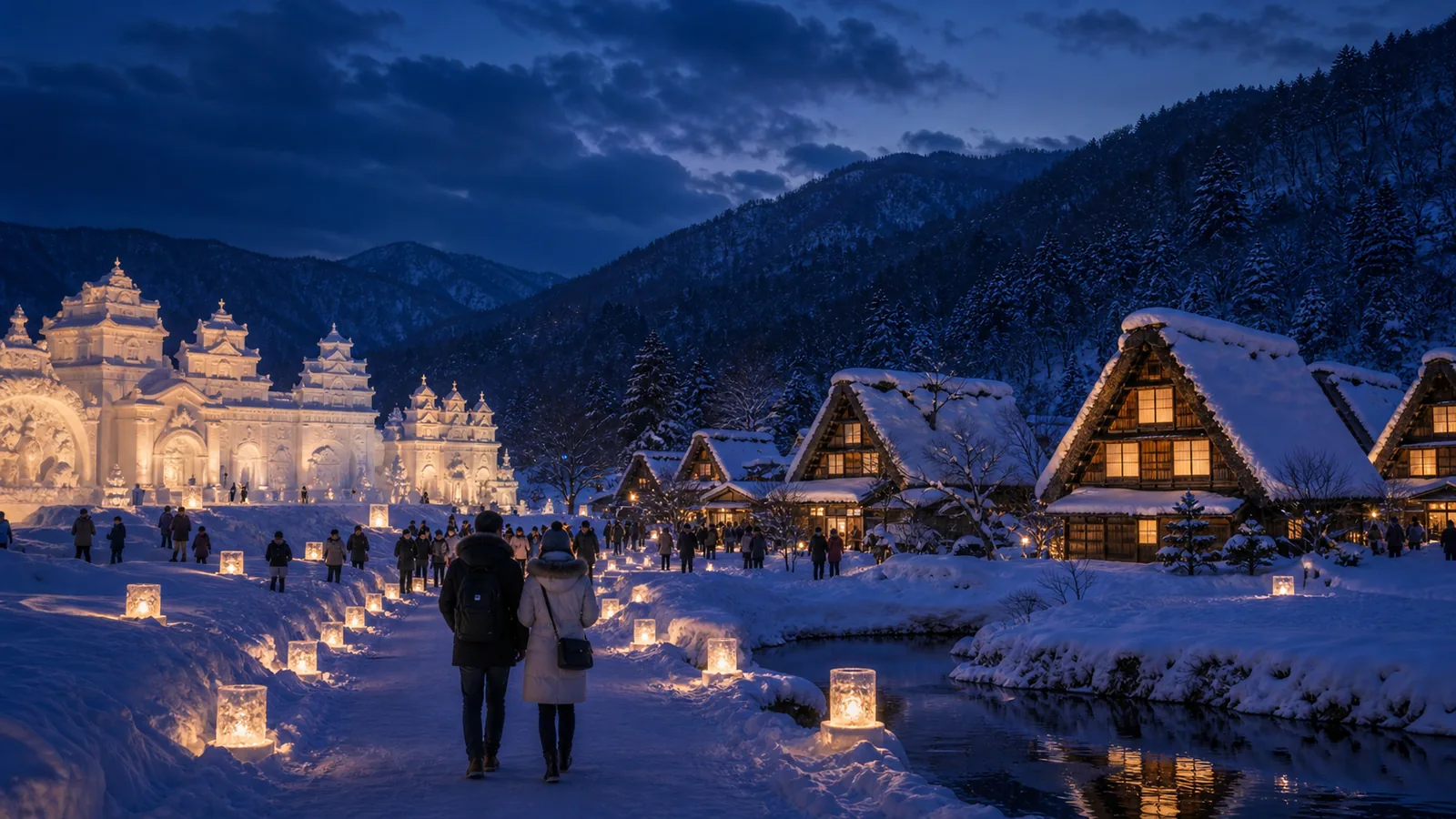
Want to see Japan in its most magical winter form? Two places top every list: the elaborate snow sculptures of Sapporo Yuki Matsuri, and the fairy-tale snow nights of Shirakawa-go gassho village. This guide lays out precise dates, lodging strategy, and transit logistics for both, turning your winter Japan trip from a ski run into a cultural deep dive.
Sapporo Yuki Matsuri — Hokkaido is largest festival
The Sapporo Yuki Matsuri (Sapporo Snow Festival) is Japan is biggest winter event, pulling in 2 million visitors a year. It launched in 1950 with just six sculptures; today the count tops 200.
Exact timing
— 2026 dates: February 4 (Wed) through February 11 (Wed) — Opening day usually lands on the first Saturday of February, running 8 days — Peak crowd days: the middle weekend (Feb 7-8)
Three venues, each with its own character
1. Odori Park venue: the main sculpture display. Stretches from blocks 1 to 12, totaling 1.5 km. The largest snow sculptures reach roughly 15 meters tall and usually feature current themes (anime, famous buildings, historical figures).
2. Tsudome venue: away from downtown (20 minutes by subway plus shuttle bus). Best for families — snow slides, sled rides, outdoor activities. Kids love it.
3. Susukino venue: the nighttime ice festival, with over 100 finely carved ice sculptures. Set inside the entertainment district, it offers the most atmospheric snow-night lighting.
Evening illuminations
All venues light up nightly from 17:30 to 22:00. Massive snow sculptures and ice carvings glow with LED projections, the magic enhanced by snow reflecting double the light. Nights outshine days here. Be warned: temperatures drop to -10C, so polar-grade gear is non-negotiable.
Lodging strategy
— Hotel prices inside Sapporo spike 2-3x during the festival — book 6 months ahead — Alternative: stay at Jozankei Onsen (1 hour by subway) or Otaru (30 min by JR) and commute in — From New Chitose Airport to Sapporo: 36 min by JR for 1,150 yen, frequent service
Day-trip options nearby
— Otaru (30 min by JR): canal walk plus the Otaru Snow Light Path illumination (2/2 to 2/11, same window) — Noboribetsu Onsen (1.5 hr by JR plus bus): Hell Valley plus hot springs — Niseko / Rusutsu: ski resorts
Shirakawa-go Gassho Village — fairy-tale winter night
Shirakawa-go gassho village is a traditional mountain settlement in Gifu, registered as a UNESCO World Heritage Site in 1995. The village holds about 60 gassho-zukuri houses with triangular thatched roofs shaped like hands in prayer, designed to bear heavy snow loads. Once buried in winter snow, the view turns into a storybook scene.
Exact timing
— Snow cover period: late December through mid-March — Deepest snow and most beautiful: mid-late January through early February — Nighttime illumination (light-up): only 6-8 days a year (in 2026: January 18, 19, 25, 26 plus February 1, 2, 8, 9, pending official confirmation)
What is the illumination?
From 17:30 to 19:30 each illumination night, every gassho house is lit up. The combination of snow, lights, and triangular roofs makes for one of the most enchanting winter night scenes in all of Japan. Outside of light-up dates, the village goes dark after 17:00, so daytime is the only option.
The harsh lodging reality
Only 10-plus minshuku (private guesthouses) inside Shirakawa-go take foreign tourists, so capacity is tiny. Rooms on illumination nights sell out a full year ahead — every year.
Alternatives:
1. Stay in Takayama plus catch the early Nohi Bus for a same-day round trip (50 min Takayama to Shirakawa-go, about 1.5 hours one way)
2. Stay in Kanazawa and take the direct Kanazawa to Shirakawa-go bus (75 min)
3. Illumination viewing from the observation deck: skip the overnight. Arrive during the day, walk up to the hilltop observation deck by 17:30 (15-min hike) for photos, then catch the last bus back to Takayama or Kanazawa (usually 19:30 or 20:00)
What if there is no illumination that night?
Daytime visits are still spectacular. Snow plus gassho houses plus mountain backdrop — daytime scenery is actually more reliable than night (illumination depends on weather), and no lodging required since you can same-day it.
Getting there
From Tokyo: Shinkansen to Toyama or Takayama, then 1.5 hours by bus From Osaka: Limited Express to Kanazawa, then 1.5 hours by highway bus From Nagoya: JR to Takayama, then 50 min by Nohi Bus
Pro tip — combining both spots
5-day sample itinerary:
— Day 1: Tokyo to Sapporo (flight) — Day 2: Sapporo Snow Festival by day (Odori Park) plus evening illumination — Day 3: Otaru day trip plus Sapporo night festival (Susukino ice sculptures) — Day 4: Sapporo to Nagoya (flight), overnight in Nagoya — Day 5: Nagoya to Takayama (JR) to Nohi Bus to Shirakawa-go (daytime), back to Takayama for the night — Day 6: Takayama to Tokyo (flight or Shinkansen)
Pitfalls to avoid
1. Failing to book bus tickets early: Nohi Bus may sell out same-day — reserve online a week ahead
2. Snow-day transit delays: build in a 3-hour buffer, never schedule a tight flight connection
3. Wrong footwear: village paths mix snow and ice — wear non-slip snow boots, regular boots guarantee a fall
4. Illumination days may require tickets: village limits foot traffic — line up at the observation deck reservation area by 9 AM
For your next winter trip to Japan, Sapporo Snow Festival plus Shirakawa-go justifies the 5 days. Hokkaido offers grand snow sculpture spectacle; Shirakawa-go offers quiet snow nights — the contrast complements perfectly, making this the most rewarding winter combo Japan can offer.
Frequently Asked Questions
When is Sapporo Snow Festival held?
It is usually held in early February, but exact dates are announced each year. Check the official site before planning.
Which venue should first-time visitors see?
Start with Odori Park. Visit once by day for sculpture details and again by night for lights. Add Susukino if you have time.
Can I visit Shirakawa-go light-up without planning?
No. Light-up dates usually involve reservations and traffic control. Check official entry, bus, parking, and lodging rules first.
Can Sapporo Snow Festival and Shirakawa-go fit one trip?
Yes, but allow at least five to six days. The two places are far apart and winter transport needs buffer time.