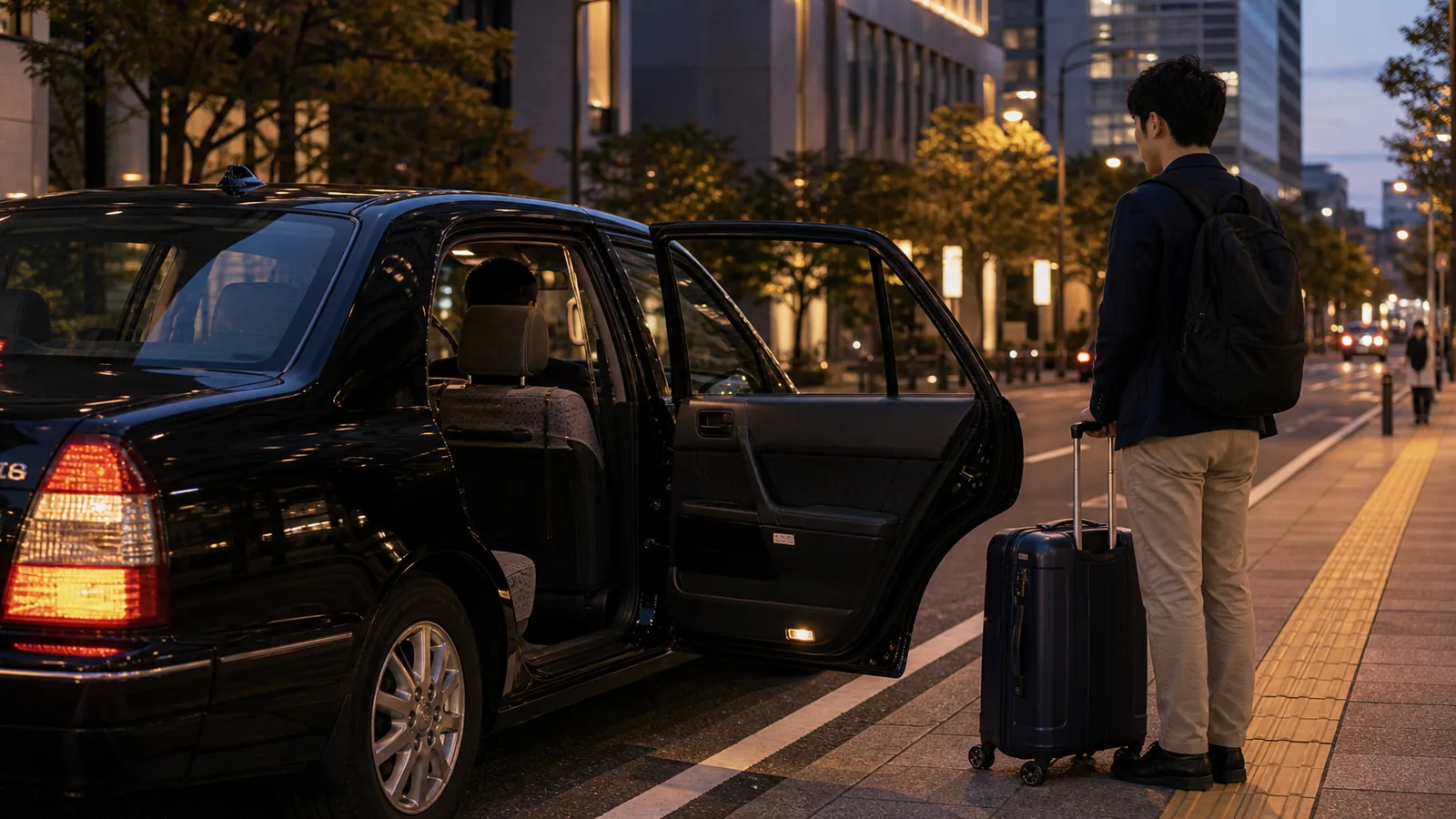
You hail a taxi in Japan, reach for the door handle naturally — and snap, the door the driver just opened catches your elbow. Japanese taxis have jidou doa (automatic doors): the driver opens the rear door from the front seat with a button. The classic tourist mistake is not knowing this, then either hurting themselves reaching for the handle or putting the driver in an awkward spot. This guide breaks down 5 hidden taxi rules in Japan.
Rule 1: the door is automatic — do not touch it 95% of Japanese taxis are equipped with auto-door systems — the driver presses a button and the rear left door (curb side in Japan) opens by itself. Stand on the curb, wait for the door to open, get in, sit down, and let the driver close it again. — Wrong move: reaching for the handle, fighting the auto-door, jamming it, possibly getting hit — Right move: stand and wait for the door to open, then keep your hands on your knees after sitting, do not touch the door, let the driver close it — Same when getting out: do not close the door yourself — pay, the door opens, step out, the door closes automatically. Forcing it shut equals an awkward driver and possibly a damaged door. Exception: the front passenger seat is not auto-door — open and close it yourself. Most taxis do not seat passengers up front (rear is more comfortable), but if you are solo with large luggage, the front is acceptable (the driver will signal).
Rule 2: how to flag a taxi Most Japanese taxis can be hailed from the street with a wave (common in central Tokyo and Osaka). How to read the indicator: — Roof light shows kuusha (empty) = available, wave it down — Roof light shows chinsou (en route) or geisha (heading to a pickup) = already has a passenger or going to a call, will not stop — No roof light or dark = private car, do not hail Modern alternatives: use the GO app (Japan largest rideshare), DiDi (Chinese DiDi Japan version), or Uber (only in major cities). Taxi queues at Tokyo, Osaka, and Kyoto stations, department stores, and airports are the simplest option — just walk to the queue and board.
Rule 3: drivers usually will not open the trunk for you Wait, would not the driver help? — In most cases yes, but you press the trunk button and the driver opens it. Some drivers will get out and help with luggage (premium fleets like Miyako Taxi and Nihon Kotsu). The convention: — Small luggage: carry it onto the rear seat or floor yourself, no need to trouble the driver — Large luggage or suitcases: driver presses the button, you load it yourself, or the driver may step out to help — Wet or dirty items: wrap them in plastic first — shoving them into the trunk raw earns silent driver resentment
Rule 4: prohibited in the cabin — eating, smoking, phone calls — Eating and drinking: prohibited — taxi interiors are kept pristine, even drinking water or eating candy is discouraged. Lunch boxes are an absolute no. — Smoking: the entire vehicle is non-smoking, including the driver seat. Violating gets you asked out. — Phone calls: avoid speaking loudly — a quick line or two is fine, but a long business call subtly affects driver attitude. Use earphones for politeness. — Music: drivers usually play radio or J-Pop at low volume and prefer not to be asked to change it. If uncomfortable, politely request onryou wo sagete kudasai (please lower the volume).
Rule 5: payment methods, and no tipping Most taxis accept: cash, IC cards (SUICA, ICOCA), credit cards (Visa, Mastercard, JCB, AMEX), and QR Code payment (PayPay, LINE Pay, Apple Pay). Newer taxis have a rear-seat tablet or touchscreen for selecting payment. — No tipping — Japan has no tipping culture, taxis included. Pay exactly what is on the meter. — Change: the driver hands it back via a karuton (small tray) inside the cabin, the same etiquette as a register checkout — Receipts (ryoushuusho): say ryoushuusho kudasai (a receipt please), the driver will print one — Fare structure: starting fare is 500-700 yen (varies by city — 500 yen in Tokyo covers 1 km, 500 yen in Kyoto covers 1.7 km), then 100 yen per 200-300 meters after that. 20% night surcharge applies 22:00-5:00. Long-distance trips (airport to downtown) have fixed-fare options (Narita to Ueno is about 21,000 yen flat) — ask the driver.
Specialty taxi services — Miyako Taxi, Nihon Kotsu, MK Taxi: premium service, strict staff training, newer vehicles, same fares — Female-only taxis: some companies operate fleets with female drivers exclusively for female passengers, selectable in apps — Accessible taxis: the JPN TAXI series (boxy modern Nissan NV200 conversions) offers extra space and a wheelchair ramp, hailable through any app — Owner-operator taxis (kojin taxi): marked with kojin on the body, with a distinct pineapple-shaped roof light. Drivers are experienced and offer attentive service, but Japanese fluency is largely required
Pro tip: write down your destination in Japanese Most Japanese taxi drivers do not speak English, and Google Translate has bugs. The safest move: before leaving, save the destination Japanese address, store name, or hotel name in your phone notes (or screenshot the Japanese-language version of Google Maps), and show it directly to the driver on boarding. Nearby landmark plus address plus phone number — all three together minimize getting lost. Next time you ride a taxi in Japan, remember: do not touch the door, do not fumble for your wallet (have your IC card ready), do not tip — your taxi experience will run as smoothly as a local.
Frequently Asked Questions
Do Japanese taxi doors really open automatically?
Many rear taxi doors are controlled by the driver. Wait for the door when entering and leaving. Larger vehicles, front seats, or some regional taxis may be manual.
Can I hail a taxi on the street in Japan?
Often yes in cities, but look for 「空車」. At stations, hotels, airports, and sights, use the taxi queue instead.
How do I show the destination without Japanese?
Prepare a Japanese address, hotel name, map screenshot, or Google Maps screen. 「ここまでお願いします」 means please go here.
Should I tip Japanese taxi drivers?
No. Pay the meter fare. A clear thank you is the natural way to show appreciation.