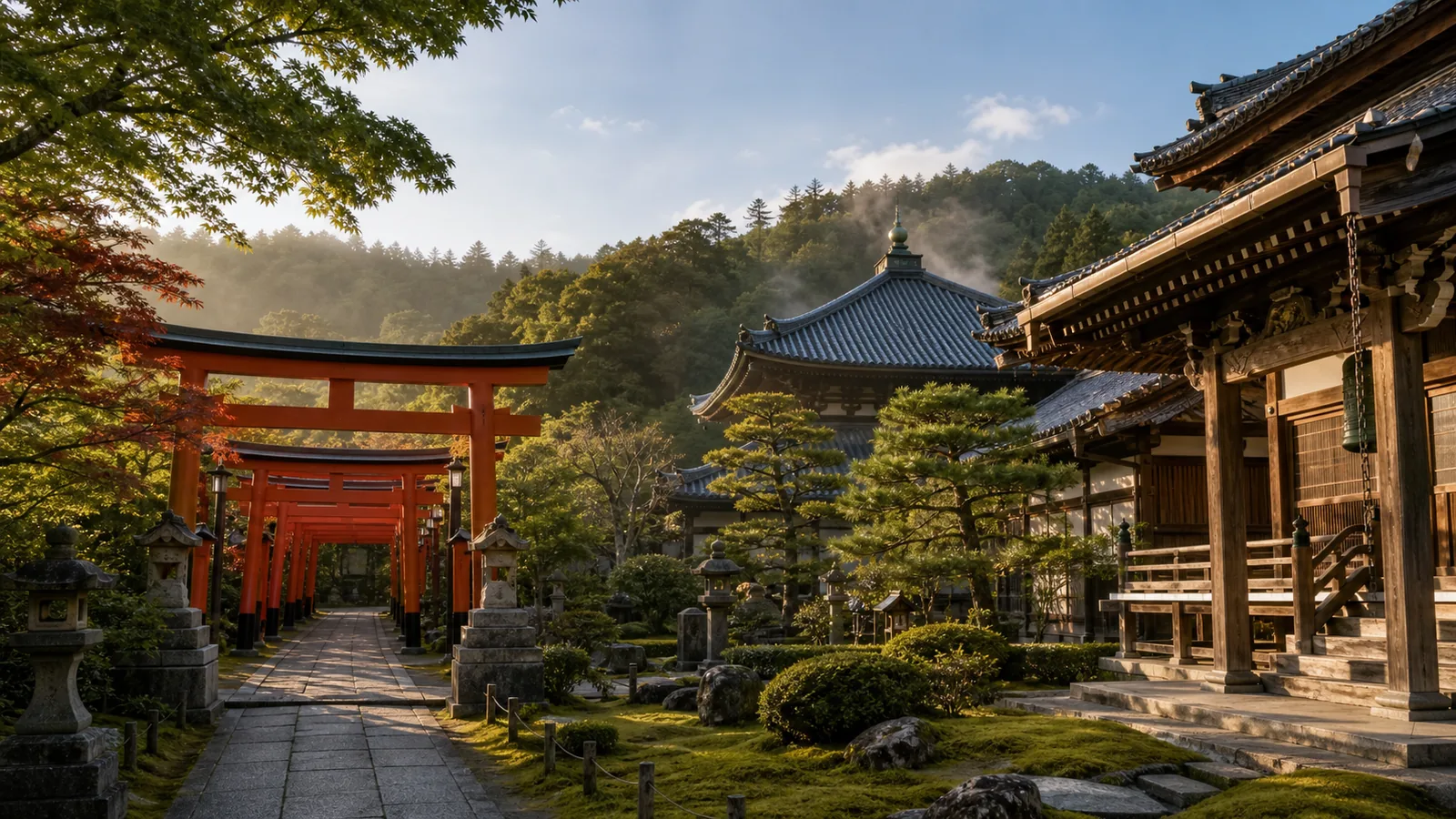
Many first-time visitors to Japan see a sacred site and apply the same routine across the board — clap, palms together, drop coins, make a wish. Then they clap twice in a Buddhist temple and watch the auntie next door stiffen for a full second. A jinja (shrine) and an o-tera (Buddhist temple) are two entirely different religious institutions, and the etiquette differences are stark enough that locals will spot you as a tourist instantly.
Difference 1: the entrance structures differ Shrines are entered through a torii — two red or wooden pillars with a crossbeam on top, often arranged in a series of multiple torii along the approach. Temples are entered through a sanmon (mountain gate), typically a roofed wooden gateway, sometimes with a temple name plaque above (Kiyomizu-dera, Kinkaku-ji, etc.). Torii equals shrine, sanmon equals temple — that one rule solves half the problem.
Difference 2: do you clap or not? The most commonly confused point. Shrines: clap. Temples: do not clap. The core shrine ritual is two bows, two claps, one bow, but at a temple you simply press palms together silently and never clap. Anyone clapping at Sensoji, Kiyomizu-dera, or Todai-ji is nine times out of ten a tourist.
Difference 3: the objects of worship differ Shrines enshrine kami (deities of Japan Shinto faith — Amaterasu, Inari, Hachiman, etc.); temples enshrine hotoke (buddhas and bodhisattvas — Shakyamuni, Kannon, Jizo, etc.). So shrines lean toward an atmosphere of "natural spirits", temples toward "Buddhist contemplation".
Difference 4: the clergy titles differ A shrine priest is a kannushi, or a miko (the young women in white robes and red hakama). A temple has obousan (monks). Looking to photograph the red-robed shrine maidens at a temple? Those only exist at shrines — do not search the wrong place.
Difference 5: offering boxes share rules, but amulets differ Both have offering boxes, and the technique is identical (gently place, do not throw). But amulets differ: shrines sell omamori (themed cloth pouches for traffic safety, academic success, romance, etc.); temples also sell omamori but with Buddhist-style designs (lotus motifs, Buddha imagery). Disposal also differs — shrine omamori are traditionally returned to the shrine after a year for o-takiage (ritual burning), while temple ones go back to the temple.
Difference 6: goshuin styles differ Both temples and shrines offer goshuin (stamp-plus-brush-calligraphy commemorative seals), but the styles are completely different. Shrine goshuin tend to feature the shrine name plus the shrine seal in firm, angular calligraphy; temple goshuin often include Buddhist phrases like houhai or namu amida butsu in softer brushwork. Buy separate goshuin books — one for shrines, one for temples. Mixing them in one book may earn polite refusal at more traditional temples.
Difference 7: bell versus large bell In front of a shrine worship hall hangs a suzuo (bell rope) — a quick pull rings the bell to call the kami. Temples instead have a bonsho (giant bell), usually housed in its own bell tower, struck 108 times on New Year Eve at joya no kane to dispel earthly desires. Tourists cannot strike these casually during regular visits.
Difference 8: photography rules differ At shrines, photography is usually fine outside the worship hall and main hall (just do not photograph people mid-prayer). Temples vary — inside the main hall where Buddha statues are enshrined, photography is mostly prohibited. Kinkaku-ji and Kiyomizu-dera main halls in Kyoto both ban interior photos, and violations get you stopped. Signs read satsuei kinshi (photography prohibited) — see one, pocket the phone.
Pro tip: Kyoto often mixes the two on a single tourist street Kyoto Kiyomizu-dera, Yasaka Shrine, and Maruyama Park happen to line up as a single sightseeing route. Kiyomizu-dera is a temple, Yasaka is a shrine — you have to switch etiquette modes between them. The classic backpacker mistake is doing "two bows two claps one bow" at Kiyomizu-dera and only pressing palms without clapping at Yasaka — exactly inverted. Before going, just check Google Maps: anything ending in -ji or -in is a temple; anything ending in -jinja, -gu, or -taisha is a shrine.
Frequently Asked Questions
How can I tell a shrine from a temple quickly?
Torii gates and names ending in jinja, gu, or taisha usually indicate shrines. Sanmon gates and names ending in ji or in usually indicate temples.
What is the main worship difference?
Most shrines use bows and claps. Buddhist temples usually use silent prayer with hands together and no clapping.
Should shrine and temple goshuin books be separate?
Separate books are conservative and easier to organize, but not universally required. Follow any local rules.
Can I take photos at shrines and temples?
Exteriors are often allowed, but halls, statues, inner sanctuaries, and prayer areas may restrict photography. Check signs.