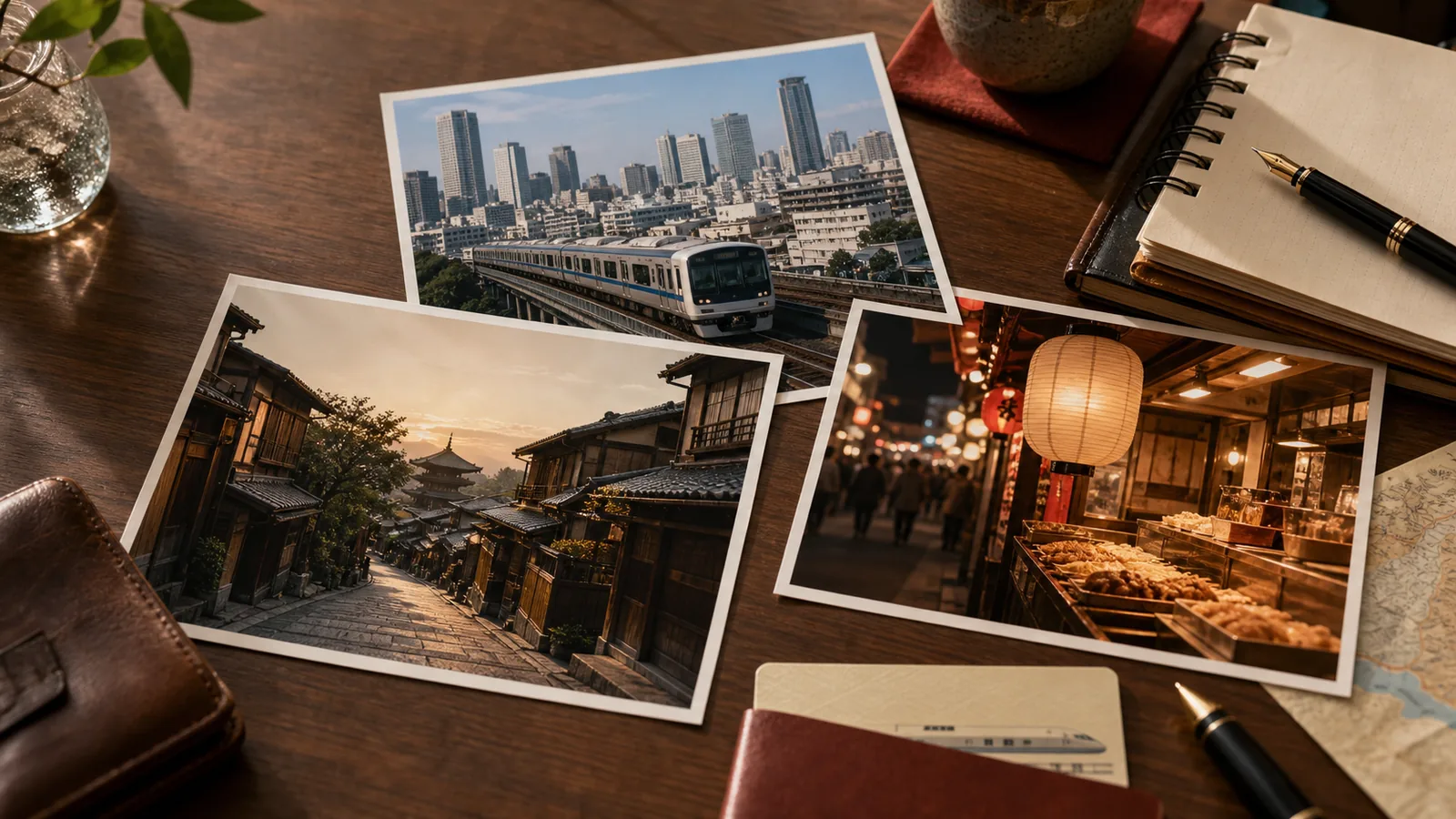
On your first trip to Japan, eight out of ten guidebooks will push the Tokyo plus Kyoto plus Osaka combo. Why these three? Taipei is tiny and just visiting Taipei is fine — why does Japan demand a tour across three cities?
The answer is that these three cities play completely different roles, and missing any one leaves you with an incomplete picture of Japan. In one line: Tokyo is the modern, Kyoto is the ancient capital, Osaka is the people. Skip any one and the trio breaks.
Tokyo — the showcase of modern Japan Population is about 14 million (9.7 million in the central wards), with a metropolitan area of 37 million — the largest urban region on earth. Geographically perched on the southern edge of the Kanto plain beside Tokyo Bay, Narita Airport sits 60-80 min from downtown and Haneda just 30 min.
What Tokyo offers is the story of how Japan became what it is today — the luxury of Ginza, the neon of Shinjuku, the street culture of Shibuya, the subculture of Akihabara, the architectural aesthetics of Omotesando, the corporate towers of Marunouchi. The 265-year Tokugawa shogunate (1603-1868) of the Edo era was laid here. When the Meiji Restoration in 1868 moved the Emperor from Kyoto, Edo was officially renamed Tokyo (the eastern capital). In other words, Tokyo today is only a "100-plus-year capital," but it laid every foundation for modernization.
Kyoto — a 1,200-year capital frozen in time Population is just 1.45 million (a rounding error compared to central Tokyo), but it served as capital for 1,074 years (794-1868), passed down all the way from Heiankyo. Geographically a basin surrounded by mountains, famous for hot summers and cold winters.
What Kyoto offers is the original Japan that never got burned down. The city holds over 1,600 temples, 400 shrines, and 17 UNESCO World Heritage sites (the Kyoto historic monuments). Kiyomizu-dera, Kinkaku-ji, Ginkaku-ji, Fushimi Inari, Arashiyama, Gion — every name carries 600-plus years of history behind it. Miraculously, Kyoto was spared from WWII US bombing (thanks to lobbying by American scholars such as Liang Sicheng), which is why you can still see original Heian, Kamakura, and Muromachi-era architecture today.
Osaka — the heart of common people and commerce Population is 2.7 million, with a metropolitan area of 19 million — Japan second-largest urban region. Sitting beside Osaka Bay at the center of Kansai, Kansai Airport reaches Namba in 40 min.
What Osaka offers is the Japan the emperor never saw — the Japan of merchants and ordinary people. Called the "kitchen of the realm" in the Edo era, when nationwide rice and grain converged here before being shipped to Edo, Osaka built its merchant culture, kuidaore (eat-till-you-go-broke) culture, and manzai comedy tradition (akin to Taiwanese xiangsheng). The neon of Dotonbori, the kushikatsu of Shinsekai, the takoyaki of Namba, the shopping of Shinsaibashi, the seafood of Kuromon Market — Osaka is cheaper than Tokyo, friendlier than Kyoto, and so blunt in speech it makes you want to talk back.
Distances and how to chain them Kyoto to Osaka is 28 min and 410 yen by JR Special Rapid Service — essentially one commuter zone. Tokyo to Kyoto runs 2 hr 15 min on the Shinkansen for 13,000 yen, with unlimited rides on a single JR Pass. The most common itinerary: fly into Tokyo, Shinkansen down to Kyoto, use Kyoto as a base for Kansai, fly out of Osaka. Five to seven days handles all three cities.
Why none of the three can be skipped Tokyo only — you would think Japan is purely a modern metropolis, blind to its thousand-plus years of culture. Kyoto only — you would think Japan is a temple museum, blind to how contemporary Japanese actually live. Osaka only — you would think Japan is just food and shopping, blind to refined culture.
For your next first-time itinerary in Japan, do not get greedy adding extra cities. Cover these three first, then decide whether your second trip goes north (Tohoku, Hokkaido) or south (Kyushu, Okinawa). The three cities are Japan in miniature — only after seeing them all do you grasp what Japan really is.