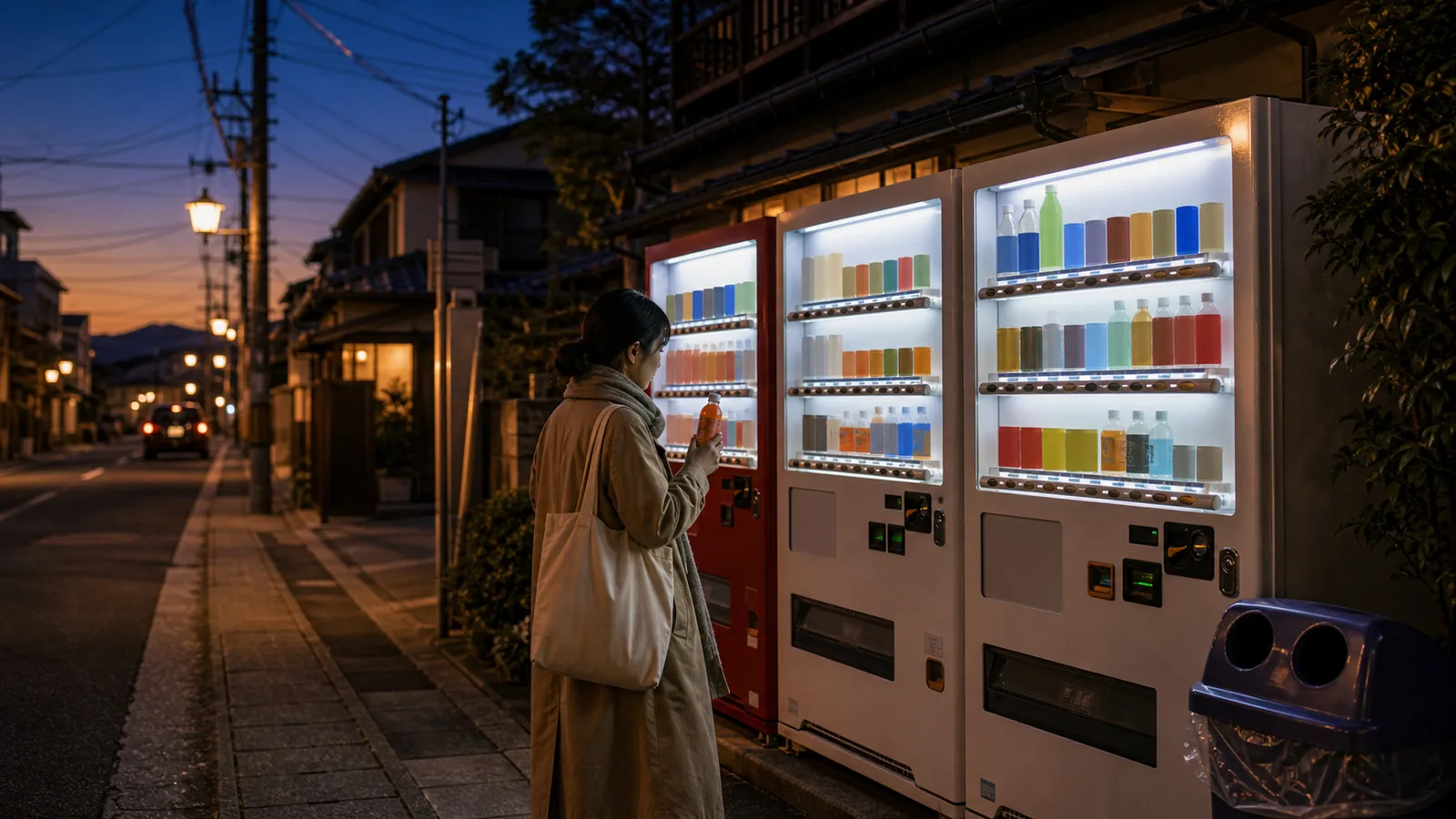
Japan has one vending machine for every 33 people (roughly 4 million nationwide, the highest density on earth) — and you thought they only sold cola? Bento boxes, hot soup, umbrellas, socks, eggs, live crabs, wedding rings — all of these are sold by machines somewhere. This article walks through the full landscape and lists 15 weird ones you have definitely never seen.
Bottom line: drinks are just the entry level. Japanese vending machines are an all-encompassing 24-hour automated convenience store.
Category 1: drinks (80% of all machines)
Cold drinks, hot drinks, or dual-temp machines. Common brands: Suntory, Asahi, Kirin, Pokka Sapporo, Coca-Cola.
Prices: small bottles 120-160 yen, large bottles 180-220 yen. Slightly more expensive than convenience stores (100-140 yen), but available 24-hour everywhere.
Winter hot drinks (red labels): milk tea, cocoa, hot coffee, ginger soup, sweet red bean soup. Some machines sell hot corn soup or hot red bean soup, perfect when your hands are freezing.
Summer cold drinks (blue labels): water, sports drinks, cold tea (Ayataka, Iyemon, Gogo no Kocha), coffee (BOSS, GEORGIA).
Category 2: hot meals and bento (lunch lifesaver)
Some highway rest stops (SA/PA), stations, and schools have hot-food vending machines. Common items:
1. Hot bento: curry rice, hamburger steak, pasta (microwave-heated type, 400-700 yen).
2. Hot ramen or udon: instant cup noodle plus auto-dispensed hot water (300-500 yen).
3. Hot curry or oyakodon: specialty machines that heat and dispense steaming bowls (500-800 yen).
The hot-ramen vending machine near the Edo-Tokyo Open Air Architectural Museum is a tourist photo spot, available even in the middle of the night.
Category 3: cold bento
At some airports, stations, and business districts, inari vending machines and onigiri vending machines sell inari sushi, rice balls, and bento. Each box runs 200-600 yen, refrigerated.
Category 4: eggs, milk, vegetables (rural type)
Rural and suburban areas have fresh-produce vending machines:
1. Eggs in 6 or 10 packs (200-400 yen), direct from local farms.
2. Fresh milk or yogurt (bottled).
3. Seasonal vegetables (cabbage, daikon, tomatoes).
4. Some carry fresh strawberries or mikan — pay and take them.
You can find these on the outskirts of Izu, Hokkaido, Nagano, and Kyoto.
Category 5: umbrellas and rain ponchos (sudden rain)
At major stations (Tokyo, Shinjuku, Ikebukuro, Kyoto) and outside convenience stores, umbrella vending machines offer:
- Plastic umbrellas: 400-600 yen.
- Folding umbrellas: 1,000-1,500 yen.
- Rain ponchos: 200-500 yen.
A lifesaver in a sudden downpour — convenience stores have queues, while the machine takes 30 seconds.
Category 6: socks, underwear, T-shirts (forgot to pack or change)
Some stations and 24-hour convenience stores have machines selling:
- Socks: 200-500 yen per pair.
- Men or women underwear: 500-1,200 yen.
- T-shirts: 1,500-3,000 yen.
Tokyo Ikebukuro Station and Shinjuku Station underground passages have sock machines — overworked commuters who forgot a pair just buy one.
Category 7: batteries, chargers, cables (out of power)
Some station and business-district machines stock:
1. Power banks: 1,000-3,000 yen (some can be rented via QR scan and returned).
2. Phone cables: Lightning or USB-C (500-1,500 yen).
3. AA/AAA batteries: 300-500 yen for a 4-pack.
4. Selfie sticks: 1,500-2,500 yen.
Category 8: stationery, books, sundries
Near college towns, cram schools, and libraries:
- Pens and highlighters: 100-300 yen.
- Mini notebooks and sticky notes: 200-400 yen.
- Manga (Weekly Jump, Magazine): 350 yen.
Arashiyama in Kyoto has a poetry vending machine — drop a coin, draw a poem.
Category 9: ties and shirts (suit emergencies)
In business districts (Tokyo Marunouchi, Shinbashi, Shinagawa), business-emergency vending machines sell:
- Ties: 1,500-3,000 yen.
- White dress shirts: 2,500-5,000 yen.
- Socks and underwear (as above).
Business travelers who spill coffee on their shirt in the morning get instant rescue.
Category 10: station coin lockers and luggage storage (now digital)
Since 2020, new-generation lockers integrate IC card payment and 24-hour storage with touchscreen operation, and some offer auto-retrieval delivery service.
15 weirdest specialty machines
- Hot soup or miso soup vending (JR Hokkaido and Tohoku)
- Ramen vending (Tokyo Ikebukuro and Osaka Shinsaibashi)
- Takoyaki and okonomiyaki (some Osaka shopping streets)
- Octopus and octopus tentacles (some Osaka and Kobe seaports)
- Whole-egg mayo canisters (Yamanashi and Nagano)
- Onsen tenugui hand towels (Atami, Hakone, Beppu)
- Fortune slips and goshuin books (Fushimi Inari, Kamakura)
- Fresh bouquets (Okinawa, Nagoya)
- Live shrimp and live crab (Hokkaido, Fukui)
- Hot oden (winter only, Tokyo and Osaka shopping streets)
- Insect snacks (some Tokyo Asakusa tourist spots)
- Mega gachapon capsule machines — not strictly vending machines, but similar mechanics
- Rings and accessories (some Tokyo Shibuya date-night hot spots)
- Books and single-volume manga (Kyoto and Osaka used-book streets)
- Omikuji fortunes plus omamori amulets (shrine grounds)
Vending machine payment methods
1. Cash (coins and bills): accepted by all machines, with new machines accepting 1,000 / 2,000 / 5,000 / 10,000 yen notes, older ones taking only coins plus 1,000 yen notes.
2. IC cards (Suica, ICOCA, etc.): about 60% support, just tap the reader.
3. Credit cards and Apple Pay: new machines at major stations and outside drugstores.
4. QR code (LINE Pay, PayPay, WeChat): the newest machines, mainly in tourist areas.
Pro tip 1: the hot or cold indicator
Machine labels are red (tsumetai, cold) or blue (atatakai, hot). Watch out for the seasonal switchover (around November and April) — you might end up buying hot Coca-Cola (some Japanese people drink hot cola for colds).
Pro tip 2: vending machines near clubs and karaoke sell ice cream
Midnight to 3 AM, convenience stores sometimes have long queues, so vending machine soft serve and ice bars (Yukimi Daifuku, Häagen-Dazs minis) are a savior at 300-500 yen.
Pro tip 3: photogenic vending machine spots
1. Tokyo Akihabara — the phone case and figure vending machines near the Animate building.
2. Tokyo Ikebukuro — the wall of a hundred drinks at the JR Ikebukuro East Exit (genuinely impressive).
3. Kyoto Arashiyama — the Japanese-style drink vending at the Randen terminal (with traditional decor).
4. Hokkaido Hakodate — the cherry-blossom beer fridge along the Hakodate Main Line (spring only).
For your next trip, slow down and watch the street-corner vending machines — stumbling on a weird one beats wandering a department store. Behind Japan 4 million machines lies a precise restocking, maintenance, and analytics system that reflects the society best mix of "mechanized convenience" and "design precision".
Frequently Asked Questions
What do red and blue labels mean on Japanese vending machines?
Blue usually means cold drinks, and red usually means hot drinks such as coffee, tea, cocoa, or corn soup.
Can I use an IC card at vending machines?
Many machines accept Suica, PASMO, ICOCA, and similar cards, but not all. Look for the IC logo.
Is there always a trash bin beside the machine?
No. Some have bottle and can recycling boxes, but not all. Carry the bottle until you find a proper bin.
Do Japanese vending machines really sell unusual things?
Yes, but they are extras. Travelers mostly use vending machines for drinks, hot coffee, water, and small emergency supplies.