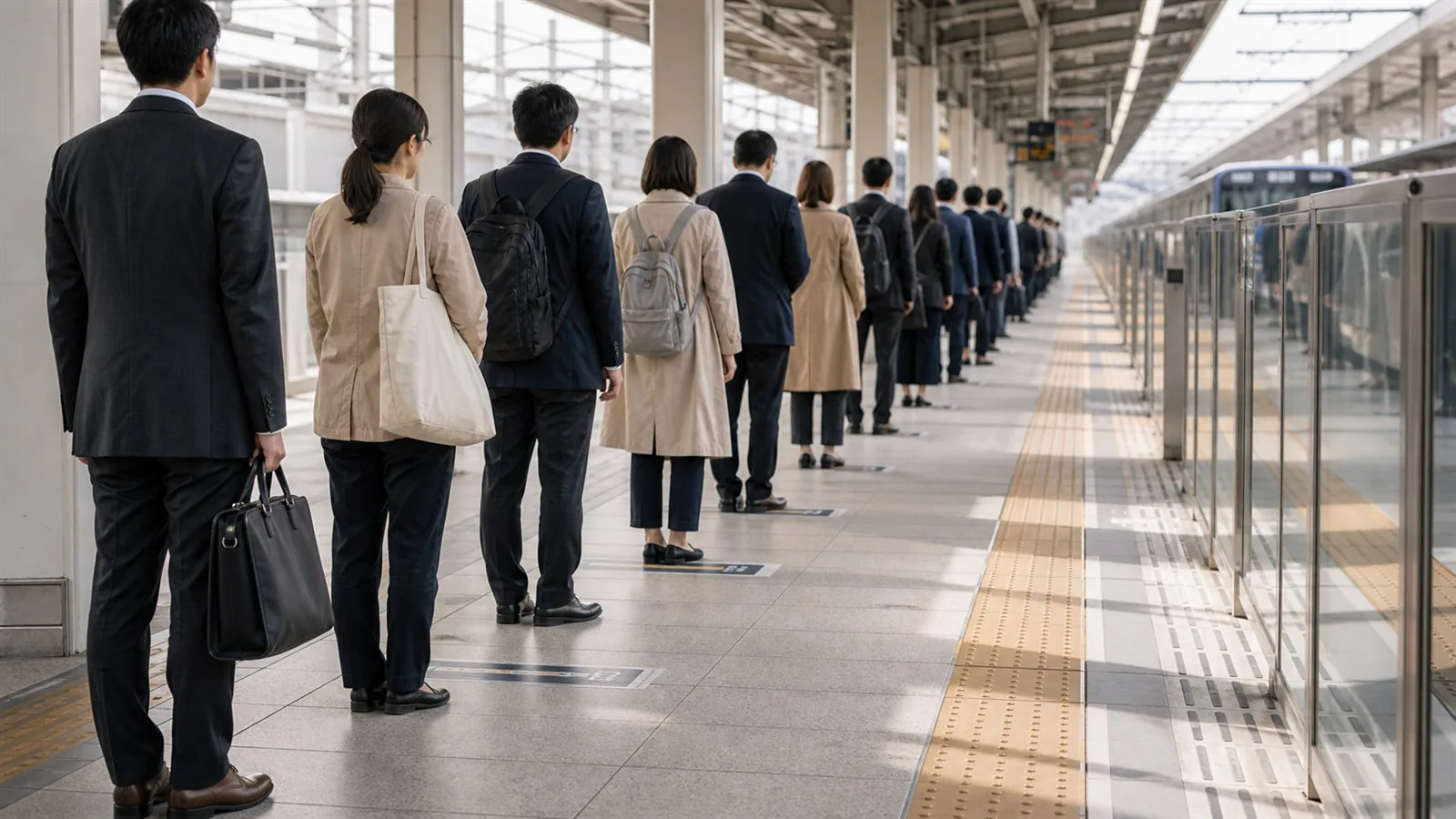
Think Japanese queueing is just "good civic manners"? In reality, it is the compound product of 300 years of group-based culture plus postwar scarcity memory plus urban spatial design. Once you understand the causes, you grasp why this "queueing culture" has such deep roots in Japan.
Edo era: the seating order of village society
Edo-era villages were called murashakai (village society), where residents were assigned positions from birth — who stood where during shrine festivals, who spoke first at meetings, who collected rice first from the granary — all governed by juuban (order). Violating the order meant being subjected to murahachibu (social ostracism), at enormous cost. Following the order was a survival skill, encoded as muscle memory.
Postwar 1945-1955: rationing and the queue
After WWII, Japan faced extreme shortages — rice, oil, and cloth were all distributed by government rationing. Each family received ration coupons and queued to claim supplies. No queue meant no food. The collective memory of that decade planted queue equals fairness deep in the collective unconscious. Japanese elders over 80 today are far more attached to queueing than younger generations, having lived through the rationing era.
The concept of meiwaku and queueing
The core Japanese social term meiwaku (causing trouble for others is a fundamental social failure) maps perfectly onto queueing. Cutting in line creates meiwaku. Even if you are just in a rush, forcing 10 other people to wait an extra minute for you translates in Japanese logic to "your personal convenience built on the inconvenience of ten people".
So Japanese queue for: train doors, public toilets, ATMs, convenience stores, ramen shops, shrine goshuin windows, New Year hatsumode (Meiji Shrine queues can stretch 3 km), fukubukuro sales, every Disneyland attraction — even on escalators they queue (left side in Kanto, right side in Kansai).
The real reason for queueing at restrooms
Tourists see "all 3 stalls are open and everyone is still queuing outside" and assume Japanese people are "overly rule-bound". The actual reason: some stalls inside might already be in use, invisible from outside. So the fairest method is to queue outside and let the first in line enter when a stall opens. This is more efficient than "walk in and knock", and avoids disturbing anyone.
The difference in escalator side between Tokyo and Osaka
Tokyo and northern Japan: stand on the left, leave the right for those in a hurry. Osaka and Kansai: stand on the right, leave the left for hurried walkers. Why the difference? Two theories — one, that for the 1970 Osaka World Expo the convention was reversed to match foreign visitors; two, that samurai drew their swords with the right hand, so standing on the left kept blades clear. The reality is "nobody really knows, but everyone follows it".
Since 2024, officials have started calling for "do not walk on the escalator" (due to accidents and equipment wear), but the social habit persists — those who walk keep walking.
Exceptions: when Japanese do not queue
First, boarding Shinkansen unreserved seats — platform lines mark two queues, but the instant the doors open it becomes a scramble (not chaos, but a "rapid seat-grab"). Second, department store sales (fukubukuro day) — queues form outside well before opening, and at the moment of opening, people genuinely run (though basic order still holds). Third, late-night izakaya — drunk patrons queue less, but self-restraint usually remains strong.
Most common tourist mistakes
First, at train doors — lines on both sides form two queues, and when doors open, let people off first, then board. Cutting straight through the middle is the biggest no. Second, at convenience store checkout — even with just 1-2 customers ahead, you go to the back of the line, never walk directly to the counter from the side. Third, popular ramen shops — 30-60 minute waits outside are standard, so go to the back of the line and queue, do not try to "make a connection" or "borrow a spot" with someone up front. Fourth, shrine hatsumode — Meiji Shrine on January 1 can have a 3 km queue, so no cutting is possible, just queue honestly.
Pro tip: queueing techniques for tourists
First, before heading to a popular shop, check Google Maps reviews for wait time, and arrive early. Second, while queuing outside, watch the staff hand signals — they signal "next" or "please come in". Third, do not speak loudly while queueing (again, the meiwaku principle — surrounding residents get disturbed). Fourth, sometimes you will see seiriken (numbered tickets) — take a number and walk away, return at the indicated time. This is the advanced version of queueing — famous ramen shops, sales events, and popular restaurants all use this system.
Why does this work in Japanese society?
Because Japanese society has extreme homogeneity — everyone trusts that everyone else will queue, so no one sneaks ahead and benefits. The system depends on trust to sustain, and once trust collapses, the dominoes fall. That is why Japanese react so strongly to line-cutting — it is not personal, it is fear of system collapse.
Next time you visit Japan, treat queueing as part of the experience. Look at the Japanese people around you and notice — no one is scrolling, no one is complaining, they are just waiting quietly — and that is the shape of 300 years of accumulated culture.
Frequently Asked Questions
Why do people queue so carefully in Japan?
Queuing makes order visible and reduces friction. In crowded places, a shared rule prevents small conflicts.
Can you leave a queue in Japan?
It depends on the setting. Restaurant waits, event lines, and train platforms work differently. Avoid saving a place with belongings when unsure.
How do you queue for trains in Japan?
Follow platform markings, stand to the side of the doors, let passengers exit first, then board in order.
What if a traveler lines up in the wrong place?
Pause, check the markings and flow of people, or ask “koko ni narande imasu ka.” Most people understand travelers may be unsure.