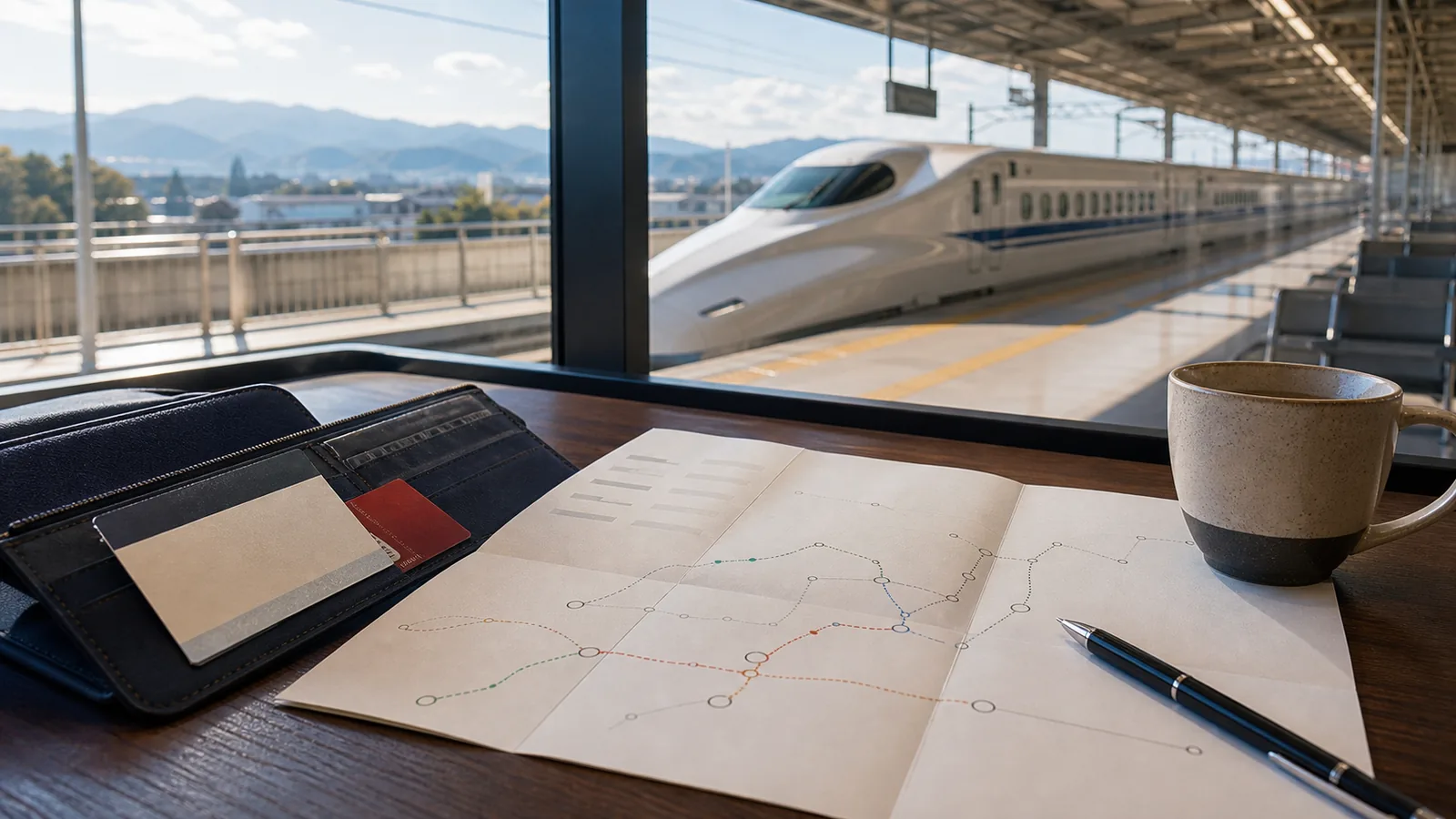
If the 50,000-yen JR Pass 7-day price made you gasp, you are not alone. In October 2023, the JR Pass jumped 70% — from 29,650 yen to 50,000 yen. Online chatter declared it "no longer worth it," but in reality it remains a great deal for certain itineraries — just not the ones you might assume. This guide walks through the real ticket math.
The baseline: JR Pass 7-day is 50,000 yen (ordinary car) or 70,000 yen (Green Car)
2024 pricing: 50,000 yen for 7 days, 80,000 for 14 days, 100,000 for 21 days. Available exclusively to foreign tourists (short-stay visa, under 90 days); Japanese residents cannot buy it. Purchase an exchange voucher in advance through Taiwanese / Chinese / Hong Kong travel agencies or the JR official site, then redeem it for the actual pass at a JR counter after landing.
Key point: the JR Pass covers all JR lines nationwide, the shinkansen (except Nozomi and Mizuho), some buses, and JR ferries
Three traps to watch: First, the fastest Nozomi and Mizuho services are excluded — you can only ride Hikari and Kodama, which add 30-60 minutes. Second, private railways (Tokyo Metro, Keihan, Hankyu) are not covered. Third, the JR Keiyo line to Tokyo Disney is covered, but the monorail inside the park is not.
Itinerary 1: Tokyo ⟷ Kyoto ⟷ Tokyo (7 days, two cities only)
Tokyo to Kyoto on the Hikari is 13,520 yen one way, 27,040 yen round trip. Use ICOCA for Kyoto subway; no need for the JR Pass. Verdict: not worth it (50,000 yen vs 27,040 yen, a 23,000 yen difference).
Itinerary 2: Tokyo → Kyoto → Osaka → Tokyo (7 days)
Tokyo to Kyoto 13,520 yen + Kyoto to Osaka (ICOCA at 560 yen) + Osaka to Tokyo 14,720 yen = 28,800 yen. The Kyoto-Osaka short hop does not need the JR Pass. Verdict: still not worth it.
Itinerary 3: Tokyo → Kyoto → Hiroshima → Tokyo (7 days, 3 cities)
Tokyo to Kyoto 13,520 yen + Kyoto to Hiroshima 11,420 yen + Hiroshima to Tokyo 19,440 yen = 44,380 yen. Verdict: marginal (a 5,620 yen gap). If you also visit Miyajima (JR West Miyajima ferry at 180 yen each way, with Hiroshima streetcars excluded), it just breaks even.
Itinerary 4: Tokyo → Kyoto → Hiroshima → Hakata (Fukuoka) → Tokyo (7 days, 4 cities)
Tokyo to Kyoto 13,520 yen + Kyoto to Hiroshima 11,420 yen + Hiroshima to Hakata 9,160 yen + Hakata to Tokyo 23,390 yen = 57,490 yen. Verdict: worth it (saves 7,490 yen). Plus the JR Pass lets you take the JR Sagano line from Kyoto to Arashiyama and the JR Kobe line from Osaka to Kobe for additional savings.
Itinerary 5: Tokyo → Sendai → Hakodate → Sapporo → Tokyo (7 days, Honshu plus Hokkaido)
Tokyo to Sendai 11,410 yen + Sendai to Hakodate 17,810 yen + Hakodate to Sapporo 9,440 yen + Sapporo to Tokyo 27,000 yen (via the Seikan Tunnel and shinkansen) = 65,660 yen. Verdict: a clear win (saves 15,660 yen). Even the 70,000-yen Green Car version still comes out ahead.
When the JR Pass makes sense
- A single trip crossing 3 or more cities (Tokyo / Kyoto / Osaka / Hiroshima / Fukuoka / Sendai / Sapporo).
- The itinerary spans different "islands" (Honshu to Kyushu or Hokkaido).
- You plan to use the Yamanote loop in Tokyo or the Osaka Loop Line as unlimited transit.
- You are visiting Kanazawa, Izu, Nikko, or Karuizawa via shinkansen.
When not to buy the JR Pass
- You are staying only in Tokyo, or only in Kansai.
- The itinerary covers two cities or fewer.
- The trip leans heavily on private railways (Kyoto Randen, Hakone Tozan, Fujikyu).
- You want the fastest Nozomi service (which the JR Pass cannot access).
Alternative: regional JR Passes are far cheaper
If you stay only in Kansai, the JR Kansai Wide Area Pass runs 12,000 yen for 5 days and covers Kyoto, Osaka, Kobe, Nara, Himeji, and Kinosaki Onsen. For greater Tokyo, the JR Tokyo Wide Pass is 15,000 yen for 3 days, covering Tokyo, Kamakura, Nikko, Lake Kawaguchi, and Karuizawa. These regional passes are far better value than the national pass.
Pro tip: buy the exchange voucher in your name, then convert to a magnetic card after landing
After the 2023 redesign, the JR Pass became a magnetic card that taps through ticket gates (previously paper tickets required manual lanes). When redeeming, remember the start date carefully — the 7 / 14 / 21 days run consecutively from activation and cannot be split. If you land on Friday evening, do not activate yet; wait until Saturday morning when your itinerary actually begins, and save a full day’s allowance.
Starting in 2024, the JR Pass also offers online reserved-seat booking, removing the need to queue at a Midori-no-Madoguchi counter after arrival. (Data as of 2024; verify the latest official information before departure.)
Frequently Asked Questions
Do I need a JR Pass for Tokyo, Kyoto, and Osaka?
Usually no. For Tokyo to Kyoto or Osaka, or a Tokyo-in Osaka-out trip, ordinary one-way shinkansen tickets are often simpler than the nationwide JR Pass.
Is the 2026 JR Pass still 50,000 yen?
As of May 25, 2026, the official online 7-day Ordinary adult pass remains 50,000 yen. Overseas agency prices are scheduled to change from October 1, 2026, so check before buying.
Can JR Pass holders ride Nozomi or Mizuho?
Yes, with a special supplement ticket. Whether it saves money depends on your itinerary, so recalculate before buying.
When is the nationwide JR Pass worth it?
It is more likely to work for high-mileage trips across several regions, such as Tokyo, Kyoto, Hiroshima, and Fukuoka within a short period.